Phone:
(701)814-6992
Physical address:
6296 Donnelly Plaza
Ratkeville, Bahamas.

Phone:
(701)814-6992
Physical address:
6296 Donnelly Plaza
Ratkeville, Bahamas.

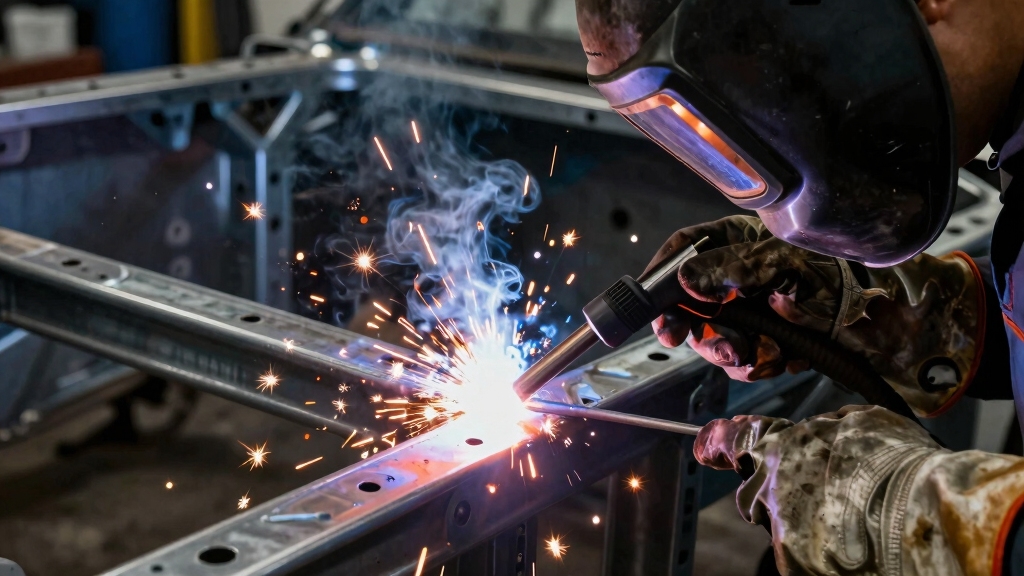
You can weld mild steel, stainless steel, aluminum, copper alloys, magnesium, and titanium with a MIG welder. Each metal needs specific filler wires and shielding gases, like ER70S-6 with C-25 gas for mild steel or 100% Argon with ER4043 for aluminum, to guarantee strong, clean welds.
Managing heat input and using proper transfer modes also help prevent defects and distortion. Understanding these essentials will guide you to achieve precise, high-quality welds across these metals.
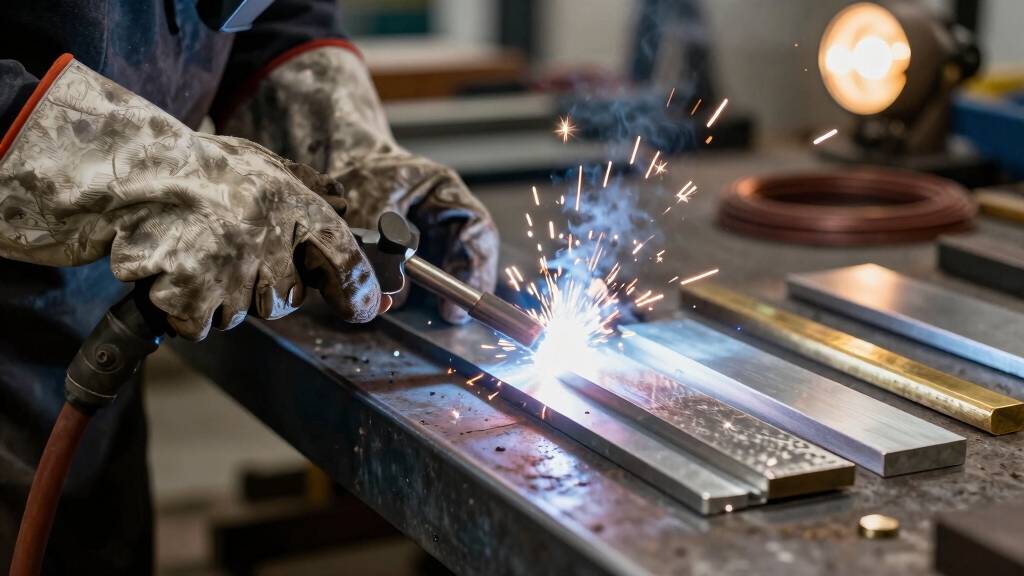
When you use a MIG welder, you can weld a variety of metals, each requiring specific settings and consumables to guarantee strong, clean joints.
MIG welding adapts to many metals, each needing tailored settings and consumables for optimal results.
Mild steel is the easiest metal to weld, needing a solid steel wire and C-25 shielding gas (75% Argon/25% CO2) for ideal fusion.
Stainless steel demands specialized MIG wire and Argon/CO2 blends to maintain corrosion resistance and prevent distortion, with careful amperage control.
Aluminum requires 100% Argon shielding and ER4043 filler wire, plus a spool gun to handle its high thermal conductivity and prevent burn-through.
Copper alloys need higher heat input and compatible filler metals to counter rapid heat dissipation.
Nickel alloys and reactive metals like magnesium or titanium call for inert shielding gases and precise heat management to avoid warping or contamination.
Proper shielding gas flow is essential to prevent weld defects like porosity and contamination when welding these metals.
When you’re welding mild steel, it’s a good idea to use solid steel wire along with a C-25 gas mix. This combo really helps with shielding and penetration, giving you the best results.
Make sure to maintain a steady travel speed and keep that arc length consistent. This way, you’ll achieve clean weld beads and ensure strong fusion. It’s all about getting that rhythm down!
Also, don’t forget to control your heat input. You definitely want to avoid excessive weaving or any kind of contamination. Taking these steps will help you prevent cracks and defects in your work. Happy welding!
Using the correct ER70S-6 wire ensures good penetration and sound metallurgical properties for mild steel welding.
Selecting the right wire and shielding gas is crucial for achieving strong, clean welds on mild steel with a MIG welder. You should use a solid steel wire, typically ER70S-6, as it offers excellent weldability and penetration.
For shielding gas, C-25 (75% Argon/25% CO2) is the industry standard, balancing arc stability and minimal spatter.
| Wire Type | Purpose |
|---|---|
| ER70S-6 | General mild steel welding |
| ER70S-3 | Dirty or rusty mild steel |
| Flux-Cored | Outdoor or windy conditions |
| Gas Composition | Effect |
| C-25 (75/25) | Smooth arc, less spatter |
| 100% CO2 | Deeper penetration, more spatter |
This combination guarantees peak fusion and consistent weld quality. Small additions of oxygen in argon can further improve arc stability and droplet transfer on carbon steel.
Achieving strong, clean welds on mild steel depends not only on choosing the right wire and shielding gas but also on applying proper welding techniques. Maintain a steady travel speed and consistent gun angle, typically 10 to 15 degrees off vertical, to guarantee peak bead shape and penetration.
Use a push technique to improve gas coverage and reduce spatter. Control your amperage and voltage settings to match the material thickness. Too high causes burn-through, while too low results in poor fusion.
Keep the nozzle close, around 1/4 inch from the workpiece, to minimize contamination and maximize shielding gas effectiveness. Clean the base metal thoroughly before welding to avoid inclusions.
Finally, practice maintaining a uniform bead width and overlapping passes by about 30-50% to produce strong, defect-free welds. Regularly cleaning and maintaining consumables like contact tips and nozzles ensures consistent wire feeding and arc stability.
Although mild steel is known for its high weldability, preventing cracks and defects requires careful control of heat input and proper material preparation.
You should pre-clean the metal to remove rust, oil, or paint. Maintain steady heat to avoid excessive thermal stress, which causes cracking.
Use correct wire feed speed and shielding gas to guarantee consistent weld quality.
Selecting a power source that delivers steady, precise arcs is crucial for maintaining weld stability and quality.
| Step | Action | Purpose |
|---|---|---|
| Surface Cleaning | Remove contaminants | Prevent inclusions |
| Heat Control | Adjust amperage/voltage | Minimize thermal stress |
| Wire Feed Setting | Calibrate speed | Guarantee weld uniformity |
| Gas Selection | Use C-25 (75% Ar/25% CO2) | Proper shielding |
| Joint Design | Use appropriate bevel | Promote penetration |
These practices help you achieve defect-free, durable welds on mild steel.
When you’re welding stainless steel, one of the most important things to keep in mind is controlling your amperage. It’s really crucial to avoid distortion and to make sure that your weld maintains its integrity.
Now, let’s talk about gas. You’ll want to use a specialized Argon/CO2 gas mixture. This not only helps enhance corrosion resistance but also stabilizes the arc while you’re working.
Additionally, maintaining proper heat input control is essential to preserve the chromium oxide layer and prevent oxidation during welding.
Control your amperage carefully to prevent distortion and maintain the corrosion-resistant properties of stainless steel welds. Setting too high an amperage risks warping and burning through the material. Too low results in weak fusion.
Adjust amperage based on material thickness and wire diameter for optimal penetration without overheating.
| Material Thickness (mm) | Recommended Amperage (A) |
|---|---|
| 1-2 | 60-90 |
| 3-5 | 90-140 |
| 6-10 | 140-200 |
Use precise amperage control to balance heat input and preserve stainless steel’s chromium layer. Consistent settings guarantee weld integrity and avoid post-weld corrosion or structural defects.
Always test settings on scrap material before final welding. Proper heat input control is essential to minimize distortion and prevent carbide precipitation in the heat-affected zone.
Maintaining correct amperage lays a foundation for strong, corrosion-resistant stainless steel welds. Selecting the right shielding gas mixture also plays a significant role.
You’ll typically use a blend of Argon and CO2, often around 98% Argon and 2% CO2, to optimize arc stability and penetration without compromising corrosion resistance. This mixture minimizes spatter and produces a cleaner weld bead compared to pure CO2.
Adjusting the CO2 percentage affects weld heat and bead profile, so fine-tune it based on joint configuration and stainless steel grade. Avoid higher CO2 levels that can cause oxidation and weaken corrosion resistance.
When MIG welding stainless steel, pairing proper amperage with this Argon/CO2 blend guarantees weld integrity, mechanical strength, and longevity in demanding environments. Small additions of CO2 improve arc stability and penetration, enhancing overall weld quality on stainless steel.
Welding aluminum with a MIG welder demands precise heat management and specialized equipment to guarantee clean, strong joints. You’ll want to use 100% Argon shielding gas to secure proper arc stability and prevent contamination.
Because aluminum dissipates heat quickly, controlling amperage and travel speed is critical to avoid burn-through and warping. Employ an ER4043 filler wire, which contains silicon to enhance fluidity and reduce cracking.
Manage amperage and speed carefully; use ER4043 filler wire for fluid, crack-resistant aluminum welds.
A spool gun is highly recommended to feed the softer aluminum wire consistently, preventing bird-nesting and feeding issues common with standard MIG torches. Utilize spray or pulsed spray transfer modes to achieve smooth weld beads and deep penetration.
Pay close attention to joint preparation and cleanliness, as aluminum oxidizes rapidly. Contaminants can severely weaken weld integrity. Using 100% argon as the shielding gas provides excellent arc control and minimal spatter for aluminum up to 1/2 inch thick.
When you’re welding copper and its alloys, managing heat is super important. Copper has high thermal conductivity, so if you’re not careful, you can end up with distortion in your work. It’s all about finding that sweet spot!
Also, picking the right filler metals is crucial. You want to ensure that your welds are strong and clean, matching the properties of the base material. Trust me, choosing compatible fillers makes a huge difference. Using inert gas shielding like a helium-argon mix can help reduce oxidation and improve weld quality when working with copper alloys.
Controlling heat input plays a critical role in achieving clean, precise joints when working with copper and its alloys.
Because copper dissipates heat rapidly, you need to increase your welder’s heat output to maintain adequate penetration.
However, you must avoid overheating, which can cause warping or burn-through due to copper’s softness.
Use short, controlled welds and allow cooling intervals between passes to prevent excessive heat buildup.
Adjust your amperage and wire feed speed carefully, balancing enough heat without deforming the base metal.
Preheating thicker sections can improve weld pool stability and reduce thermal shock.
Additionally, employ proper joint fit-up to minimize gaps that demand excessive heat.
Managing heat effectively sets the stage for selecting the right filler metals. This choice directly impacts weld quality and joint integrity in copper and its alloys.
You’ll want filler metals that match thermal expansion and conductivity to prevent cracking or distortion. Consider these key factors when choosing:
Use copper-based fillers with similar alloying elements to the base metal.
Opt for phosphor bronze or silicon bronze fillers for improved fluidity.
Avoid fillers that introduce brittleness or excessive hardness.
Match filler composition to the specific copper alloy for corrosion resistance.
Make sure filler wire diameter suits your MIG welder’s capacity for stable feeding.
Although welding nickel alloys presents unique difficulties due to their high melting points and susceptibility to cracking, you can achieve strong, durable joints by carefully selecting shielding gases and controlling heat input.
Use pure Argon or an Argon-Helium mix with minimal CO2 to prevent weld contamination and reduce cracking risk.
Maintain steady, moderate heat input to avoid warping and distortion in the workpiece.
Choose filler metals compatible with the base alloy to guarantee proper fusion and corrosion resistance.
Pre-weld cleaning is critical to remove surface oxides that could weaken the joint.
Nickel alloys demand careful heat control and shielding to maintain weld integrity.
Magnesium and titanium require an even more meticulous approach due to their high reactivity and sensitivity to contamination.
Welding magnesium and titanium demands exceptional care because of their extreme reactivity and contamination sensitivity.
When welding these metals with a MIG welder, you must:
When selecting filler wire for MIG welding, you must match the wire composition to the base metal to guarantee strong, defect-free welds. For mild steel, use a solid steel wire that complements the low carbon content to avoid cracking.
Stainless steel requires specialized wires, such as those for grade 304, which maintain corrosion resistance and strength. Aluminum welding demands ER4043 filler wire with added silicon to improve fluidity and reduce burn-through risks.
Copper alloys need compatible filler metals that accommodate high heat dissipation without deforming the soft base metal. Nickel alloys call for wires alloyed with chromium or iron to sustain high-temperature durability.
For magnesium and titanium, select filler metals that precisely match the base alloy to maintain mechanical properties and prevent contamination during welding.
Because shielding gas directly influences arc stability, weld quality, and penetration, selecting the right gas mixture is critical for MIG welding success. You need to match the gas to your base metal and welding application to optimize results.
Here’s what to contemplate:
Mild Steel: Use C-25 (75% Argon/25% CO2) for strong, cost-effective welds with solid wire.
Stainless Steel: Argon mixed with CO2 provides corrosion-resistant, stable arcs.
Aluminum: Use 100% Argon to ensure smooth spray transfer and prevent contamination.
Nickel Alloys: Pure Argon or Argon-Helium blends minimize cracking and maintain weld integrity.
Magnesium/Titanium: Require pure Argon or Helium to shield reactive metals and avoid oxidation.
Choosing the right gas improves stability, penetration, and cleanliness, directly impacting weld performance.
Shielding gas plays a key role in stabilizing the arc and ensuring clean welds. Managing heat input is equally important to control distortion during MIG welding.
You need to adjust amperage, travel speed, and wire feed to minimize excessive heat buildup. For thin metals like aluminum, precise heat control prevents burn-through. Thicker materials tolerate higher heat.
| Material | Heat Sensitivity | Distortion Risk |
|---|---|---|
| Aluminum | High | High |
| Stainless Steel | Medium | Medium |
| Mild Steel | Low | Low |
Controlling interpass temperature and using tack welds help reduce warping. Proper heat management enhances weld quality and maintains dimensional accuracy in your projects.
You maintain your MIG welder by regularly cleaning the nozzle and contact tip to prevent spatter buildup.
Check and replace worn consumables like liners and wires frequently.
Keep the drive rollers free of debris and adjust their tension properly.
Inspect gas hoses and connections for leaks.
Calibrate voltage and wire feed speed settings for consistent weld quality.
Store your welder in a dry, dust-free environment to avoid electrical issues and corrosion.
You need a welding helmet with an auto-darkening lens to protect your eyes from intense UV and infrared light.
Wear flame-resistant gloves and long-sleeve clothing to shield your skin from sparks and heat.
Use ear protection to guard against noise and respirators or fume extractors to avoid inhaling harmful gases.
Always ensure proper ventilation and avoid synthetic fabrics that can melt.
These essentials keep you safe while MIG welding.
You wouldn’t try welding with a quill pen, and similarly, you shouldn’t MIG weld painted or coated metals directly.
The coatings interfere with the weld pool, causing contamination, porosity, and weak joints.
Always strip paint, rust, or galvanization down to bare metal first.
Use a grinder or chemical stripper for clean surfaces.
Proper prep guarantees strong, defect-free welds and prevents hazardous fumes from burning coatings during welding.
To troubleshoot common MIG welding defects, check your wire feed speed and voltage settings first. They must match the material thickness.
Inspect your gas flow rate to prevent porosity; adjust it if you see inconsistent shielding. Clean the base metal thoroughly to avoid contamination.
If you notice excessive spatter, reduce voltage or improve ground connection. Finally, maintain proper gun angle and travel speed to minimize undercut or lack of fusion.
Outdoor MIG welding can feel like battling a hurricane, but you can control it. Shield your weld from wind using windshields or tents to prevent gas blow-off.
Use heavier gas flows to compensate for drafts. Keep cables dry and secure to avoid hazards.
Choose flux-cored wires if conditions are too windy. Always wear proper PPE and maintain consistent travel speed and angle to guarantee quality welds despite outdoor challenges.
With a MIG welder, you can tackle a wide range of metals, from mild steel to aluminum and even titanium, with the right techniques and materials.
Did you know that over 60% of industrial welding projects use MIG welding due to its versatility and efficiency?
By selecting the correct filler wire and shielding gas and controlling heat properly, you’ll achieve strong, clean welds across various metals. This makes MIG welding an essential skill for any metalworker.