Phone:
(701)814-6992
Physical address:
6296 Donnelly Plaza
Ratkeville, Bahamas.

Phone:
(701)814-6992
Physical address:
6296 Donnelly Plaza
Ratkeville, Bahamas.

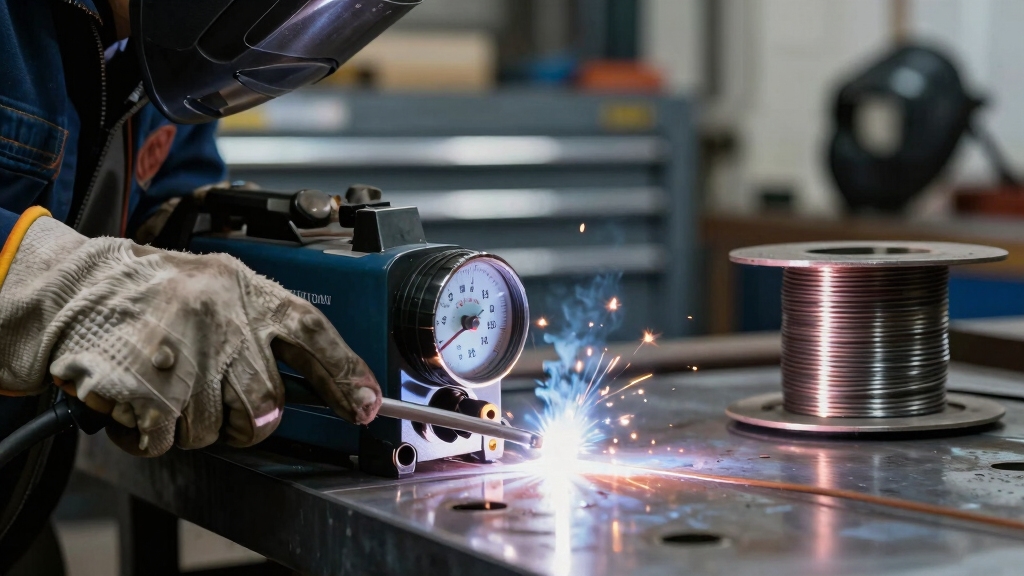
You’ll need to set your MIG welder’s amps based on material type and thickness. Roughly 50–70 amps for 1/16” mild steel and up to 230–250 amps for 3/8” steel.
Thicker aluminum demands higher amps due to thermal conductivity, while stainless requires slightly less than steel. Match wire size to amp range for stable arc and avoid burn-through.
Also, note that 120V machines typically max out around 140–160 amps because of duty cycle and power constraints. Understanding these factors helps optimize your weld quality and equipment use.
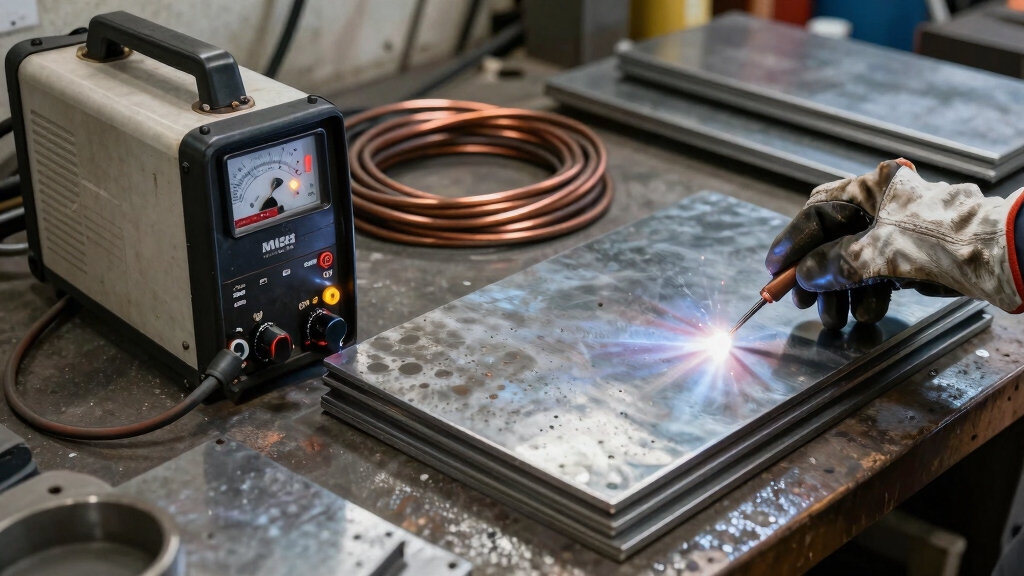
Selecting the right amperage for your welding project starts with analyzing the material thickness and type you’ll be working with. You need to match amperage to thickness precisely; for example, the rule of thumb is 1 amp per 0.001” thickness.
Welding thinner materials demands lower amps to avoid burn-through and spatter. Thicker materials require higher amperage for sufficient penetration. Consider the wire size too, as it directly influences amperage range.
.030” wire works well between 40-145 amps, aligning with typical mild steel thicknesses. Also, be aware that machine output ratings often specify amperage at a given duty cycle, not maximum capacity.
Finally, input voltage limits the amperage your machine can deliver. Check your power supply compatibility to guarantee peak welding performance. For welding 1/2 inch steel, a machine capable of delivering at least 250 amps is essential to achieve proper penetration.
Knowing how many amps you need depends directly on the steel thickness you’re working with. A practical rule is 1 amp per 0.001” of steel thickness.
For example, 1/16” mild steel requires roughly 50-70 amps, while 1/8” steel needs about 125 amps. Welding 3/16” steel typically demands 140-160 amps, and 5/16” steel requires 180-200 amps.
For 3/8” thick steel, expect to use 230-250 amps, often requiring preheating or beveling to ensure proper fusion.
Keep in mind, excessive amperage causes burn-through and poor penetration, so precise calibration is key.
Select wire size accordingly; .030” wire works for 1/8”, while .035” or .045” wire suits thicker plates. Always check your welder’s specifications to match amperage limits with steel thickness efficiently.
Proper machine setup, including wire feed speed, is essential to maintain consistent weld quality and avoid common issues.
Although aluminum and stainless steel require different welding approaches than mild steel, adjusting amperage correctly is vital for clean, strong welds.
For aluminum, you’ll need higher amperage, around 140-160A for 1/8” thickness, because of its high thermal conductivity. This means you must compensate with increased heat input to achieve proper fusion without burn-through.
Stainless steel, conversely, runs hotter and requires lower amperage than mild steel for the same thickness. Reducing amps prevents warping and excessive penetration.
Aim for amperage settings slightly below those used for mild steel, carefully monitoring bead appearance. Always consider the material’s thickness and thermal properties, adjusting amperage within the welder’s range to balance penetration, spatter, and weld quality.
Precise amperage control guarantees structural integrity and ideal weld aesthetics.
For thicker aluminum sections, using higher amperage settings with appropriate argon-helium gas mixtures can improve penetration and weld quality.
When it comes to getting the best weld quality, matching your wire diameter to the right amperage range is super important.
For example, if you’re using a .023” wire, you’ll want to be in the 30-130 amp range. On the other hand, a .045” wire can handle a much beefier 75-250 amps. This choice really affects the thickness of the materials you can work with.
Choosing the right wire size isn’t just about numbers; it’s key to avoiding burn-through. By maintaining the proper heat input and penetration, you can achieve cleaner, more effective welds. Additionally, using compatible filler materials like ER70S-6 wire for steel helps improve arc stability and reduce spatter.
Selecting the appropriate wire diameter directly impacts the amperage range your MIG welder can efficiently operate within.
Thinner wires like .023” handle 30-130 amps, ideal for light gauge materials, while .030” wires cover 40-145 amps, balancing versatility and penetration.
Increasing to .035” wire extends the range to 50-180 amps, suitable for medium thicknesses. .045” wire supports 75-250 amps, necessary for heavy-duty applications.
Choosing the correct wire diameter prevents issues like burn-through or insufficient fusion by matching the amperage output to weld requirements.
Your welder’s voltage and duty cycle ratings also influence optimal wire selection. Always consult your machine’s specifications to align wire size with amperage limits, ensuring consistent arc stability and weld quality across your projects.
For optimal results, select the wire diameter and amperage settings based on the material thickness considerations to avoid burn-through or poor fusion.
When welding different material thicknesses, wire size directly determines the amperage range your MIG welder must deliver to achieve proper fusion without defects.
For example, a .023” wire operates between 30-130 amps, fitting thinner metals like 18-gauge steel.
In contrast, a .045” wire spans 75-250 amps, suitable for thicker plates up to 3/8”.
Selecting the correct wire size guarantees your welder’s amperage aligns with the material thickness.
Too low, and penetration is insufficient; too high, and you risk weld defects.
Using a .030” wire typically covers 40-145 amps, ideal for medium thicknesses like 1/8” steel at about 130 amps.
By matching wire diameter to your material, you optimize amperage settings.
This improves weld quality and efficiency without frequent wire or amperage changes.
Choosing the appropriate wire diameter also helps maintain arc stability and reduces spatter, contributing to a cleaner weld.
Although proper amperage is essential for weld strength, excessive current often leads to burn-through, especially on thinner materials. Your wire size directly affects the amperage range you can safely use.
For example, a .023” wire supports 30-130 amps, suitable for thin gauge steel, while a .045” wire handles up to 250 amps for thicker plates. If you select a wire too large for your material, you risk applying too much heat, causing burn-through and warping.
Conversely, too small a wire limits penetration and weld integrity. Always match wire diameter to material thickness, like .030” wire for 18 gauge steel at 70-80 amps, to maintain controlled heat input.
This balance guarantees structural soundness without damaging your workpiece through overheating. Managing heat input control is critical to avoid distortion and defects, especially in thin or heat-sensitive materials.
Because input voltage directly influences your welder’s maximum amperage output, it’s essential to match the power source to your welding requirements.
For instance, 120V input limits your machine to a maximum of about 140-160 amps, restricting you to lighter-duty welding tasks.
If you need higher amperage up to 230-250 amps for thicker materials, you must use a 208-230V power supply.
Dual-voltage machines running on 120V will derate, meaning they deliver less amperage than their 208-240V rating.
This reduction affects penetration and weld quality, especially on heavier gauge steel.
Understanding this relationship helps you select the correct voltage input to achieve optimal amperage output.
This ensures your welder operates efficiently within its designed duty cycle without compromising performance or risking damage.
Always consult your machine’s specifications for exact voltage-amperage compatibility.
Modern inverter welding machines use high-frequency inverter technology to efficiently regulate current output and maintain arc stability across varying voltages.
When it comes to welding, matching your welder’s amperage output to the plate thickness is crucial for achieving the best results. For instance, if you’re working with 140-160 amps, you can effectively handle up to 3/16” steel. Pretty handy, right?
Now, if you’re looking at thicker materials, like 3/8” plates, you’ll want to bump up your amperage to around 230-250 amps, especially with proper preparation. This ensures you get a solid weld without the risk of burning through the material.
Keep in mind that increasing amperage also increases the penetration and deposition rate, which is essential for achieving a strong weld on thicker plates.
Amperage capacity directly determines the maximum plate thickness a MIG welder can effectively handle. You need to match the welder’s output to the material thickness for ideal penetration and weld quality.
Undersized amperage leads to weak fusion, while too much causes burn-through or excessive spatter.
Consider these typical amperage-to-thickness relationships:
140-160 amps effectively weld up to 3/16” steel plate.
180-200 amps cover 5/16” plate without preheating.
230-250 amps handle 3/8” plate, often requiring beveling or preheat.
Keep in mind, the welder’s duty cycle rating affects sustained output. Selecting the correct wire size complements amperage for precise control.
Understanding this alignment guarantees efficient welding and structural integrity. For thicker plates, employing multi-pass welding is essential to ensure full penetration and minimize distortion.
Matching the correct amp range to plate thickness guarantees ideal weld quality and penetration. For instance, if you work with 3/16” steel, a 140-160 amp welder suits your needs, providing adequate heat without risking burn-through.
When tackling 5/16” plate, you’ll want to step up to 180-200 amps to secure consistent fusion.
For 3/8” plates, amps between 230-250 are necessary, often requiring preheating or beveling to enhance penetration and minimize distortion.
Keep in mind, amperage ratings correspond with duty cycles, so your machine’s maximum output may vary. By aligning your amperage settings precisely with plate thickness, you avoid common welding issues like insufficient penetration or excessive spatter, optimizing weld integrity and efficiency.
Although selecting the proper amperage depends on various factors, understanding the maximum plate thickness each amperage range can handle is essential for peak welding performance.
You need to match amperage to material thickness to avoid burn-through or insufficient penetration. Use these guidelines:
140-160 amps effectively weld up to 3/16” mild steel plates, ideal for light fabrication.
180-200 amps cover thicknesses up to 5/16”, suitable for moderate structural work.
230-250 amps can weld 3/8” plates, but preheating or beveling may be necessary for consistent fusion.
Keep in mind, amperage ratings reflect duty cycle conditions, so always consult your machine’s specs.
Accurate amperage selection guarantees proper bead shape, weld integrity, and efficient energy use.
Since welding machines generate heat during operation, their duty cycle directly restricts how long you can run at a given amperage without overheating.
The duty cycle is expressed as a percentage of a 10-minute period during which the welder can operate at a specified amperage before needing to cool.
For example, a 160-amp welder with a 60% duty cycle lets you weld continuously for 6 minutes, then requires 4 minutes of rest.
Exceeding this limit risks thermal shutdown or damage.
As amperage increases, duty cycle typically decreases, so high-amperage welders often have shorter allowable run times.
Understanding your machine’s duty cycle is critical for planning welds and avoiding interruptions caused by overheating.
This ensures you select a welder that matches both amperage and operational demands.
Frequently, you’ll need to preheat or bevel thick steel plates when using high-amperage welders to guarantee proper weld quality.
When working with plates thicker than 3/8” or machines rated above 230 amps, preheating reduces thermal shock and prevents cracking.
Beveling prepares the edge for full penetration, essential with heavy industrial welders.
Consider these factors when deciding to preheat or bevel:
Control your amperage settings carefully to prevent burn-through and spatter when MIG welding. Excessive amps increase heat input, causing molten metal to penetrate too deeply and burn through thin materials.
Conversely, too low amps lead to poor fusion and excessive spatter due to unstable arc conditions. Match amperage to material thickness using the 1 amp per 0.001” steel rule. For example, 125 amps for 1/8” steel.
Also, align wire size with amperage; .030” wire operates most effectively between 40-145 amps. Adjust voltage in tandem with amperage to stabilize the arc.
Monitor manufacturer specs to avoid exceeding duty cycles, which can degrade weld quality. Fine-tune settings incrementally, observing bead profile and spatter levels to achieve consistent, clean welds without defects.
You know, smaller 120V MIG welders come with some built-in limitations when it comes to amperage. Since they operate on 120 volts, their power output and the thickness of materials they can handle are somewhat restricted.
Typically, these machines max out around 140 to 160 amps. This makes them great for working with thinner materials, but if you’re looking to weld heavier gauge steel, you might run into some challenges unless you preheat or bevel the edges.
Also, keep in mind that if you’re using a dual voltage model, you might encounter some derating when it’s running on 120V. This can further cap the welding capacity, so it’s something to consider if you’re planning on taking on bigger projects.
Although smaller MIG welders designed for 120V input can be convenient and portable, their amperage output is inherently limited by the lower voltage supply.
Voltage directly affects the power capacity, which in turn restricts the maximum amperage you can draw without tripping breakers or overheating components.
With 120V machines, you typically see amperage limits around 140-160A. This limitation stems from the electrical current capacity of standard household circuits, often capped at 15-20 amps.
It also relates to the transformer and internal components designed to handle lower power input. Increased heat generation at higher current levels is another factor, which smaller units can’t dissipate effectively.
Understanding this helps you anticipate the performance ceiling and select the right machine for your welding needs.
Because smaller 120V MIG welders have limited amperage output, they inherently restrict the maximum plate thickness you can weld effectively. Typically, these machines deliver up to 140-160 amps, which aligns with welding plate thicknesses around 3/16” (4.8mm).
You won’t achieve clean, consistent penetration on thicker steel without increasing amperage. For example, welding 1/4” (6.4mm) or greater requires 180-200 amps, demanding higher voltage input.
The amperage limit stems from transformer size and power supply constraints inherent in 120V models. If you push thicker material without adequate amps, you risk burn-through, poor fusion, and excessive spatter.
Consequently, understanding these amperage limits guarantees you select the right welder for your plate thickness and avoid suboptimal weld quality or equipment damage.
Understanding why smaller 120V MIG welders have amperage limits requires examining how these machines handle power input.
Since 120V supplies less power than 208-240V lines, the welder’s output must be derated to prevent overheating and maintain duty cycle compliance. This derating restricts maximum amperage, limiting you to thinner materials or shorter welds.
Key reasons for derating include:
Limited input voltage restricts transformer and inverter capacity, capping output amperage.
Thermal management constraints force lower continuous current to avoid damage.
Electrical component sizing balances cost and efficiency, favoring lighter-duty ratings.
Consequently, smaller 120V MIG welders typically max out around 140-160 amps. They’re suitable for light fabrication but not heavy structural work.
Recognizing this helps you select the right machine for your welding demands.
Amperage directly influences your welding speed and efficiency by controlling heat input.
Higher amps increase penetration and melting rate, letting you weld faster on thicker materials.
But if you crank amps too high, you risk burn-through and excessive spatter, reducing efficiency and weld quality.
Too low amps slow you down, causing poor fusion.
Amperage settings act like the tempo of a drumbeat. You control the pace that shapes performance.
If you run your MIG welder too high, you’ll burn through consumables faster, causing wire tips and nozzles to degrade prematurely.
Too low, and you risk poor arc stability, increasing spatter and buildup.
Precise amperage tuning balances heat input and material feed, extending consumable lifespan while maintaining weld quality.
Always consult specs for ideal settings.
When welding at higher amperages, you must wear appropriate PPE, including flame-resistant clothing, gloves, and a properly rated welding helmet to protect against intense UV radiation.
Make certain good ventilation to avoid toxic fumes. Maintain proper grounding to prevent electric shock risks.
Use insulated tools and avoid wet environments. Keep a fire extinguisher nearby since high amperage increases burn-through and sparks.
Follow manufacturer specs strictly to prevent equipment overload and accidents.
Amperage is the heartbeat of your weld bead’s appearance and quality.
Too low, and your bead will look weak, with poor fusion and lack of penetration.
Too high, and you’ll get excessive spatter, burn-through, or a convex bead shape.
Finding the right amperage guarantees ideal heat input, leading to smooth, consistent beads with proper fusion and penetration.
This is critical for strong, reliable welds.
Always adjust amperage to match material thickness and wire size precisely.
Yes, you should adjust amperage based on joint type. For butt joints, use amperage that guarantees full penetration without burn-through, typically matching material thickness.
Lap joints require slightly lower amperage to avoid excessive fusion. Fillet welds need amperage set for proper throat size and penetration depth.
Always fine-tune amperage to balance heat input, avoiding defects. Refer to wire size and thickness charts, and validate settings with test welds for peak joint quality.
Choosing the right amperage for your MIG welder is essential for clean, strong welds without burn-through or excessive spatter.
Have you ever struggled with inconsistent welds because your settings were off? By understanding steel thickness, material type, wire size, input voltage, and duty cycle, you can optimize your welder’s performance.
Remember, smaller 120V machines have limits, so always match your amperage to the task for precision and efficiency in every project.