Phone:
(701)814-6992
Physical address:
6296 Donnelly Plaza
Ratkeville, Bahamas.

Phone:
(701)814-6992
Physical address:
6296 Donnelly Plaza
Ratkeville, Bahamas.

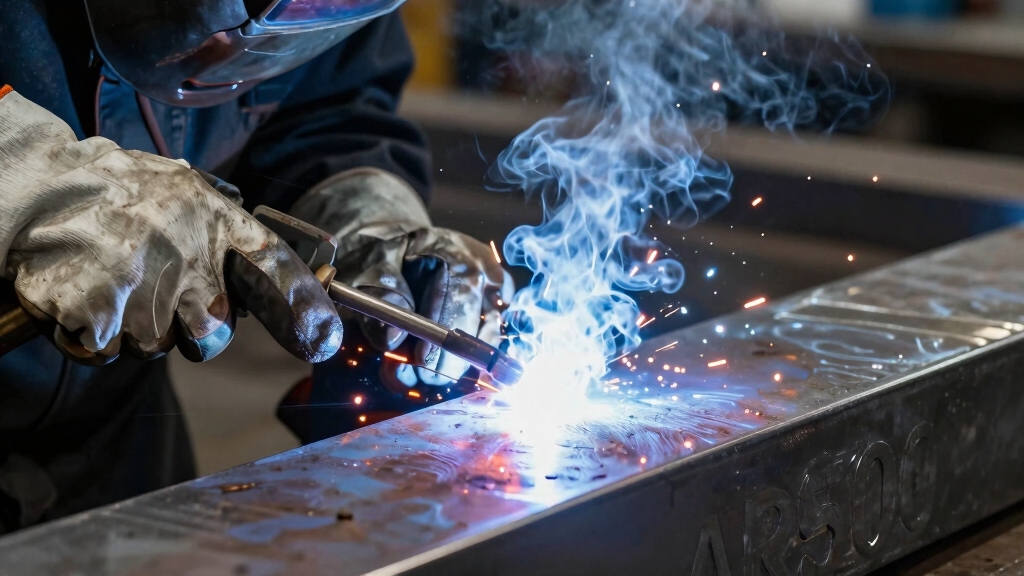
You can weld AR500 steel, but you must manage its high hardness and carbon content carefully to avoid cracking and loss of structural integrity.
Preheating between 300–350°F and controlled cooling reduce residual stresses and brittle martensite formation.
Use low-hydrogen fillers like ER70S-6 or E7018 to match mechanical properties and maintain toughness.
Precision in heat input and handling prevents weld defects and preserves hardness.
Understanding these details equips you to optimize AR500 weld quality and performance.
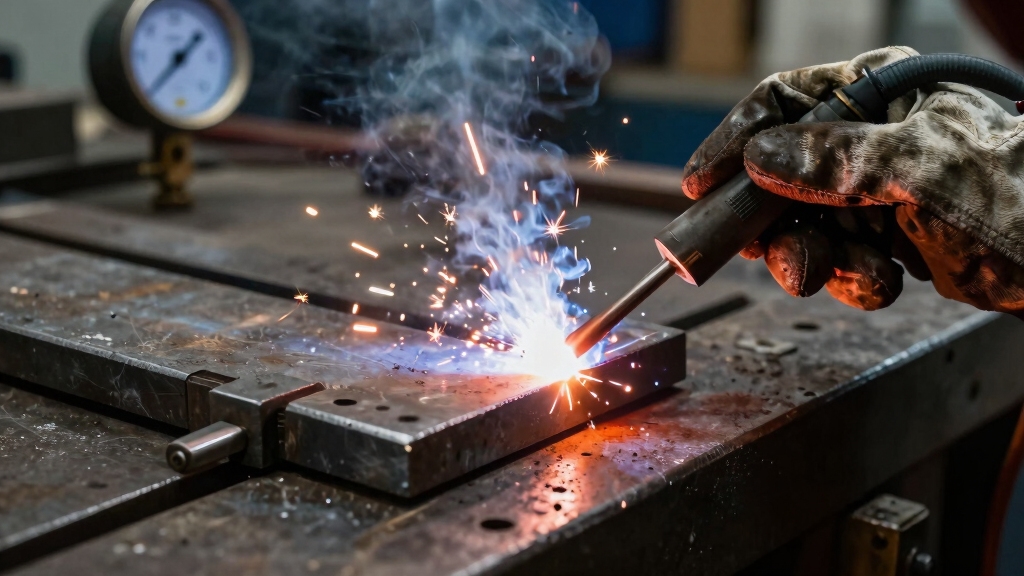
Although AR500 steel offers exceptional hardness and wear resistance, you’ll find it challenging to weld due to its high hardness (470-530 HBW) and carbon content. These factors increase the risk of cracking.
This steel’s yield strength ranges from 160 to 280 ksi, with tensile strength near 200 ksi and elongation limited to 10-15%. This reflects its low ductility.
Its carbon equivalent, close to 0.72, elevates susceptibility to heat-affected zone (HAZ) hardening and subsequent cold cracking. When you weld AR500, controlling heat input is critical to prevent softening or brittleness in the HAZ.
Additionally, you must use preheating and low hydrogen techniques to mitigate residual stresses. Understanding these metallurgical properties helps you plan welding parameters that preserve AR500’s structural integrity while minimizing defects.
Using nickel alloy fillers can help accommodate thermal expansion differences and reduce cracking risks when welding high-carbon steels like AR500.
When welding AR500 steel, you’ll commonly encounter cracking due to its high hardness and carbon content. This creates a brittle heat-affected zone (HAZ).
Welding AR500 steel often causes cracking from its hardness and carbon-rich, brittle heat-affected zone.
This brittleness increases susceptibility to hydrogen-induced cold cracking, especially under rapid cooling. You must control heat input carefully; excessive heat softens the material, reducing wear resistance. Insufficient heat, however, raises cracking risks.
The steel’s carbon equivalent, usually near 0.72, demands preheating and low-hydrogen welding consumables to mitigate stresses. Additionally, AR500’s high Brinell hardness (470-530 HBW) challenges weld fusion and filler metal compatibility.
Using appropriate filler metals like ER70S-6 and maintaining slow cooling within specified temperature limits helps maintain HAZ toughness. Without precise control, you’ll face weld defects that compromise structural integrity and wear resistance.
Applying post-weld heat treatments (PWHT) can significantly reduce residual stresses and improve the toughness of the HAZ, minimizing the risk of cracking.
Managing the risks of cracking and hardness in AR500 steel welding starts with thorough preparation.
You need to preheat the steel carefully, maintaining temperatures between 250°F and 350°F to reduce thermal gradients without softening the material.
Clean the surface meticulously to remove contaminants like oil, rust, and mill scale, which can introduce hydrogen and cause weld defects.
Use low hydrogen welding electrodes and ensure a dry environment to prevent hydrogen-induced cracking.
Clamp the workpiece firmly to minimize distortion and control heat input to avoid excessive heat-affected zone (HAZ) softening.
Finally, plan for post-weld heat treatment to restore toughness and relieve residual stresses.
Following these steps helps maintain AR500’s structural integrity and mitigates common welding challenges linked to its high hardness and carbon content.
It is also important to use proper storage and handling of welding rods to prevent moisture absorption and maintain electrode quality during welding.
Selecting the right welding process is essential to preserve AR500 steel’s hardness and structural integrity. You’ll find Shielded Metal Arc Welding (SMAW), Gas Metal Arc Welding (GMAW or MIG), and Submerged Arc Welding (SAW) are the most suitable.
Choosing the proper welding method is crucial to maintain the hardness and strength of AR500 steel.
These methods allow controlled heat input, reducing the risk of cracking. Preheating the steel to just below 350°F minimizes thermal gradients. Maintaining low hydrogen environments prevents weld embrittlement.
TIG welding is less common due to slower deposition rates but can offer precision if post-weld heat treatment is applied. Avoid excessive heat input; it softens the heat-affected zone, diminishing hardness.
Careful parameter control in GMAW with ER70S-6 filler wire under argon-CO2 shielding gas balances penetration and toughness. Using these processes guarantees welds retain mechanical properties without compromising AR500’s wear resistance.
For MIG welding, ensure DCEP polarity is used with solid wire to achieve deep penetration and stable welds that maintain strength and quality.
Choose filler metals that maintain the hardness and toughness of AR500 steel while minimizing weld defects like cracking or embrittlement. You want filler metals with low hydrogen content and mechanical properties compatible with AR500’s high hardness and strength.
ER70S-6 is a common choice for MIG and TIG welding due to its balance of strength and ductility. However, specialized hardfacing alloys may be necessary for wear resistance. Consider the chemical composition and carbon equivalent to avoid increasing weld cracking risk. Proper selection of consumables ensures weld quality, strength, durability, and reduces defects and rework.
| Filler Metal | Application | Key Feature |
|---|---|---|
| ER70S-6 | MIG/TIG | Low hydrogen, ductile |
| E7018 | SMAW | Crack resistance |
| Hardfacing | Wear surfaces | High abrasion resistance |
| Stainless | Corrosion resistance | Moderate hardness |
| Custom Alloy | Specialized uses | Tailored properties |
After ensuring the proper filler metal is selected to match AR500 steel’s mechanical demands, you need to focus on controlling the thermal environment before and after welding.
Selecting the right filler metal is just the first step; managing the thermal environment is crucial for AR500 welding success.
Preheating AR500 to around 300-350°F reduces thermal gradients, minimizing residual stresses and cracking risk. Avoid exceeding 350°F to prevent softening that compromises hardness and strength.
Post-weld heat treatment (PWHT) is often necessary to relieve stresses and restore toughness in the heat-affected zone. PWHT temperatures should stay below 400°F to avoid altering the steel’s microstructure detrimentally.
Controlled cooling rates are critical. Rapid cooling prevents coarse grain growth and maintains hardness, while slow cooling risks reduced toughness.
For thicker AR500 plates, employing multi-pass welding with controlled heat input is essential to ensure full penetration and minimize distortion.
When welding AR500 steel, you must carefully control heat input and employ appropriate filler metals to prevent cracking and preserve hardness.
Use low hydrogen electrodes like ER70S-6 to minimize hydrogen-induced cracking.
Maintain preheat temperatures below 350°F to reduce thermal stresses while avoiding softening of the heat-affected zone (HAZ).
Control interpass temperature to guarantee uniform weld cooling, preventing brittle microstructures.
Avoid slow cooling rates that lower HAZ toughness.
Post-weld heat treatment can relieve residual stresses but shouldn’t exceed 400°F to maintain hardness.
Monitor welding parameters closely to minimize dilution of the base metal’s hardness by the filler.
Proper surface preparation and cleaning are essential to prevent porosity and maintain weld integrity in AR500 steel welding, as outlined in the Surface Preparation guidelines.
After welding AR500 steel, it’s really important to apply a controlled post-weld heat treatment. This helps relieve stresses in the material without softening its hardness. You definitely want to keep that hardness intact!
When it comes to machining the welded areas, you’ll need to use specialized carbide tooling. Trust me, regular tools just won’t cut it—literally! Also, make sure to reduce your cutting speeds. The high hardness and altered microstructure of AR500 mean you have to approach machining with care.
Now, if you’re into fabrication, keep an eye on those bend radii. Maintaining proper radii and minimizing heat input is crucial for ensuring that the structural integrity and dimensional stability are up to par. It’s all about getting it right!
Because increased hardness reduces weldability, controlling preheat and post-weld heat treatment is essential to prevent HAZ cracking and brittleness.
Although welding AR500 steel provides strong joints, you’ll need to implement post-weld heat treatment carefully to preserve its hardness and toughness.
Controlled heating below 400°F is vital to relieve residual stresses without softening the heat-affected zone (HAZ).
Avoid exceeding this temperature to maintain the steel’s high Brinell hardness (470-530 HBW) and yield strength.
The treatment reduces cracking risk by tempering martensitic microstructures formed during welding, enhancing ductility without compromising abrasion resistance.
You should apply low hydrogen conditions and ensure slow, controlled cooling to prevent brittleness.
Neglecting proper heat treatment can degrade mechanical properties and cause unpredictable failures.
Therefore, precise temperature control and timing are essential to optimize the balance between strength, toughness, and wear resistance in welded AR500 components.
Implementing best practices in welding parameters and material handling further minimizes the risk of weld defects in AR500 steel fabrication.
Maintaining AR500 steel’s mechanical properties through proper post-weld heat treatment sets the stage for the next challenge: machining the welded components.
You’ll face increased tool wear due to the steel’s high hardness (470-530 HBW), requiring specialized carbide tooling and reduced cutting speeds.
The heat-affected zone (HAZ) may exhibit microstructural variations, causing uneven machinability and demanding precise tool path control to avoid surface defects.
Residual stresses from welding can induce distortion during machining, so you must plan for stress-relief measures and stable fixturing.
Additionally, AR500’s low machinability index (~30% relative to AISI 1212) means chip formation is more difficult, increasing the risk of tool breakage.
Understanding these factors helps you optimize machining parameters and tooling choices for welded AR500 components, ensuring dimensional accuracy and surface integrity.
Consideration of thermal expansion effects is critical when planning machining sequences to minimize warping and maintain component integrity.
When working with welded AR500 steel, you must carefully control machining parameters and fabrication techniques to preserve the material’s hardness and structural integrity. The high hardness and narrow heat-affected zone (HAZ) demand precise handling to prevent cracking and softening. Follow strict guidelines to maintain peak performance.
Adhering to these practices guarantees weld integrity and long-term durability in AR500 assemblies.
When you’re welding AR500 steel, one common mistake isn’t preheating it enough. Because of its high hardness and carbon content, this can lead to cracking. It’s definitely something to keep in mind!
Another issue is picking the wrong filler metal. This choice can really compromise the integrity of your welds, making them brittle or causing poor fusion. You really want to make sure you’re using the right materials.
And let’s not forget about cooling rates. Rapid cooling can increase the risk of low toughness in the heat-affected zone, which isn’t ideal for durability. So, it’s super important to control those cooling rates to ensure your welds hold up well.
Because AR500 steel has a high hardness and carbon content, insufficient preheating markedly raises the risk of weld cracking and poor fusion.
When you skip or underperform preheating, rapid cooling induces thermal stresses that cause brittle martensitic structures in the heat-affected zone (HAZ).
This compromises weld integrity and leads to cracking.
To avoid these issues, focus on:
Insufficient preheating undermines weld quality by increasing residual stresses and reducing ductility.
Proper thermal management is critical for sound, crack-free welds on AR500 steel.
Managing preheating temperatures effectively sets the foundation for sound welds on AR500 steel. Selecting the right filler metal is just as pivotal to prevent weld failures.
Using filler metals with incompatible chemical compositions can induce excessive hardness or brittleness in the weld zone, increasing the risk of cracking. For AR500, fillers like ER70S-6 offer a balanced tensile strength and ductility that complement the base metal’s properties.
Avoid high-carbon or high-alloy fillers that disrupt the weld’s microstructure and cause stress concentrations. Additionally, mismatched filler metals can create dilution issues, leading to uneven hardness profiles and compromised impact resistance.
You must make certain the filler metal matches or slightly undermatches AR500’s mechanical properties while maintaining low hydrogen content to preserve weld integrity under service conditions.
If you fail to control the cooling rate after welding AR500 steel, you risk inducing rapid cooling that severely compromises the heat-affected zone (HAZ).
This rapid quenching can cause brittle microstructures, increasing crack susceptibility.
Here’s what happens with rapid cooling:
To avoid these issues, maintain controlled cooling rates by preheating within recommended temperatures and applying post-weld heat treatment.
Neglecting this increases the risk of weld defects and compromises AR500 steel’s performance in high-stress applications.
You’ll find AR500 steel widely used in industries demanding extreme abrasion resistance.
Mining and heavy machinery sectors rely on it for wear parts that endure harsh conditions.
Defense applications use it for armor plating and armored vehicles due to its high hardness.
Shooting ranges and target manufacturers incorporate AR500 for durable steel targets.
You’ll also see it in construction and material handling equipment where impact resistance and longevity are critical.
You’ll find AR500 steel excels in hardness (470-530 HBW) and tensile strength (~200 ksi), outperforming many abrasion-resistant steels in wear resistance.
Its balance of toughness and elongation (10-15%) provides superior impact durability.
However, AR500 demands careful fabrication due to cracking risk and limited formability.
Compared to others, it’s ideal for high-impact, wear-heavy applications but requires precise welding and heat treatment to maintain integrity.
Yes, you can laser cut AR500 steel without markedly affecting its hardness, provided you control the heat input carefully.
Using a fiber laser helps maintain a narrow heat-affected zone (HAZ), preserving the steel’s abrasion resistance.
Avoid excessive post-cut heating above 400°F to prevent softening.
Think of AR500 steel as a fortress against wear.
Beyond armor plating, you’ll find it in heavy machinery parts, mining equipment, and high-impact components where abrasion resistance is king.
Its hardness and toughness make it perfect for target shooting plates and wear-resistant surfaces.
When you need durability with low maintenance, AR500 stands firm, especially in applications demanding high tensile strength and resistance to deformation under extreme conditions.
You’ll find AR500 steel’s density of 0.283 lb/in³ impacts construction by increasing overall structural weight.
This demands stronger support frameworks.
Its high density delivers excellent abrasion resistance but requires careful load calculations to avoid overdesign.
While heavier, its durability reduces maintenance frequency, benefiting high-wear environments.
You must balance weight penalties against longevity, especially in heavy machinery or impact-prone areas.
This optimizes design for both performance and safety.
Welding AR500 steel isn’t a walk in the park, but with the right prep and techniques, you can master it.
Avoid cracking by preheating, choosing proper filler metals, and applying post-weld heat treatment. Remember, maintaining hardness while preventing brittleness is key. Think of it like forging Excalibur, not just patching metal.
Stay precise in your approach, and you’ll guarantee durable, reliable welds on this tough, abrasion-resistant steel.