Phone:
(701)814-6992
Physical address:
6296 Donnelly Plaza
Ratkeville, Bahamas.

Phone:
(701)814-6992
Physical address:
6296 Donnelly Plaza
Ratkeville, Bahamas.

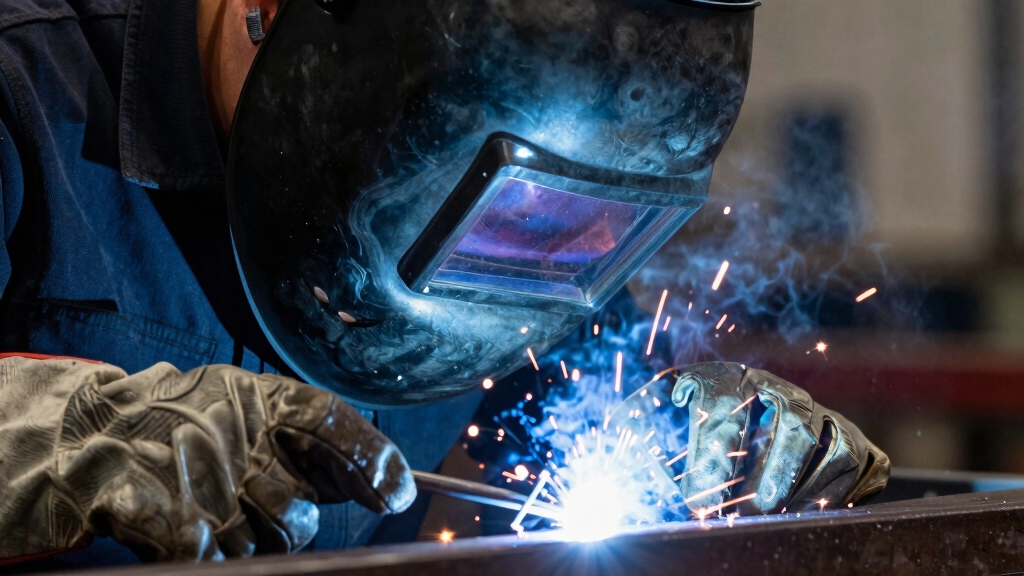
Auto darkening welding helmets protect your eyes by instantly detecting arc light using sensors that identify sudden UV/IR spikes, not ambient light.
A microcontroller processes these signals and quickly triggers the LCD lens to shift from clear to dark by realigning liquid crystals with an electric field.
You’ll find adjustable shade, sensitivity, and delay settings tailored to your welding type, plus reliable power sources like batteries and solar cells.
Exploring these features reveals how they enhance both safety and precision.
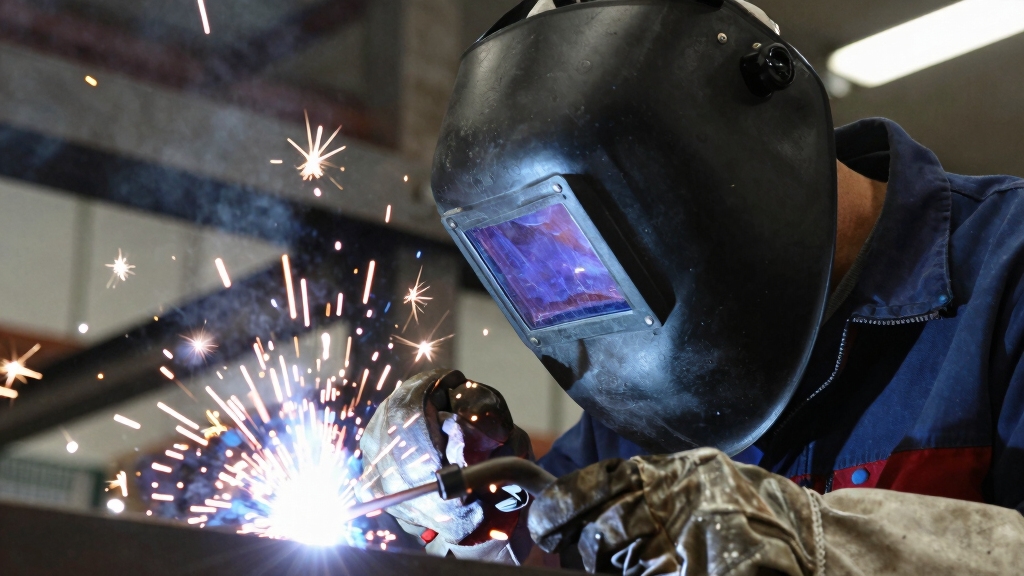
When you’re welding, protecting your eyes from intense light and harmful radiation is crucial.
Eye protection is essential when welding to shield against intense light and harmful radiation.
Auto darkening welding helmets do just that.
These helmets feature an advanced LCD lens that automatically shifts from a light state to a darkened state the moment it detects the welding arc’s brightness.
This rapid response blocks harmful ultraviolet and infrared rays, preventing eye damage and arc flash.
Unlike traditional helmets, you don’t need to flip the visor manually, allowing you to maintain focus and improve accuracy.
The helmets use liquid crystal technology to control light transmission precisely, enhancing safety without compromising visibility.
Auto-darkening lenses are preferred for variable arc intensities to enhance safety and comfort through precise shade selection.
Although ambient light can vary widely in a welding environment, sensors in auto darkening helmets precisely distinguish the welding arc by detecting sudden changes in ultraviolet (UV) and infrared (IR) radiation levels.
These sensors instantly respond to the intense UV and IR emissions unique to welding arcs, filtering out ordinary light sources like sunlight or indoor bulbs.
Here’s how they do it:
Use multiple sensors positioned near the lens for comprehensive arc detection.
Monitor rapid spikes in UV and IR radiation beyond ambient thresholds.
Activate only when light intensity surpasses preset sensitivity levels.
Avoid false triggers by ignoring steady or gradual changes in light.
This guarantees your helmet darkens only when actual welding occurs, protecting your eyes without interruption.
Proper maintenance and regular inspection of sensors ensure reliable arc detection accuracy and helmet performance.
Once the sensors detect the welding arc’s UV and IR radiation spikes, the microcontroller receives and processes these signals instantly.
The microcontroller instantly processes UV and IR radiation spikes detected by the welding arc sensors.
It evaluates whether the intensity surpasses the preset activation threshold, filtering out false positives like ambient light.
Upon confirming an arc event, the microcontroller sends an immediate electronic command to the LCD lens controller, triggering the liquid crystal cells to realign and darken the lens.
This shift occurs within milliseconds to protect your eyes from intense light and UV exposure.
The microcontroller also manages adjustable features such as delay and sensitivity by interpreting user settings.
This ensures the lens stays dark for the required duration after the arc ends.
This precise control mechanism guarantees real-time responsiveness and reliable protection during welding tasks.
Proper use of protective gear such as welding helmets with correct shading is essential for safety during operation.
When the sensors pick up the welding arc, the microcontroller jumps into action. It sends a signal to the LCD lens, telling it to activate its liquid crystals. These crystals are pretty cool—they quickly align themselves to block out that intense light. Basically, the lens goes from being clear to dark in the blink of an eye.
Now, once the arc is finished, the crystals don’t just stay in that dark state. They realign back to their original position, and just like that, the lens goes back to being clear again. It’s a neat little dance happening inside the lens! This process is crucial because maintaining arc stability ensures consistent protection and optimal performance of the auto darkening feature.
As the sensors detect the intense arc light, the microcontroller sends a signal to the liquid crystal display (LCD) panel within the helmet lens.
This prompts the liquid crystals to realign, shifting from a random to a structured orientation.
This realignment controls light transmission through the lens.
When aligned, the crystals effectively reduce light passage, darkening the viewing area instantly.
In this process, you’ll notice:
This precise control lets you weld safely without manual lens adjustments. Additionally, the microcontroller’s dynamic response ensures consistent protection even under fluctuating arc intensities.
Although the liquid crystals realign to block light, the actual light blocking inside the LCD lens occurs through controlled modulation of polarized light waves. When an arc is detected, the microcontroller signals the crystals to twist and alter their orientation, changing the polarization state of incoming light.
This modulation reduces light transmission, effectively darkening the lens. The degree of blocking depends on the crystals’ alignment and electric field strength, ensuring variable shading.
| Component | Function | Effect on Light |
|---|---|---|
| Liquid Crystals | Reorient molecules | Change polarization angle |
| Polarizers | Filter polarized light | Allow/block specific waves |
| Electric Field | Controls crystal state | Adjusts light transmission |
| Sensors | Detect arc intensity | Trigger crystal alignment |
| Microcontroller | Processes sensor input | Regulates electric field |
This precise modulation protects your eyes by efficiently controlling visible and harmful radiation. The effectiveness of this protection is enhanced by using argon shielding gas, which stabilizes the welding arc and reduces harmful light fluctuations during welding.
Because the liquid crystals inside the LCD lens must respond instantaneously to changes in arc intensity, they undergo a rapid reorientation process that shifts the lens from its light to dark state.
When the sensors detect the welding arc’s UV and IR radiation exceeding a preset threshold, the microcontroller triggers the liquid crystals to realign. This reorientation adjusts the lens’s opacity, blocking intense light instantly.
Once the arc ends, the crystals return to their original alignment, restoring transparency.
Inside this shift, you’ll find:
This seamless shift protects your eyes while maintaining clear visibility. Proper use of personal protective equipment is essential to ensure complete eye and face safety during welding operations.
Lens shading levels vary from 5 to 13, and it’s important to choose the right one for your needs. Each level strikes a balance between visibility and protection, depending on how bright the arc is.
When you pick the correct shade, you’re not just blocking harmful radiation; you’re also making sure you can still see the weld clearly. It’s all about finding that sweet spot!
Plus, adjusting the shade levels properly can really help reduce eye strain. This means you can work more comfortably and improve your welding accuracy at the same time. How great is that?
Remember, starting with a darker shade and reducing one level at a time helps optimize both protection and visibility for your specific welding amperage and conditions, as outlined in the shade number guidance.
When selecting an auto darkening welding helmet, understanding shade levels is essential for balancing visibility and protection.
Shade levels, ranging typically from 5 to 13, determine how much light your lens blocks during welding. Choosing the correct shade prevents eye strain and protects against harmful UV and IR radiation without compromising your view of the weld.
Consider these key points about shade levels:
Lower shades (5-9) suit grinding or light welding tasks.
Shade 10 is standard for most MIG and TIG welding.
Higher shades (11-13) protect against intense arcs or high amperage.
Variable shade helmets adjust automatically to changing light intensity.
Proper selection of shade levels is as important as choosing heat-resistant materials in gloves to ensure comprehensive safety during welding.
Lens shading levels directly influence both the clarity of your view and the degree of eye protection during welding.
Selecting the proper shade guarantees you see the weld pool clearly while blocking harmful UV and IR radiation. Lighter shades improve visibility but reduce protection, while darker shades enhance protection but can obscure details.
| Shade Level | Application |
|---|---|
| 5 – 8 | Low amp TIG welding |
| 9 – 10 | Standard MIG/TIG |
| 11 – 12 | High amp welding |
| 13 | Plasma cutting |
| Variable | Adaptive real-time |
Balancing shading means choosing a level that fits your welding type and brightness. This optimizes safety and precision simultaneously. Proper shading is especially important when working with AC polarity in TIG welding due to the alternating heat and cleaning cycles.
Although auto darkening helmets automatically adjust to arc light, fine-tuning sensitivity and delay settings guarantees peak performance for specific welding tasks.
You’ll want to calibrate sensitivity to make certain the helmet activates promptly without false triggers. For low-amp TIG welding, increase sensitivity to detect dimmer arcs. Delay controls how long the lens stays dark after the arc ends. Adjusting this prevents premature light exposure or unnecessary darkness.
Consider these adjustments:
Precisely adjusting these settings optimizes safety and visibility for your welding needs.
Powering your auto darkening welding helmet reliably guarantees uninterrupted protection and peak performance. Helmets typically use rechargeable batteries combined with solar cells to maintain consistent energy. Batteries supply power to the LCD filter, while solar cells extend battery life by harvesting ambient light during welding. This hybrid system guarantees the helmet functions even in low-light conditions. If power fails, the helmet defaults to a passive light state, still offering basic protection.
| Power Source | Function | Typical Lifespan |
|---|---|---|
| Rechargeable Battery | Powers LCD filter and electronics | 1-3 years |
| Solar Cells | Supplements battery, extends life | Indefinite with light |
| Battery-Solar Combo | Hybrid system for reliability | 1-3 years plus solar |
| Passive Mode | No power needed, lens fixed shade | Unlimited |
| Backup Battery | Emergency power backup | Varies by model |
When you select an auto darkening welding helmet, you gain access to multiple modes and features designed to enhance versatility across various welding tasks.
These helmets integrate adaptive technologies to suit different processes like MIG, TIG, and stick welding. You can optimize performance with adjustable sensitivity and delay controls, essential for tasks requiring precise timing and protection.
Additionally, specialized modes support grinding, plasma cutting, and gas cutting without lens darkening.
Key features include:
These capabilities allow you to tailor your helmet for a broad range of welding environments efficiently.
Beyond versatility, auto darkening helmets markedly enhance safety and comfort for welders. They reduce arc flash risks by instantly darkening the lens when sensors detect intense light. This protects your eyes from harmful UV and IR radiation.
You won’t need to flip the helmet manually, minimizing neck strain and improving focus. Adjustable sensitivity and delay controls adapt to different welding conditions, providing personalized comfort and precision.
| Feature | Benefit |
|---|---|
| Instant darkening | Prevents eye damage from sudden arc light |
| Adjustable delay | Reduces eye strain post-weld |
| Sensitivity control | Optimizes lens response for welding type |
| Hands-free use | Improves comfort and workflow |
| UV/IR protection | Shields eyes from harmful radiation |
These features work together to guarantee safer, more comfortable welding sessions.
To properly maintain and clean your auto darkening helmet, regularly wipe the lens with a soft, lint-free cloth and mild soap solution to avoid scratches.
Check sensors and solar cells for debris or damage, gently cleaning them with a soft brush. Inspect battery life and replace if needed.
Store the helmet in a cool, dry place away from direct sunlight and chemicals. Avoid harsh solvents to preserve lens coatings and guarantee peak sensor function.
Yes, you can use auto darkening helmets with prescription glasses. Many helmets feature ample interior space to accommodate glasses comfortably without compromising fit or seal.
Look for helmets labeled as “over-the-glasses” (OTG) compatible, designed with extra room and adjustable headgear. This ensures your glasses won’t interfere with the helmet’s sensors or lens.
Always verify clearance and comfort before use to maintain safety and peak performance.
You should look for helmets meeting ANSI Z87.1 and CSA Z94.3 standards, ensuring impact resistance and optical clarity.
Importantly, 90% of welding-related eye injuries happen due to inadequate protection, underscoring certification importance.
Also check for EN379 if in Europe, which rates auto-darkening filters’ performance.
These certifications guarantee your helmet’s durability, lens reliability, and safety against UV/IR radiation, giving you consistent protection during welding tasks.
Sensors in auto-darkening helmets typically last several years under normal use, often matching the helmet’s overall lifespan of 3 to 5 years.
However, factors like exposure to extreme heat, impact, or excessive dirt can reduce sensor longevity.
You should inspect sensors regularly and replace the helmet or service the sensors if you notice delayed activation or inconsistent darkening.
This ensures continued protection and performance.
Like puzzle pieces, auto darkening helmets don’t always fit every accessory perfectly.
You’ll find most accessories designed specifically for your helmet model work seamlessly, but universal compatibility isn’t guaranteed.
Always check manufacturer guidelines to make certain proper fit and function.
Mismatched parts can interfere with sensor performance or comfort.
If you want to add items like magnifying lenses or sweatbands, confirm they’re approved to maintain safety and peak helmet operation.
You might think auto darkening welding helmets are just fancy gear, but they’re absolute game-changers.
Instantly switching from clear to dark, they protect your eyes with lightning speed and precision no human could match.
With adjustable settings and advanced sensors, these helmets adapt seamlessly to every weld, making your work safer and far more comfortable.
Skipping one? That’d be like welding blindfolded—utterly unthinkable for anyone serious about quality and safety.