Phone:
(701)814-6992
Physical address:
6296 Donnelly Plaza
Ratkeville, Bahamas.

Phone:
(701)814-6992
Physical address:
6296 Donnelly Plaza
Ratkeville, Bahamas.

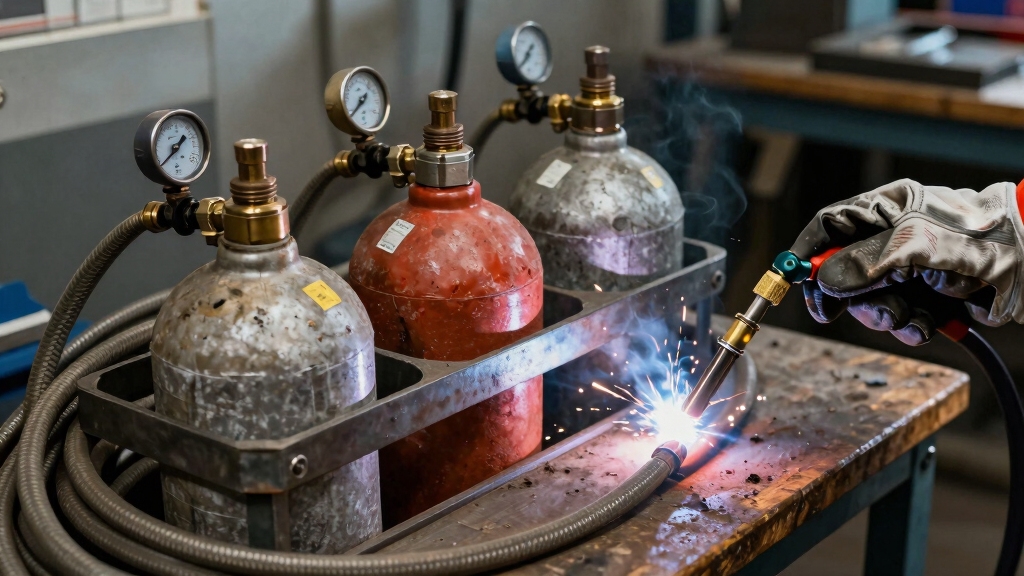
You use shielding gases like argon, helium, carbon dioxide, oxygen, and nitrogen to optimize welding quality and protect the weld pool.
Argon provides excellent arc stability, while helium enhances heat and penetration.
Carbon dioxide offers deep penetration but can increase spatter, so it’s often blended with argon or oxygen for better control.
Specialized blends with nitrogen or hydrogen improve stainless steel welds.
For cutting and brazing, acetylene delivers the hottest flame. Exploring these gases further reveals key performance advantages.
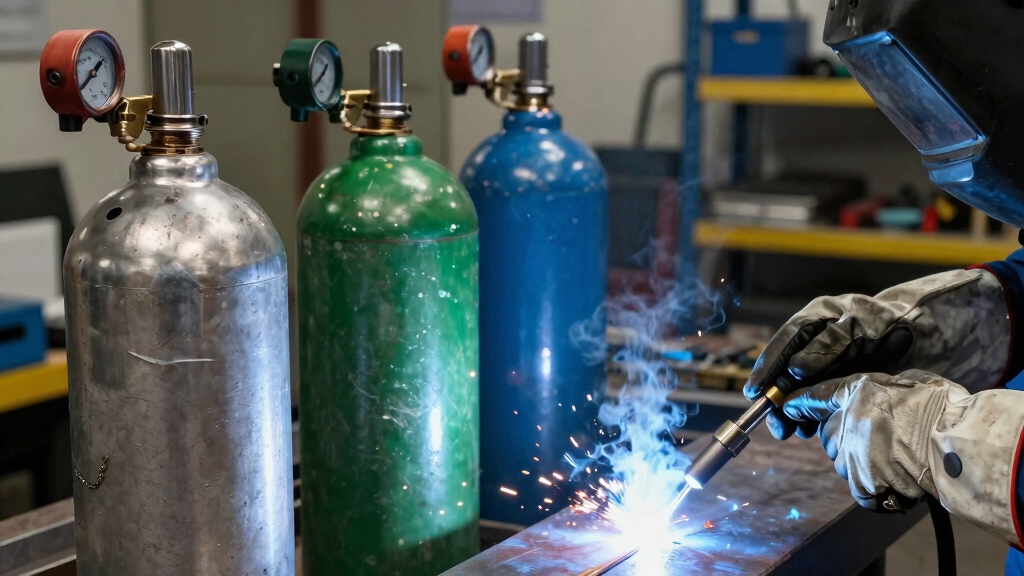
Although selecting the right shielding gas can be complex, understanding the common types simplifies your welding process.
Argon, an inert gas, provides excellent arc stability and clean finishes. It’s ideal for TIG and MIG welding on aluminum, stainless, and carbon steel.
Helium, though costlier, increases heat input and penetration. It’s often blended with argon for thick or high-conductivity metals.
Carbon dioxide offers deep penetration and is cost-effective but causes more spatter alone. Blending it with argon optimizes weld quality on carbon steel.
Oxygen, used in small amounts, enhances fluidity and penetration but is never used pure due to reactivity.
Nitrogen stabilizes the arc and increases penetration in stainless steel welds.
These gases, either pure or blended, form the foundation of effective shielding in welding applications.
Argon’s inert atmosphere effectively prevents oxidation and porosity, ensuring high-quality welds.
Argon and helium frequently serve as the backbone of high-quality welding processes due to their unique shielding properties.
You rely on argon for arc stability, smooth metal transfer, and minimal spatter, especially with TIG and MIG welding on aluminum and stainless steel.
Helium, meanwhile, increases heat input and penetration, ideal for thick or high-thermal-conductivity metals.
Blending helium with argon enhances arc starts and weld fusion.
Selecting the correct argon-helium blend ratios is essential to balance arc stability and heat input for different metals and thicknesses.
| Property | Argon | Helium |
|---|---|---|
| Arc Stability | Excellent | Good |
| Heat Input | Moderate | High |
| Penetration | Moderate | Deep |
| Spatter Control | Superior | Moderate |
| Cost | Lower | Higher |
Using these gases optimizes weld quality, consistency, and finish.
When selecting shielding gases for welding carbon steel, you’ll find that carbon dioxide and oxygen mixtures offer distinct advantages.
Carbon dioxide alone provides deep penetration but increases spatter, so blending it with argon reduces spatter and improves weld appearance.
Carbon dioxide delivers deep penetration; mixing with argon lessens spatter and enhances weld quality.
Adding small amounts of oxygen, typically 1-5%, to argon or argon-CO2 mixtures enhances arc stability, increases molten metal fluidity, and speeds the welding process.
Oxygen’s reactivity requires careful control in mixtures to avoid oxidation, so it’s never used pure.
These blends optimize arc voltage and heat input, making them ideal for metal active gas (MAG) welding on carbon steel.
Selecting the proper shielding gas is critical as it directly affects arc stability and weld quality.
Since nitrogen and hydrogen each bring unique properties to welding processes, understanding their roles can greatly improve your specialized welding outcomes.
Nitrogen acts as a semi-inert gas that enhances weld penetration and stabilizes the arc when blended with other gases. It’s commonly used as a backing or purging gas in stainless steel welding, plasma cutting, and laser applications. This prevents contamination and improves chemical characteristics in nitrogen-alloyed metals.
Hydrogen, when added in small amounts to argon, increases penetration and welding speed, especially in TIG welding of stainless steel. However, you need to control hydrogen carefully to avoid porosity.
Tri-mix blends with argon and CO2 leverage hydrogen’s benefits while maintaining weld integrity. Using these gases strategically optimizes arc stability, weld quality, and process efficiency in specialized welding tasks.
Additionally, the use of weld-through primers containing zinc and copper can complement these gases by providing corrosion-resistant coatings that protect joints during welding and improve overall weld integrity.
Beyond inert and semi-inert gases, fuel gases play a significant role in welding and cutting, particularly acetylene. When you use acetylene combined with oxygen, you get the hottest flame available for ferrous metal cutting and welding.
Here’s what you need to know about acetylene in these processes:
You need to store welding gas cylinders upright, secured with chains or straps to prevent tipping.
Keep them in a well-ventilated, dry area away from heat sources, sparks, and flammable materials.
Always cap cylinders when not in use, and separate full from empty tanks.
Avoid storing oxygen cylinders near fuel gases to prevent fire hazards.
Regularly inspect for leaks or damage, ensuring labels remain visible for safety and compliance.
You might say welding gases have a “subtle footprint” on the environment.
While inert gases like argon and helium are non-toxic and don’t deplete ozone, their extraction and production consume significant energy. This contributes to greenhouse gas emissions.
Carbon dioxide used in welding adds to atmospheric CO2 levels, intensifying climate change concerns.
You generally can’t recycle or directly reuse welding shielding gases after use because they mix with atmospheric air and contaminants during welding, losing purity.
However, some advanced systems capture and purify exhaust gases for limited reuse, primarily in industrial settings.
For most applications, you’ll need fresh gas cylinders to guarantee weld quality and consistency.
Proper cylinder handling and storage help minimize waste and maintain gas integrity before use.
Impurities in shielding gases act like tiny saboteurs, disrupting the perfect dance of molten metal. When oxygen, moisture, or nitrogen sneak in, they cause porosity, weak bonds, and inconsistent arcs. This compromises your weld’s strength and appearance.
Even trace contaminants increase spatter and oxidation, leading to brittle, cracked joints. To guarantee your weld quality stays first-rate, you must use ultra-pure gases and maintain your equipment’s seals and filters meticulously.
You should always wear flame-resistant gloves, safety goggles or a full-face shield, and a welding helmet with the correct filter lens when handling welding gases.
Use protective clothing to prevent burns and respiratory protection, like a respirator or adequate ventilation, to avoid inhaling harmful fumes.
Additionally, wear steel-toed boots and make sure cylinders are secured properly to prevent accidents.
These precautions minimize exposure to toxic gases and physical hazards during welding operations.
As you navigate the welding world, picture each gas as a brushstroke shaping your metal masterpiece.
Argon and helium cloak your welds in a protective shield, while carbon dioxide and oxygen mixtures fuel the fiery dance of fusion.
Nitrogen and hydrogen fine-tune strength in specialized tasks, and acetylene fuels the spark of precision cutting.
Mastering these gases lets you command the arc with exact control, forging bonds as strong and clear as steel itself.