Phone:
(701)814-6992
Physical address:
6296 Donnelly Plaza
Ratkeville, Bahamas.

Phone:
(701)814-6992
Physical address:
6296 Donnelly Plaza
Ratkeville, Bahamas.

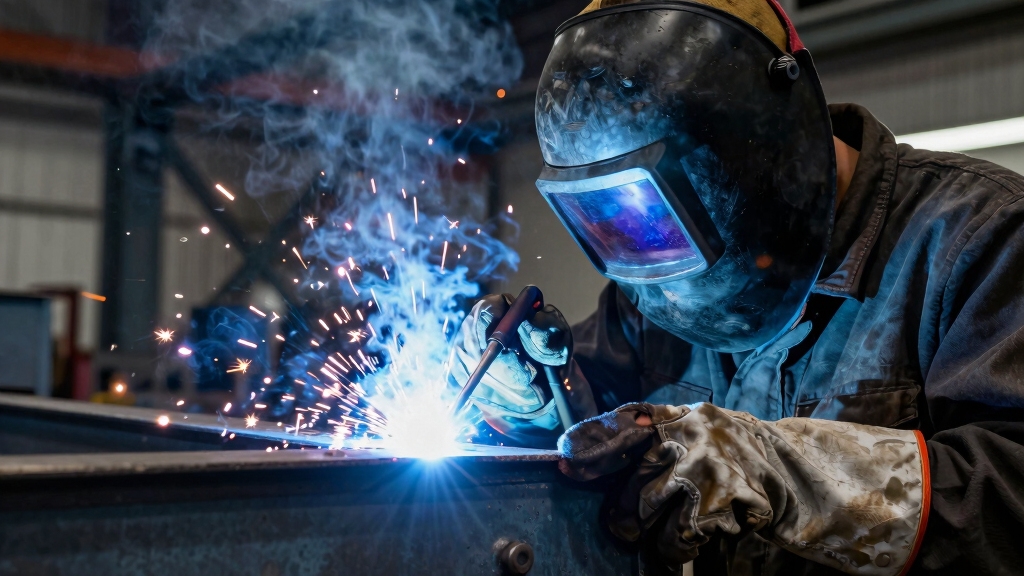
As a structural welder, you join metal components to build frameworks for bridges, buildings, and pipelines.
You’ll interpret blueprints to prepare materials, then apply welding methods like MIG, TIG, or stick welding in multiple positions. This ensures precise bead quality and structural integrity.
Your role demands strict adherence to specifications, safety protocols, and equipment maintenance.
You’ll also perform inspections to detect defects and guarantee compliance.
Keep following to understand essential skills, certifications, and working conditions in this field.
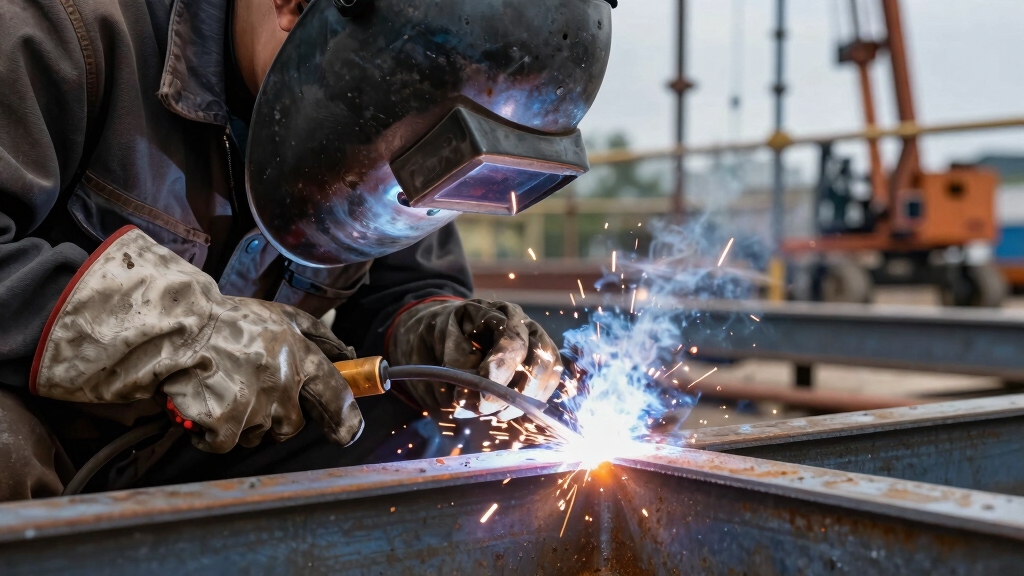
As a structural welder, you interpret blueprints and engineering drawings to prepare and join metal components accurately.
Interpreting blueprints and engineering drawings ensures precise preparation and joining of metal components in structural welding.
You analyze specifications to determine welding techniques and materials required for each project.
You set up welding equipment, selecting processes like MIG, TIG, or stick welding, and prepare metal surfaces by cleaning and aligning parts precisely.
You perform welding operations in various positions, assuring consistent penetration and bead quality.
Post-weld, you conduct inspections and tests to verify structural integrity, checking for defects such as cracks or porosity.
You follow strict safety protocols to protect yourself and maintain a clean work environment.
Additionally, you repair and maintain welding equipment to guarantee operational efficiency.
Your methodical approach guarantees that steel structures meet design standards and safety requirements.
Welding is a critical step within fabrication that provides permanent metal bonds and structural integrity to assembled components.
You really need to be able to interpret blueprints accurately. This helps you understand the welding requirements and ensures everything gets assembled correctly.
It’s all about mastering those welding techniques, right? Whether it’s MIG, TIG, or stick welding, having a solid grasp on these skills is crucial. They play a big role in creating strong, defect-free joints.
And let’s not forget, these skills aren’t just about looking good on paper. They directly impact the structural integrity and safety of the final construction. So, it’s super important to take them seriously!
Additionally, understanding the importance of precise positioning and fit-up is essential to prevent defects that could compromise the strength and durability of welded structures.
How do you guarantee every weld meets exact specifications and structural requirements? You master blueprint interpretation proficiency.
Accurately reading and decoding blueprints, engineering drawings, and schematics is essential. You identify welding symbols, dimensions, tolerances, and material specifications to plan each weld precisely.
You cross-reference notes and standards to confirm compliance with design criteria. This skill enables you to determine joint types, weld sizes, and positions, preventing errors before fabrication.
A methodical approach guarantees you align components correctly, prepare materials according to specifications, and execute welds that maintain structural integrity.
Misreading blueprints risks costly rework or compromised safety, so developing sharp interpretation skills directly impacts your efficiency and quality.
Your expertise in blueprint reading forms the foundation for every successful structural weld you produce. Additionally, understanding and applying welding procedure specifications (WPS) ensures that welds meet quality and safety standards as outlined in the blueprints.
Mastering welding techniques is essential for producing strong, reliable structural welds that meet stringent industry standards. You’ll need proficiency in methods like FCAW, GMAW, SMAW, and TIG, adapting to positions such as flat, vertical, and overhead with precision.
Skillful control of heat input and travel speed prevents defects and guarantees weld integrity. You must accurately align and fit metal parts using jacks and wedges before welding. Post-weld, you’ll chip slag and inspect welds for quality.
Familiarity with filler rod application and equipment calibration is vital. Consistently following safety protocols and maintaining a clean workspace supports efficiency and safety.
Developing these competencies assures your welds withstand structural stresses, fulfilling both design specifications and regulatory requirements critical in construction and engineering projects. Utilizing an inverter welding machine can further enhance precision and control in structural welding applications.
When working as a structural welder, interpreting blueprints accurately forms the foundation for precise metal fabrication and assembly.
You’ll analyze detailed schematics and engineering drawings to understand dimensions, weld symbols, joint types, and material specifications.
Reading these blueprints lets you identify exact locations for welds, required weld sizes, and positional information.
Blueprint reading reveals precise weld locations, sizes, and orientations essential for accurate structural assembly.
You must recognize symbols indicating welding processes, inspection criteria, and tolerances.
This skill guarantees you prepare and align components correctly before welding, preventing structural weaknesses or misfits.
Your ability to convert two-dimensional plans into three-dimensional frameworks directly impacts the integrity and safety of the final structure.
Mastering blueprint reading not only guides your welding tasks but also supports effective communication with engineers and construction teams throughout the project lifecycle.
To maintain your certification validity, it is essential to perform welding with the qualified process at least once every six months to meet the continuity requirement.
When it comes to joining structural components, you’ll be using a variety of welding processes like FCAW, GMAW, and SMAW. Each of these methods has its own strengths and applications, so it’s good to get familiar with all of them.
Now, let’s talk about positional welding techniques. You’ll need to master different positions: flat, horizontal, vertical, and overhead. It’s not just about knowing these positions; it’s crucial for making strong, reliable welds. MIG welding, for example, favors flat and horizontal positions due to gravity effects that can cause porosity in vertical and overhead welding.
Structural welders rely on a range of welding processes to join metal components effectively and guarantee strong, durable connections. You’ll use specific techniques depending on the metal type, joint design, and structural requirements.
Here are the most common welding processes you’ll encounter:
Mastering these processes guarantees you achieve welds that meet structural codes and withstand stress. Additionally, maintaining proper welding parameters such as heat input and shielding gas flow is crucial for weld quality and integrity.
Mastering welding processes like SMAW, GMAW, and FCAW sets the foundation for effective metal joining, but applying these techniques across various positions demands refined skill and control.
You’ll weld in flat, horizontal, vertical, and overhead positions, each presenting unique challenges. In flat position, gravity aids molten metal flow, making it the easiest.
Horizontal and vertical welding require steady hand control to prevent sagging or uneven bead formation. Overhead welding is the most demanding; you must control molten metal against gravity to avoid drips and guarantee penetration.
You’ll adjust torch angle, travel speed, and electrode manipulation to maintain consistent weld quality. Precise positioning guarantees structural integrity, especially in critical builds like bridges and pipelines.
Mastery of positional welding techniques is essential to meet code standards and pass certification tests. Extensive training and practice, often exceeding 30 to 100 hours, are essential to develop the precision and control necessary for defect-free welds.
Although experience plays a critical role, obtaining specific certifications is essential to validate your skills as a structural welder.
Experience is vital, but certifications are crucial to prove your skills as a structural welder.
These certifications confirm your ability to perform welds that meet industry standards and safety regulations.
You’ll typically need to pass qualification tests in various welding positions and processes.
Key certifications and qualifications include:
These credentials ensure you can interpret blueprints accurately, handle equipment skillfully, and maintain structural integrity under rigorous conditions. Mastery of electrodes with all-position capability is also crucial for adapting to diverse welding environments.
When you work as a welder specializing in metal structures, you’ll find yourself in a variety of environments, from shipyards and fabrication shops to outdoor construction sites.
You’ll operate in confined spaces, on scaffolding, or elevated platforms, often climbing ladders and stairs. Your tasks may require working in flat, vertical, or overhead welding positions, adapting to site-specific conditions.
You’ll frequently handle heavy equipment, such as cranes and forklifts, to position components accurately. Collaboration with engineers and construction teams is essential to align with project specifications.
The work demands consistent physical stamina, as you’ll stand, crouch, and lift repeatedly throughout your shifts. Your workspace may range from controlled shop floors to dynamic, weather-exposed locations, requiring precise adjustments to welding techniques and equipment settings to maintain structural integrity.
Effective heat management is crucial in these environments to prevent cracking and ensure the durability of welded joints.
Consistently following safety protocols is essential to prevent accidents and injuries while working as a structural welder.
Consistent adherence to safety protocols is crucial to avoid accidents and injuries in structural welding.
You must wear appropriate personal protective equipment (PPE) such as helmets with proper eye protection, flame-resistant clothing, and gloves to shield against sparks and UV radiation.
Maintaining a clean workspace reduces tripping hazards and fire risks. Always inspect your welding area for flammable materials and make certain proper ventilation to avoid inhaling toxic fumes.
Additionally, adhere to lockout/tagout procedures when servicing equipment to prevent accidental activation.
Key safety practices include:
These steps safeguard your health and make certain compliance with industry safety standards.
Mastering structural welding requires proficiency with a range of specialized tools and equipment designed for precision and safety.
You’ll rely on welding machines like MIG, TIG, and stick welders, each suited for specific metal types and joint configurations. Proper protective gear such as helmets, gloves, and flame-resistant clothing is essential to prevent injuries.
Additionally, measuring and aligning tools, including clamps, jacks, and squares, guarantee accurate fit-up before welding.
| Tool/Equipment | Purpose |
|---|---|
| Welding Machine | Delivers controlled heat source |
| Protective Gear | Shields from sparks and UV rays |
| Measuring Devices | Guarantees precise alignment |
Using and maintaining these tools properly is critical for the structural integrity and quality of your welds.
Proper use and maintenance of welding tools and equipment set the foundation for quality work. However, structural welders encounter numerous challenges beyond the technical setup.
You must consistently adapt to varying work environments, which often involve confined spaces or elevated positions. This increases physical strain and risk.
Handling complex blueprints and ensuring precise alignment demands constant focus and technical proficiency. Additionally, strict adherence to safety protocols is mandatory to prevent accidents.
Key challenges you face include:
Overcoming these challenges requires discipline, skill, and continuous vigilance to guarantee structural integrity and personal safety.
It typically takes several months to a year to become a certified structural welder, depending on your prior experience and training program.
You’ll need to complete welding courses, gain hands-on practice with MIG, TIG, and SMAW processes, and pass certification exams in 2G, 3G, 4G, or 6GR positions.
Consistent practice and studying blueprints help you meet industry standards efficiently and ensure you’re ready for the demanding work environment.
You earn, you build, you secure. On average, a structural welder makes between $45,000 and $70,000 annually, depending on experience, location, and certifications.
You leverage your skills in MIG, TIG, and stick welding to join metal parts, ensuring structural integrity. You interpret blueprints precisely and follow safety protocols diligently.
With advanced certifications, overtime, or specialized projects, your salary can increase, reflecting your technical expertise and critical role in construction and manufacturing industries.
Yes, structural welders are in high demand right now.
You’ll find opportunities growing due to infrastructure projects, industrial construction, and maintenance needs.
Your skills in interpreting blueprints, executing precise welds, and ensuring structural integrity make you essential.
Industries like shipbuilding, manufacturing, and engineering rely on your expertise.
As construction and repair efforts expand, your ability to work safely with various welding techniques keeps you sought after in a competitive job market.
You can work internationally or on offshore projects as a structural welder, given that global infrastructure demand grows at 3.5% annually.
Your certifications in welding positions like 3G, 4G, and 6GR qualify you for diverse environments, including shipyards and offshore platforms.
You’ll apply MIG, TIG, or FCAW techniques, adhere to safety protocols, and interpret complex blueprints.
Physical stamina and adaptability are essential for these challenging, varied locations worldwide.
You can advance by gaining certifications in specialized welding techniques like 3G, 4G, and 6GR, enhancing your qualifications.
Moving into supervisory or inspection roles is common, where you oversee welding quality and safety compliance.
You might also shift to welding engineering, project management, or training positions.
Pursuing additional education or technical degrees can open doors to design and consulting careers within structural fabrication and construction industries.
As a structural welder, you’ll need to master precise techniques, read blueprints accurately, and prioritize safety at all times.
Your skills and certifications will open doors in various demanding environments. Remember, every weld you make is a building block; no cutting corners here.
By honing your expertise and using the right tools, you’ll make certain structures stand strong, proving that in this line of work, the proof is truly in the pudding.