Phone:
(701)814-6992
Physical address:
6296 Donnelly Plaza
Ratkeville, Bahamas.

Phone:
(701)814-6992
Physical address:
6296 Donnelly Plaza
Ratkeville, Bahamas.

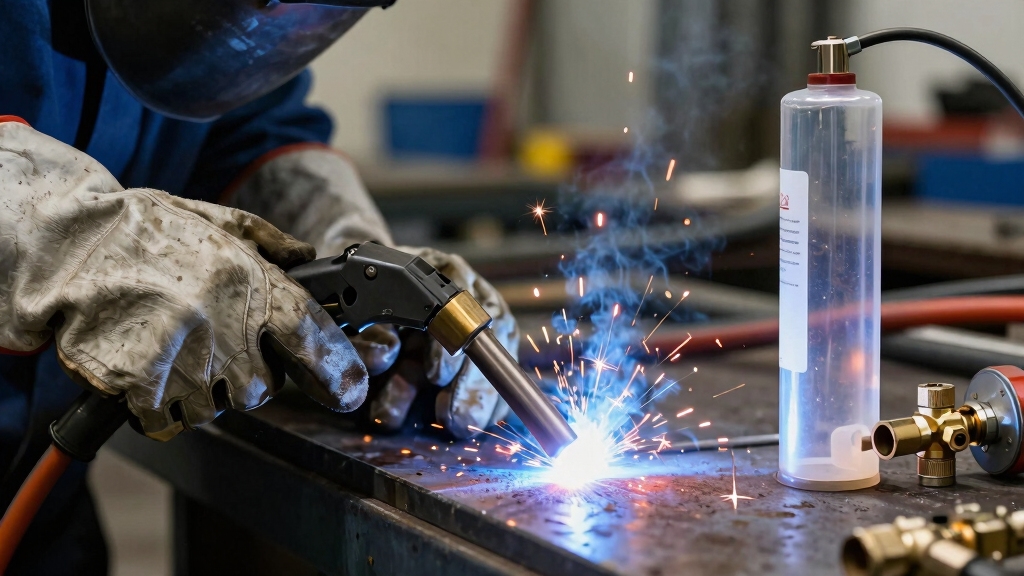
For MIG welding, you’ll mainly use argon mixed with carbon dioxide or oxygen to protect the weld pool and maintain arc stability. Pure argon offers smooth arcs but less penetration, while adding CO2 boosts penetration but may increase spatter.
Small oxygen additions improve droplet transfer, and helium mixes raise welding temperature for thicker metals. Choosing the right blend depends on your metal type and thickness, ensuring optimal weld quality.
Explore further to understand ideal gas mixes and flow rates for your project.
When you set out to choose a gas for MIG welding, you’ll typically come across several common options, each designed to optimize different welding characteristics.
Argon serves as the primary inert gas, offering low thermal conductivity and excellent arc stability, making it ideal for aluminum and stainless steel.
Carbon dioxide provides deep penetration on mild steel, though it increases spatter and creates a harsher arc. Oxygen is added in small amounts to improve arc stability and droplet transfer.
Helium produces hotter welds with mild penetration, beneficial for thicker materials but at a higher cost. Occasionally, nitrogen is used for specific applications, though less common.
Understanding these gases lets you select the right option based on your base metal and desired weld properties, ensuring efficient and quality MIG welding performance.
Argon mixed with CO2 produces a softer, more stable arc and smoother weld bead than 100% CO2, making it a popular argon/CO2 blend for balancing weld quality and consistency.
Selecting the right gas mix directly influences your MIG weld’s penetration, arc stability, and spatter levels. For instance, pure CO2 delivers deep penetration but increases spatter. Argon-rich mixes stabilize the arc with less spatter.
Helium raises weld temperature for better fusion but at higher cost. Oxygen additions improve droplet transfer, enhancing weld quality on carbon steels. Understanding these effects helps you tailor your gas choice to welding demands.
| Gas Mix Composition | Effect on Weld |
|---|---|
| 75% Argon / 25% CO2 | Balanced penetration & stability |
| 98% Argon / 2% CO2 | Smooth arc, low spatter |
| Pure CO2 | Deep penetration, high spatter |
| 95% Argon / 5% O2 | Improved droplet transfer |
| 90% Helium mix | Hotter weld, better fusion |
Small additions of CO2 or O2 to argon significantly improve arc stability and penetration when welding carbon steel.
Although choosing the right MIG welding gas depends on several factors, understanding the base metal and its thickness is essential.
Selecting the appropriate MIG welding gas starts with knowing your base metal and its thickness.
For mild steel thicker than 1/8 inch, a 75% argon and 25% CO2 mixture offers deep penetration and stable arc characteristics.
For thinner carbon steel up to 14 gauge, a 92% argon and 8% CO2 blend minimizes spatter while maintaining weld quality.
When welding aluminum, pure argon is your best choice due to its inert properties and smooth arc.
Stainless steel requires a balanced argon/CO2 mix to optimize weld strength and corrosion resistance. Helium-rich gases suit thicker sections needing higher heat input.
Always consult wire manufacturer guidelines to match gas mixtures with specific metal types and thicknesses, ensuring peak weld integrity and performance.
For aluminum thicker than 1/8 inch, using argon-helium mixtures improves heat input and weld penetration for better quality.
To dial in the best MIG welding gas mixture for your project, you need to match the gas blend with the metal type and application demands. Using the right mix guarantees penetration, arc stability, and weld quality.
For mild steel thicker than 1/8 inch, a 75% argon and 25% CO2 blend delivers balanced penetration and reduced spatter. Thin carbon steel up to 14 gauge benefits from 92% argon and 8% CO2, offering smoother arcs.
Stainless steel welds perform best with 98% argon and 2% CO2 or helium-rich mixes for deeper penetration. Aluminum requires pure argon to ensure clean, stable arcs.
Choosing the correct gas blend is essential to support the optimal polarity and transfer mode needed for each metal type and welding process.
When you set up your MIG welding system, choosing the right cylinder size and gas flow rate is essential for consistent weld quality and efficiency.
Selecting the correct cylinder size and gas flow rate ensures consistent MIG weld quality and efficiency.
Common cylinder sizes for argon or argon-based blends include 40 cf (22 inches tall), 80 cf (35 inches), and 125 cf (45 inches).
Select a size based on project scope and portability needs. For CO2, cylinders are sized by weight and require a separate regulator.
Proper gas flow rates typically range between 25 and 35 cubic feet per hour (cfh) for short-circuit MIG welding. Adjust flow rates depending on shielding needs and environmental factors like wind.
Too low flow causes porosity; too high wastes gas and causes turbulence. Always match flow rates to wire diameter and material thickness to maintain optimal arc steadiness and penetration.
Maintaining proper gas flow rates is critical to prevent contamination and ensure a stable weld pool.
When it comes to storing MIG welding gas cylinders, don’t cut corners. Always secure cylinders upright with chains or straps to prevent tipping.
Keep them in a well-ventilated, dry area away from heat sources or open flames. Store different gases separately, especially oxygen and fuel gases.
Make sure valve caps are on when not in use and label cylinders clearly. Regularly inspect for leaks or damage to keep safety front and center.
You can’t directly recycle or reuse MIG welding gases once released, as they disperse into the atmosphere during welding.
However, you can optimize gas usage by adjusting flow rates, typically 25-35 cfh, and using proper storage and handling to minimize leaks.
Closed-loop recovery systems exist but are rare and costly. For efficiency, focus on preventing waste rather than gas recycling. Ensure you select the right mixture and cylinder size for your project.
You should know MIG welding gases like argon and CO2 have differing environmental impacts. Argon is inert and non-toxic but requires energy-intensive extraction.
CO2, while cheap, contributes to greenhouse gas emissions if released in large amounts. Helium is rare and costly to extract.
To minimize your environmental footprint, focus on efficient gas usage, proper storage to avoid leaks, and recycling when possible. This reduces waste and emissions during welding operations.
Think of your MIG welding gas like a chameleon reacting to heat. Temperature shifts influence its flow and shielding ability.
As temperatures rise, gas density decreases, causing flow rates to increase if unadjusted. This can lead to turbulence and contamination. Conversely, cold reduces flow, risking poor arc stability.
You’ll need to recalibrate flow rates accordingly, ensuring ideal shielding gas coverage for consistent weld quality despite temperature swings. Monitoring is key to precision welding.
Yes, breathing MIG welding gases can pose health risks. Argon and helium are inert and generally safe but displace oxygen, causing asphyxiation in confined spaces.
Carbon dioxide can cause dizziness and headaches at high concentrations. Oxygen additives improve arc stability but increase fire risk.
Prolonged exposure to welding fumes, including metal particulates, can lead to respiratory issues. Always ensure proper ventilation and use appropriate respiratory protection when welding.
Choosing the correct gas for MIG welding sharpens your skill and strengthens your steel. Whether you select pure argon for aluminum or a CO2 blend for carbon steel, your choice changes the characteristics of your weld, from penetration to spatter control.
By balancing blends and adjusting flow rates, you’ll achieve consistent, clean, and controlled cuts every time. Mastering gas mixtures means maximizing metal mastery and making every weld work with precision and power.