Phone:
(701)814-6992
Physical address:
6296 Donnelly Plaza
Ratkeville, Bahamas.

Phone:
(701)814-6992
Physical address:
6296 Donnelly Plaza
Ratkeville, Bahamas.

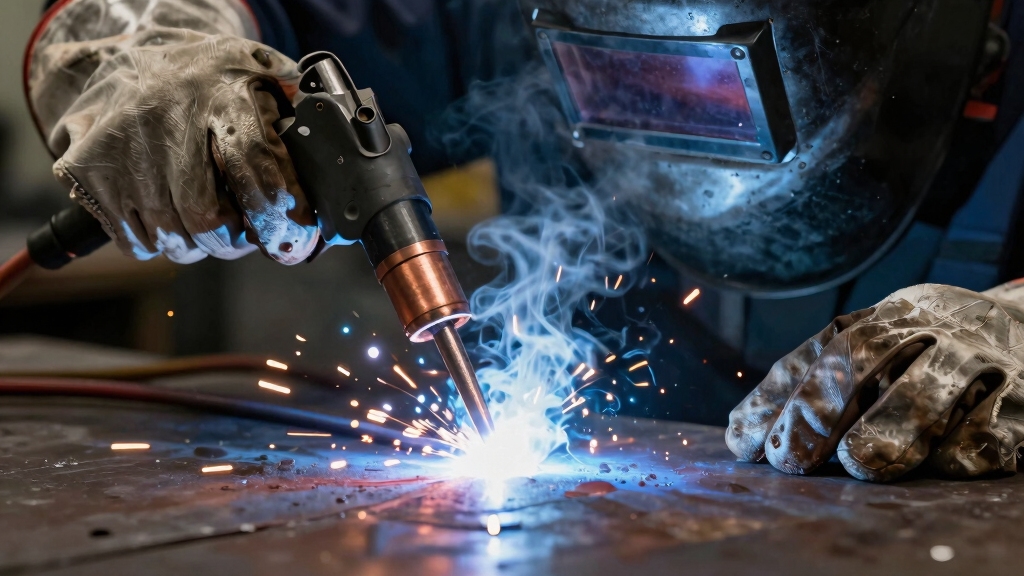
For MIG welding with solid wire, you’ll want to use Direct Current Electrode Positive (DCEP) polarity because it directs most heat to the workpiece.
This ensures deep penetration and a stable arc. This polarity promotes smooth wire melting and consistent metal transfer, reducing spatter and defects.
Using DC Electrode Negative (DCEN) can cause unstable arcs and shallow fusion, which is generally undesirable.
Understanding polarity’s impact on heat distribution and transfer will help you optimize your welds and avoid common issues.
Polarity in MIG welding refers to the direction of electrical current flow between the welding electrode and the workpiece.
Polarity in MIG welding defines the current flow direction between the electrode and the workpiece.
This directly affects arc stability, heat distribution, and weld quality.
You control polarity by connecting the electrode and workpiece to either the positive or negative terminal of the power source.
In MIG, polarity determines how heat concentrates and how the molten metal transfers.
Electrode positive polarity directs more heat to the workpiece, promoting deeper penetration and stable arc characteristics.
Conversely, reversing polarity affects wire melting and can destabilize the arc.
Understanding polarity’s role helps you optimize weld bead formation, minimize spatter, and ensure consistent deposition.
You must select polarity based on the wire type and desired weld attributes, as improper polarity compromises weld integrity and efficiency.
Adjusting polarity and welding parameters is especially important when using different shielding gases like 100% argon.
When you set up your MIG welding machine, choosing Direct Current Electrode Positive (DCEP) guarantees ideal heat distribution by directing roughly two-thirds of the heat to the workpiece.
This polarity enables deep penetration, essential for strong welds, by concentrating heat where it’s most needed. DCEP also promotes stable spray transfer, reducing spatter and enhancing bead appearance.
The electrode connects to the positive terminal, causing the wire to melt consistently and transfer droplets smoothly. This results in a controlled arc and uniform deposition, critical for high-quality welds.
Additionally, DCEP reduces inclusion defects and balances heat input, making it the preferred polarity for gas-shielded MIG welding with solid wire.
Using DCEN polarity directs more heat to the electrode, which is generally less effective for penetration in MIG welding compared to DCEP.
If you decide to use DCEN in MIG welding, you’re likely going to run into some issues. First off, you’ll notice significant arc instability. This instability can really mess with the metal transfer, making it hard to maintain a consistent weld.
The reason behind this is that DCEN shifts the heat away from the workpiece. This can lead to poor penetration in your welds, which is definitely not what you want. Plus, it can create increased spatter, making cleanup a real hassle.
As a result, the overall quality of your welds will take a hit. You might end up with weak and inconsistent joints, which aren’t suitable for most applications. So, it’s best to stick with the proper polarity to ensure your welding goes smoothly! Using DCEN polarity helps achieve deeper penetration and reduce electrode wear in specific scenarios, but it is generally not preferred for MIG welding stainless steel.
Using DCEN in MIG welding disrupts arc stability and compromises weld quality significantly.
When you connect the electrode negative, the molten metal transfer shifts from spray to globular mode, causing erratic droplet detachment.
This instability increases spatter and results in an inconsistent arc length, making it challenging to maintain a smooth and controlled weld pool.
The reduced heat concentration at the workpiece diminishes penetration, further destabilizing the arc.
You’ll notice frequent arc interruptions and difficulty sustaining a steady arc voltage.
Additionally, the electromagnetic forces change, influencing metal transfer dynamics unfavorably.
These factors collectively degrade arc stability, increase operator fatigue, and lead to unpredictable weld bead formation.
Therefore, employing DCEN in MIG welding is impractical and undermines the process’s inherent advantages.
Always use DCEP for reliable, stable arcs.
Furthermore, selecting the correct torch angle is crucial to optimize gas shielding and bead quality in MIG welding.
Poor weld quality directly results from employing DCEN in MIG welding, as the altered polarity disrupts metal transfer consistency and heat distribution. When you use DCEN, the arc becomes unstable, causing erratic droplet transfer and uneven bead formation.
Additionally, the heat shifts more toward the electrode, reducing penetration depth and weakening the weld joint.
Here are three specific consequences you’ll encounter with DCEN in MIG welding:
In short, DCEN compromises weld integrity and appearance, making it unsuitable for gas-shielded MIG welding applications. Proper control of heat input is critical in MIG welding to avoid defects and ensure weld quality.
When you use DCEP polarity in MIG welding, you’ll notice that around two-thirds of the heat actually concentrates at the workpiece. This is great because it really enhances penetration depth. With this heat distribution, you get a stable arc and deep fusion with the base metal, which is exactly what you want for a solid weld.
On the flip side, when you’re using DCEN polarity, the situation changes quite a bit. Most of the heat gets focused on the electrode instead, which doesn’t help with penetration at all. In fact, it can actually reduce penetration and negatively impact the overall quality of the weld.
So, it’s pretty clear that choosing the right polarity can make a big difference in your welding results! Using argon as a shielding gas helps maintain arc stability and consistent heat input, which further optimizes penetration depth.
Heat concentration plays a crucial role in determining weld penetration and overall quality in MIG welding. When you use DCEP polarity, about two-thirds of the heat focuses on the workpiece. This enables deep penetration and a stable arc.
This heat distribution optimizes fusion without excessive wire melting. Conversely, DCEN polarity directs more heat to the electrode. This causes rapid wire melting but less workpiece penetration, which can lead to inconsistent welds.
Consider these key aspects of heat concentration effects:
Understanding these effects helps you select the right polarity for your welding objectives. Proper heat management is especially critical when welding alloys like chromoly steel to prevent brittleness and cracking.
Although polarity choice might seem straightforward, it critically influences how heat distributes during MIG welding. This directly affects penetration depth and weld quality.
When you use DCEP (electrode positive), about two-thirds of the heat concentrates at the workpiece. This promotes deep penetration essential for strong welds on thick materials. This polarity stabilizes the arc and guarantees consistent metal transfer.
Conversely, DCEN (electrode negative) directs more heat to the wire. This causes rapid melting but shallow penetration, which compromises weld integrity and is generally unsuitable for MIG.
Using DCEP helps you balance deposition rate and heat input, reducing defects like inclusions. Understanding these penetration differences allows you to select the appropriate polarity for your application, assuring peak weld strength and appearance.
DCEP is preferred in MIG welding because it provides deep penetration and stable arc characteristics necessary for quality welds on ferrous metals.
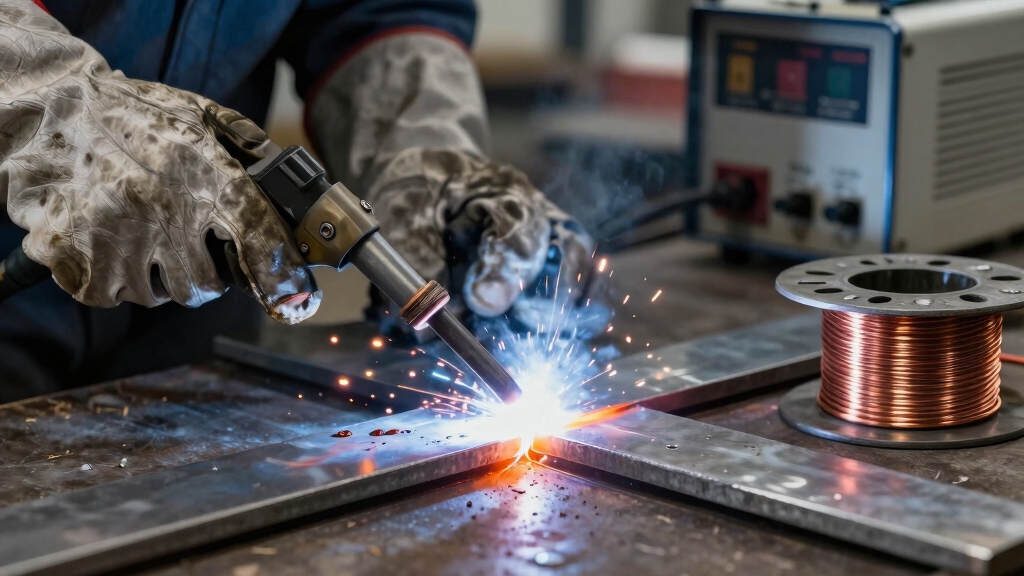
Choosing the right polarity for different wire types in MIG welding directly impacts weld quality and efficiency.
You primarily use DCEP (Direct Current Electrode Positive) with solid wires in gas-shielded MIG welding. This ensures deep penetration, stable arc, and minimal spatter.
For flux-cored wires, however, DCEN (Direct Current Electrode Negative) is standard. This promotes consistent droplet transfer despite a less stable arc.
Here’s a quick guide:
Selecting proper polarity prevents defects and maximizes weld integrity. Proper polarity selection also helps control heat input, which is critical for avoiding defects and ensuring structural integrity.
While DCEP remains the standard for most MIG welding with solid wires, there are specific scenarios involving thin metals where using reverse polarity (DCEN) can be advantageous.
When welding thin gauge materials, DCEN concentrates more heat at the wire, promoting faster melting and reducing overall heat input to the base metal. This helps minimize burn-through and warping, which are common risks with thin metals.
You’ll find reverse polarity useful for rapid deposition rates on delicate sheets, especially when precise control over heat input is critical. However, keep in mind DCEN’s tendency toward globular transfer can reduce arc stability.
It’s best reserved for specialized applications or when using wires designed for that polarity. Always consult your machine and wire specifications before switching to reverse polarity on thin metals.
In aluminum MIG welding, DCEN polarity is often used with helium-argon blends to achieve deeper penetration and improved weld quality on thicker sections.
You’ll notice that using DCEP polarity really promotes a stable spray transfer, right? It leads to minimal spatter because of the controlled droplet detachment.
On the other hand, when you switch to DCEN, things can change quite a bit. You often end up with globular transfer, which tends to increase spatter and reduces arc consistency.
Understanding polarity’s impact on metal transfer is essential for optimizing weld quality and minimizing spatter in MIG welding.
Choosing DCEP (Direct Current Electrode Positive) concentrates heat at the workpiece, stabilizing the arc and enabling smooth spray transfer. This results in consistent droplet detachment and minimal spatter.
Conversely, DCEN (Direct Current Electrode Negative) intensifies wire melting but produces erratic globular transfer, increasing spatter and reducing weld integrity.
Focus on these key effects:
You must match polarity to wire and material for optimal transfer characteristics.
Spatter levels consistently depend on the selected polarity in MIG welding, as it directly affects metal transfer stability and droplet formation.
Using DCEP (Direct Current Electrode Positive) promotes spray transfer, producing fine, consistent droplets that minimize spatter and guarantee a stable arc.
This polarity concentrates heat at the workpiece, allowing deep penetration with low spatter levels.
Conversely, DCEN (Direct Current Electrode Negative) encourages globular transfer, causing larger, irregular droplets that increase spatter and reduce weld quality.
You’ll notice inconsistent arc behavior and excessive spatter with DCEN, making it unsuitable for most MIG applications.
Consequently, selecting DCEP polarity is critical to achieving controlled metal transfer, minimizing spatter, and securing superior weld bead appearance and structural integrity in standard MIG welding processes.
Before starting your MIG welding project, make sure your machine’s polarity is correctly set to DCEP. This polarity is crucial for achieving peak arc stability and penetration with solid wire.
Setting and verifying polarity involves a few precise steps:
Following these steps guarantees proper heat distribution and stable metal transfer. This optimizes weld quality and minimizes spatter during your MIG welding process.
When you set the wrong polarity on your MIG welder, you’ll quickly notice poor arc stability and excessive spatter that degrade weld quality.
A common mistake is using DCEN instead of the standard DCEP for gas-shielded MIG with solid wire.
DCEN causes inconsistent globular transfer, resulting in weak penetration and irregular bead appearance.
To avoid this, always verify that the electrode connects to the positive terminal and the workpiece to the negative.
Check your polarity switch matches the wire type before welding.
Additionally, improper travel angle can exacerbate polarity issues; maintain a 5-15 degree angle to optimize DCEP performance.
Although MIG welding polarity is generally standardized to DCEP, the specific material you’re working with and the application requirements greatly influence the best polarity choice.
Understanding these factors guarantees peak weld quality and efficiency.
Tailoring polarity to these parameters maximizes weld performance and minimizes defects.
Always consult your machine and wire specifications before adjusting polarity.
Yes, polarity settings directly affect your MIG welding speed.
Using DCEP (Direct Current Electrode Positive) provides deep penetration and stable spray transfer, optimizing welding speed for most applications.
Conversely, DCEN (Direct Current Electrode Negative) concentrates heat on the electrode, melting wire faster and increasing speed on thin materials but sacrificing consistency.
Polarity directly influences your wire feed speed adjustments because DCEP concentrates heat on the workpiece. This allows you to maintain moderate feed speeds with stable arc and penetration.
If you switch to DCEN, which melts the wire more intensely, you’ll need to reduce wire feed speed to avoid excessive spatter and poor bead quality.
You generally don’t need to change polarity for MIG welding aluminum; it still uses DCEP (Direct Current Electrode Positive) to ensure stable arc and deep penetration.
However, aluminum often requires AC polarity in TIG welding, not MIG. Focus instead on using the right shielding gas, wire type, and proper parameters.
Polarity shifts aren’t necessary in MIG aluminum welding, but always confirm machine settings match your wire and material for optimal results.
Think of polarity and shielding gas as dance partners; you can’t have one lead without affecting the other.
Yes, polarity influences your shielding gas choice in MIG welding.
Using DCEP, you typically pair with inert gases like argon or argon mixes for stable arcs and deep penetration.
If you shift polarity, say to DCEN for flux-cored wire, you’ll rely on CO2-rich gases that support different transfer modes and weld characteristics.
Incorrect polarity itself typically won’t damage your MIG welding machine, but it can cause unstable arcs and excessive spatter. This can potentially stress internal components over time.
The machine’s electronics and wire feed operate best under correct polarity settings, usually DCEP for MIG.
Using DCEN may lead to poor weld quality and increased wear.
Always verify polarity matches your wire and process to maintain peak machine performance and avoid long-term damage.
Choosing the right polarity in MIG welding isn’t just a switch; it’s the conductor’s baton directing the weld’s strength and quality.
By mastering DCEP and understanding when DCEN fits, you control heat, penetration, and metal transfer with surgical precision.
Picture your welder as a finely tuned instrument; set it right, and every bead flows smoothly, minimizing spatter and defects.
Get polarity wrong, and your weld becomes a discordant note, compromising the entire structure.