Phone:
(701)814-6992
Physical address:
6296 Donnelly Plaza
Ratkeville, Bahamas.

Phone:
(701)814-6992
Physical address:
6296 Donnelly Plaza
Ratkeville, Bahamas.

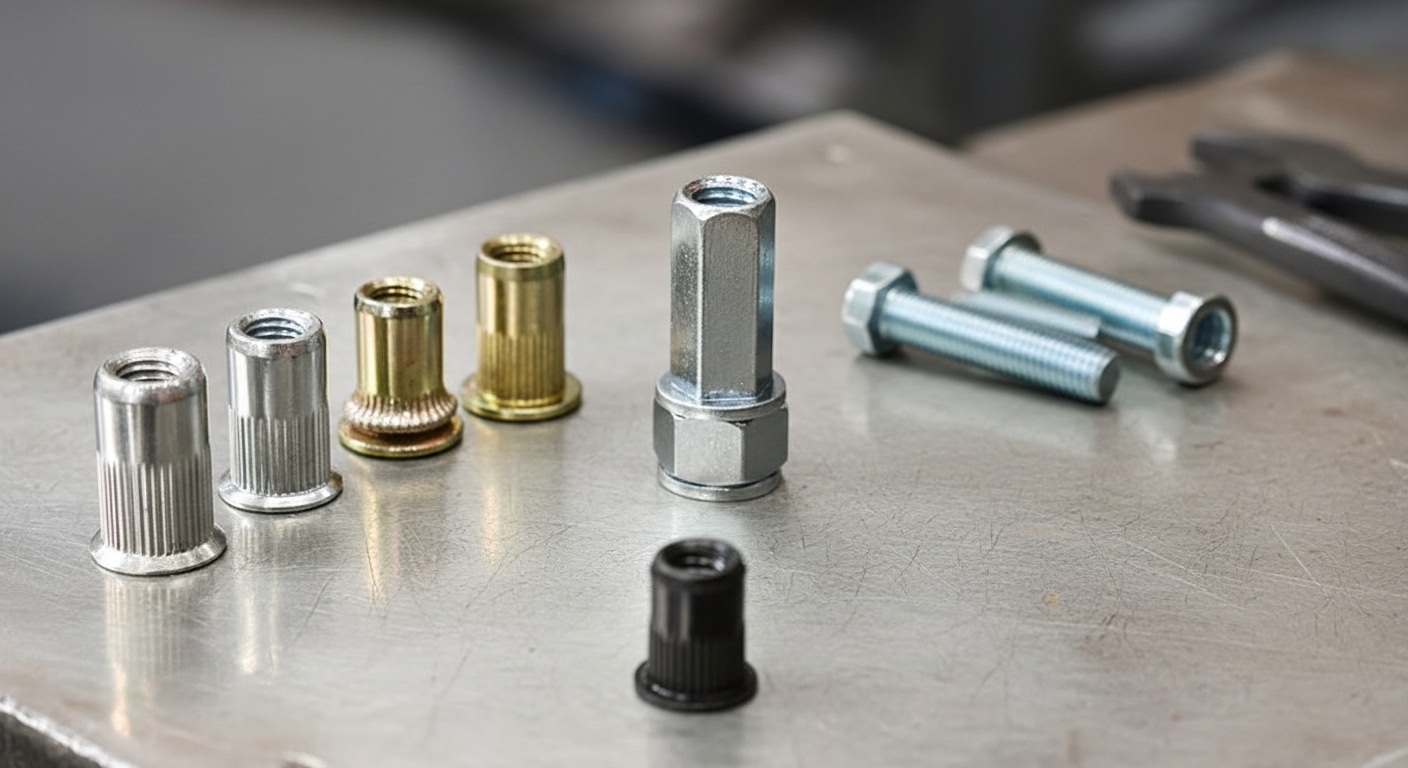
Rivet nut strength depends on size, material, and installation quality. Smaller sizes like M4 handle about 290 lbs tensile load, while larger ones like M10 support up to 600 lbs.
Stainless steel offers superior tensile, shear, and thread strength compared to steel or aluminum, which trades load capacity for lightness. Proper torque and flange support are vital to prevent failures like spin-out or thread stripping.
Understanding these factors guarantees you select the right rivet nut for your application’s load demands and durability needs.
Understanding the tensile strength of rivet nuts by size is essential when selecting the right fastener for your application.
Steel rivet nuts exhibit a clear correlation between size and tensile capacity. For example, an 8-32 (M4) rivet nut withstands pull strengths up to 290 lbs, while a 3/8″ (M10) size supports up to 600 lbs.
This incremental increase highlights how diameter influences load capacity. You’ll notice that midsize options like 1/4″ (M6) and 5/16″ (M8) provide tensile strengths of 490 lbs and 520 lbs, respectively.
When evaluating these fasteners, consider the specific load requirements of your assembly to make certain the selected rivet nut size delivers adequate tensile resistance.
This prevents joint failure under applied forces.
This data-driven approach optimizes durability and safety in fastening solutions.
When it comes to rivet nuts, you’ll notice that stainless steel rivet nuts really stand out. They consistently outperform both steel and aluminum in terms of tensile, shear, and thread strength ratings, no matter the size. Pretty impressive, right?
Now, steel does have its perks too. It offers balanced strength that’s suitable for most applications, making it a reliable choice.
On the other hand, if you’re looking for something lighter, aluminum might catch your eye. However, keep in mind that it does come with a reduced load capacity.
For applications requiring enhanced durability and corrosion resistance, understanding the effects of material composition is crucial.
Although steel rivet nuts offer moderate tensile strength suitable for many applications, stainless steel variants outperform both steel and aluminum in ultimate tensile capacity.
When selecting rivet nuts, you should consider these key points:
Understanding these differences helps you optimize material choice based on load requirements and application environment.
This ensures structural integrity and long-term reliability.
Choosing the appropriate joining method, such as rivet nuts versus welding, depends on factors including joint design and structural demands.
Beyond tensile strength, shear strength plays a pivotal role in evaluating rivet nut performance under lateral forces.
When you select a rivet nut, understanding material-specific shear capacities is essential.
Steel rivet nuts offer substantial shear resistance, making them suitable for most applications involving horizontal loads.
Aluminum variants provide lower shear strength, limiting their use in high-stress lateral environments.
Stainless steel rivet nuts outperform both, delivering superior shear resistance due to their enhanced material properties.
As rivet nut size increases, shear strength rises proportionally across all materials, with steel M12 sizes exceeding 22,000 lbs.
You must factor in these material differences when designing joints subject to shear, ensuring optimal load distribution and joint integrity.
Precise material selection helps you avoid premature failure under shear stress.
Controlling heat input during welding or joining processes can significantly influence the strength and durability of metal assemblies under shear loads.
When evaluating rivet nut performance, thread strength ratings vary markedly with material composition, directly affecting load capacity before thread stripping occurs.
You’ll find that stainless steel rivet nuts provide the highest thread strength, often reaching up to 17,250 lbs, making them ideal for heavy-duty applications.
Steel rivet nuts offer moderate to high thread strength, typically ranging between 6,400 and 17,250 lbs depending on size.
Aluminum rivet nuts, while lighter, demonstrate considerably lower thread strength and are better suited for less demanding uses.
Consider these distinctions:
Selecting the right material guarantees peak thread retention and prevents premature stripping in your assembly. Proper surface preparation is also essential to ensure optimal joint strength and corrosion resistance in assemblies using rivet nuts.
Since thread strength directly influences the load capacity before internal threads strip, understanding its impact on rivet nut durability is essential.
You need to select rivet nuts with appropriate thread strength ratings to guarantee longevity under load.
Steel and stainless steel rivet nuts provide superior thread strength compared to aluminum, reducing the risk of thread failure during torque application or cyclic loading.
Larger diameters inherently offer higher thread strength, which translates to improved durability in demanding applications.
Additionally, proper installation torque based on thread strength specifications prevents premature stripping and maintains joint integrity.
Ensuring proper surface preparation and corrosion-resistant coatings can further enhance the long-term performance of rivet nuts by preventing corrosion-related failures.
Shear strength is basically how well a rivet nut can handle forces that push against it from the side, which is super important when you’re dealing with lateral loads.
When you’re choosing a rivet nut, you’ll notice that the material really plays a big role in its performance. For example, stainless steel rivet nuts are the top performers here—they beat out both steel and aluminum options by providing better resistance.
So, understanding these material differences isn’t just a nice-to-know—it’s crucial for picking the right rivet nut.
This way, you can ensure that your joint stays strong and intact, even when it’s under shear stress.
Using the appropriate protective gear, including hand safety, when working with rivet nuts can help prevent injuries from sharp edges and improve handling during installation.
Understanding the lateral force resistance of rivet nuts is crucial for ensuring reliable joint performance in applications subject to horizontal loads.
Shear strength measures a rivet nut’s ability to withstand forces acting parallel to the installed surface, preventing joint failure or displacement.
When evaluating shear strength, consider these key aspects:
In addition, managing heat input and precise control during installation is critical to avoid material distortion that could weaken the rivet nut’s performance under shear loads, as emphasized in heat input management.
Material composition fundamentally influences the ability of rivet nuts to resist lateral forces without deformation or failure.
When you select a rivet nut, understanding how aluminum, steel, and stainless steel perform under shear stress is essential.
Aluminum rivet nuts exhibit lower shear strength, limiting their use in high lateral load scenarios.
Steel rivet nuts provide substantial shear resistance, suitable for most applications where moderate lateral forces occur.
Stainless steel rivet nuts outperform others, delivering superior shear strength, especially in larger sizes like M12, where shear capacities exceed 22,000 lbs.
This material advantage becomes critical when your assembly undergoes horizontal loading, as insufficient shear resistance can cause joint failure.
Matching material choice to shear requirements guarantees structural integrity and prolongs service life under operational stresses.
High-strength aluminum alloys can improve shear resistance but generally do not match steel or stainless steel without specialized heat treatment processes.
Applying the correct installation torque markedly influences rivet nut performance by guaranteeing peak joint integrity and preventing premature failure modes such as spin-out or thread stripping.
When you apply torque within specified limits, you maximize load capacity without compromising the rivet nut or base material interface.
Keep these key points in mind:
Accurate torque application based on material and size specifications safeguards structural integrity under load.
Similar to minimum tensile strength requirements in welding electrodes, adhering to torque specifications ensures mechanical reliability and prevents failure.
When installing rivet nuts, providing proper flange support directly influences their strength limits by stabilizing the joint and distributing load more evenly.
Without adequate flange backing, the rivet nut can deform or spin under load, reducing tensile and shear capacity.
Flange support enhances torque tolerance by preventing rotation within the base material. This allows you to apply assembly torque closer to the rivet nut’s proof load without risking spin-out failure.
This support also improves load transfer, minimizing stress concentrations around the joint and increasing fatigue resistance.
Proper flange design, such as using a hardened washer or thicker base material, ensures the rivet nut maintains structural integrity under operational stresses.
Ultimately, flange support is critical for achieving maximum rated strength and reliable, repeatable performance in rivet nut applications.
Selecting the correct drill size is essential for optimal thread engagement, typically aiming for around 75% thread engagement to balance strength and ease of assembly.
Proper flange support not only maximizes rivet nut strength but also influences how failures manifest under load.
When you install a rivet nut, understanding the difference between spin-out and thread stripping is critical for reliability.
Spin-out occurs when the rivet nut loses its crimp grip and rotates within the base material.
Thread stripping happens when internal threads shear under excessive torque or tensile load.
You should focus on these key points:
Although selecting a rivet nut might seem straightforward, choosing the right one requires careful analysis of your load requirements, material properties, and installation conditions.
You need to evaluate tensile, shear, and thread strengths relative to the application’s force vectors. Material choice, such as aluminum, steel, or stainless steel, directly influences ultimate strength and durability.
Size selection must align with expected loads to prevent failures like spin-out or thread stripping.
| Size (Imperial/Metric) | Material | Typical Tensile Strength (lbs) |
|---|---|---|
| 8-32 / M4 | Steel | 290 |
| 1/4″ / M6 | Stainless Steel | 490 |
| 3/8″ / M10 | Aluminum | 600 |
| 5/16″ / M8 | Steel | 520 |
Match your rivet nut specs to load demands precisely for peak performance.
Selecting the right rivet nut based on load requirements sets the foundation, but verifying its strength and reliability requires rigorous testing methods.
You’ll want to focus on three primary tests to guarantee performance under operational stresses:
You generally shouldn’t reuse rivet nuts after removal because their crimped flange and internal threads can deform or weaken during extraction.
This compromises their load-bearing capacity and torque specifications, risking spin-out or thread stripping upon reinstalling.
For reliable performance and safety, replace rivet nuts with new ones that meet required tensile and shear strengths.
Reusing them can lead to joint failure under operational stresses, so avoid it in critical applications.
You should use a dedicated rivet nut installation tool or rivet nut setter for precise, controlled installation.
These tools apply consistent torque and pull force, ensuring proper flange deformation without spin-out or thread stripping.
For larger sizes or high-volume work, pneumatic or hydraulic rivet nut tools deliver repeatable results.
Manual hand tools suit smaller diameters and occasional use but require careful torque application to avoid installation failures.
Always match tool specifications to rivet nut size and material.
When it comes to rivet nuts, you know every cloud has a silver lining. Environmental factors can make or break their performance.
Corrosion from moisture weakens steel and aluminum nuts, reducing tensile and shear strength. Temperature swings cause material expansion or contraction, impacting torque retention.
UV exposure degrades coatings, leading to premature failure. You must select materials like stainless steel for harsh conditions and ensure proper sealing to keep rivet nuts reliable under stress.
Yes, rivet nuts are compatible with plastic or composite materials, but you need to take into account material thickness and strength.
Since plastics and composites often have lower tensile strength and can deform under load, choose rivet nuts with appropriate flange sizes and materials to prevent pull-through or spin-out.
Using steel or stainless steel rivet nuts with proper installation torque guarantees secure fastening without damaging the substrate.
Always validate performance with testing for your specific application.
You’ll find rivet nuts extensively used in automotive industries for fastening components in tight spaces where access is limited.
They’re ideal for attaching interior panels, engine parts, and electrical assemblies, providing reliable thread strength and shear resistance.
Their ability to be installed from one side makes them perfect for lightweight materials and composite panels common in vehicles.
You can count on rivet nuts for durable, vibration-resistant joints essential in automotive manufacturing.
When selecting rivet nuts, you hold the key to structural integrity in your hands. Understanding tensile and shear strengths, material properties, and installation torque lets you avoid common failures like spin-out or thread stripping.
Think of rivet nuts as the unsung anchors of your assembly; their durability hinges on precise matching to load demands and flange support. By mastering these factors, you make certain your fastening solution won’t just hold—it will stand the test of stress and time.