Phone:
(701)814-6992
Physical address:
6296 Donnelly Plaza
Ratkeville, Bahamas.

Phone:
(701)814-6992
Physical address:
6296 Donnelly Plaza
Ratkeville, Bahamas.

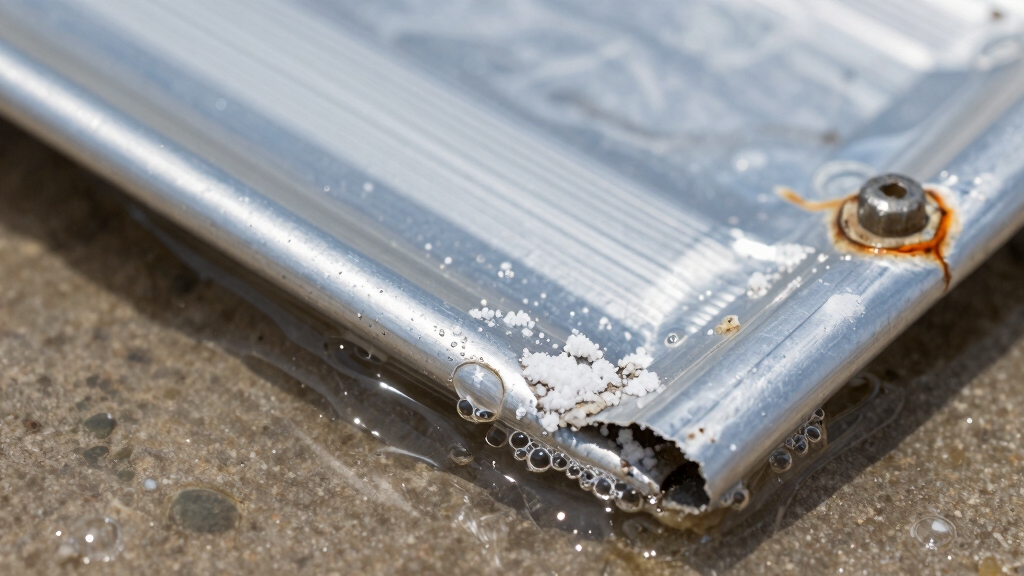
Yes, aluminum does corrode in saltwater, primarily due to chloride ions that penetrate and disrupt its protective oxide layer, causing localized pitting corrosion.
While the thin oxide film usually prevents uniform corrosion at seawater’s near-neutral pH, chloride-induced pits act as anodic sites, undermining structural integrity.
Galvanic effects with nobler metals and contaminants like copper ions can accelerate corrosion.
Understanding these mechanisms and effective mitigation strategies will help you manage aluminum’s durability in marine environments.
Although aluminum naturally forms a stable oxide layer that protects it in many environments, this passive film doesn’t fully prevent corrosion in saltwater. Chloride ions in seawater penetrate and disrupt this oxide barrier, initiating localized breakdowns.
You’ll notice pitting corrosion primarily occurs in neutral pH conditions like seawater’s 8-8.2 range. Once pits form, their depth growth slows as insoluble hydrated alumina adheres inside, inhibiting further ion exchange.
Uniform corrosion also proceeds, driven by chemical dissolution that remains consistent over time and increases with flow rate. You should consider that flow reduces pitting severity but simultaneously raises uniform corrosion rates.
Therefore, the complex interaction between chloride attack, oxide film disruption, and hydrodynamic conditions explains why aluminum corrodes in saltwater despite its passive oxide layer. Proper cleaning and applying protective coatings can help restore and maintain the oxide barrier to reduce corrosion damage.
Did you know that chloride ions in seawater can be pretty aggressive when it comes to aluminum? They actually work to break down the aluminum oxide layer, which is supposed to protect the metal. Once that barrier is breached, localized corrosion can start to happen.
Now, seawater usually has a stable pH range of about 8 to 8.2, which is great for keeping that oxide layer intact. But when chlorides come into play, they can throw that balance off, leading to the formation of pits on the aluminum surface. Regular maintenance and cleaning using near-neutral pH cleaners can help preserve the protective oxide layer and reduce corrosion risks.
When chlorides infiltrate seawater, they aggressively target the protective aluminum oxide layer, disrupting its stability and initiating corrosion.
You’ll find that chloride ions penetrate this passive film, weakening its adherence and creating localized breaches.
These breaches act as initiation sites for pitting corrosion, particularly in the neutral pH range of seawater (8-8.2), where the oxide is normally stable.
Once penetrated, chlorides destabilize the oxide’s integrity, allowing aluminum dissolution beneath the film.
However, hydrated alumina forms inside pits, slowing depth progression by limiting ion exchange.
Despite this, continuous chloride presence perpetuates damage, undermining oxide regeneration.
The dynamic interaction between chloride ions and oxide layers fundamentally governs the corrosion susceptibility of aluminum in marine environments.
This mandates careful consideration of chloride concentration and exposure duration to predict and mitigate corrosion risks.
Plasma cutting aluminum requires precise control of heat input and the use of appropriate gases to minimize thermal distortion and preserve corrosion resistance.
Since seawater maintains a relatively stable pH between 8 and 8.2, it supports the persistence of aluminum’s protective oxide layer, which remains passive within this range.
This narrow pH window prevents dissolution of the stable aluminum oxide film, maintaining its barrier function against aggressive ions like chlorides.
However, localized pH variations develop during corrosion; acidic conditions form inside pits, accelerating metal dissolution, while alkaline environments near cathodic sites promote oxide stability.
You must consider that beyond this stable pH zone, the oxide becomes amphoteric and can dissolve, undermining protection.
Consequently, seawater’s pH stability plays a critical role in limiting uniform corrosion rates and modulating pitting initiation.
Although chloride penetration and flow dynamics still influence overall corrosion behavior under marine conditions.
Additionally, the corrosion resistance of aluminum alloys can vary significantly depending on their alloy composition and treatment, impacting their performance in saltwater environments.
Pitting corrosion stands out as the most significant challenge you’ll face with aluminum alloys in saltwater environments.
It occurs when chlorides penetrate and disrupt the protective aluminum oxide layer, initiating localized breakdowns. These small pits act as anodic sites where aluminum dissolves into ions, while the surrounding surface remains passive.
Although pit growth slows due to insoluble hydrated alumina deposits, these pits can penetrate deeply, compromising structural integrity.
You must recognize that pitting is insidious because it’s highly localized and difficult to detect early. Its criticality lies in the fact that even minor breaches lead to accelerated degradation under neutral pH seawater conditions.
Managing pitting means understanding chloride interactions and maintaining oxide integrity to prevent severe, hidden damage to aluminum components in marine settings.
Effective corrosion control also requires post-weld corrosion protection to restore and maintain the protective barrier after any metal surface disturbance.
Understanding localized corrosion like pitting highlights the vulnerability of aluminum alloys in seawater. However, another significant threat arises from interactions with dissimilar metals. When aluminum contacts metals like steel, galvanic corrosion accelerates, with aluminum acting as the anode and sacrificially oxidizing.
This process requires a potential difference exceeding 100 mV and is intensified by trace copper ions depositing on aluminum surfaces.
| Factor | Aluminum Role | Effect |
|---|---|---|
| Metal Coupling | Anode | Accelerated oxidation |
| Electrolyte | Seawater | Ionic conduction |
| Trace Metals (Cu2+) | Catalyst | Localized attack intensifies |
You must avoid coupling aluminum with nobler metals to prevent rapid material loss driven by galvanic reactions in marine environments. Proper corrosion protection and maintenance practices are essential to mitigate these effects and prolong aluminum service life.
Although aluminum benefits from a stable oxide layer in seawater, the presence of flow markedly alters its corrosion behavior.
Flow increases the uniform corrosion rate by enhancing chemical dissolution, evident as a consistent rise in corrosion with flow velocity on log-log plots.
This effect stems from localized pH variations, acidification within pits and alkalinity near cathodic sites, maintaining steady uniform corrosion rates over time.
Conversely, flow tends to reduce pitting severity because it disrupts chloride ion accumulation and removes corrosion products.
However, the trade-off is a higher overall metal loss due to accelerated uniform corrosion.
When designing for marine applications, you must consider flow conditions carefully. Elevated seawater velocities will shift the corrosion regime from localized pitting towards more uniform but intensified material degradation.
Proper surface preparation and coating application are essential to mitigate corrosion risks in harsh environments, especially where mechanical damage or coating breaches can occur, exposing the underlying metal to seawater coating failure modes.
When aluminum is exposed to seawater, it quickly forms a thin, stable oxide layer that acts as a passive barrier against corrosion. This aluminum oxide, stable within seawater’s pH range of 8 to 8.2, prevents direct metal-electrolyte contact, limiting electrochemical reactions.
You’ll find this layer resists dissolution except when chlorides penetrate and locally disrupt it, initiating pitting corrosion. However, the oxide’s hydration products, primarily Al(OH)3, accumulate inside pits, slowing further degradation by impeding ionic exchange.
The oxide layer’s persistence depends on maintaining near-neutral pH and absence of aggressive ions like Cu2+ that can breach passivity. Understanding this protective film’s role clarifies why aluminum resists uniform corrosion in seawater but remains vulnerable to localized breakdown where the oxide is compromised.
Similar to how galvanized steel requires mechanical profiling to maintain coating adhesion, aluminum’s protective oxide must remain intact to prevent localized corrosion and sustain its durability in marine environments.
To effectively prevent aluminium corrosion in saltwater, it’s important to think about using alloying elements like magnesium and manganese. These elements help to enhance the stability of the oxide layer and improve intermetallic passivity. By doing this, you can create a more resilient surface that’s better equipped to handle the harsh marine environment.
Now, let’s talk about specialized coatings. Applying these can really make a difference by inhibiting chloride penetration. This means that the aluminium is less likely to corrode due to exposure to saltwater.
Another thing to keep in mind is galvanic corrosion. To control this, it’s crucial to avoid direct contact with nobler metals. Managing potential differences is also key in this scenario. By taking these steps, you can effectively minimize both localized and uniform corrosion mechanisms that often occur in marine environments. So, with the right strategies in place, you can keep your aluminium components in top shape for longer!
Additionally, ensuring surface cleanliness before coating application is essential to maximize corrosion resistance and coating adhesion.
Enhancing aluminum alloys with elements like magnesium and manganese markedly improves their resistance to corrosion in saltwater environments by stabilizing the passive oxide layer and modifying intermetallic phases.
You’ll find that magnesium increases the matrix’s passivity, while manganese refines intermetallic particles, reducing sites vulnerable to pitting. Beyond alloying, applying conversion coatings can further suppress corrosion by forming a protective barrier that impedes chloride ion ingress.
Although chromate coatings have proven effective historically, their environmental toxicity has limited use, pushing you toward alternative non-toxic coatings. These coatings must adhere well and maintain integrity under dynamic marine conditions to prevent localized breakdown.
It is crucial to recognize that the presence of chloride ions in saltwater environments significantly accelerates pitting corrosion by disrupting the passive oxide layer on aluminum surfaces.
Galvanic corrosion poses a significant threat to aluminum structures in saltwater, especially where dissimilar metals are in contact.
Since aluminum acts as the anode, it corrodes sacrificially when paired with nobler metals like steel, accelerated by electrolyte presence and potential differences exceeding 100 mV.
To control this, you must:
Implementing these strategies makes certain you mitigate galvanic attack risks, preserving aluminum’s structural integrity in aggressive marine environments.
You’ll find that higher temperatures accelerate aluminium corrosion in saltwater by increasing chemical reaction rates, particularly uniform corrosion and pitting.
Elevated temperatures enhance chloride ion activity, weakening the protective oxide layer faster. Also, temperature spikes promote localized pH shifts inside pits, intensifying attack.
Conversely, cooler conditions slow corrosion kinetics and stabilize the oxide film.
You can detect aluminum corrosion visually before structural damage, but it requires keen observation.
Look for pitting, small localized holes or surface roughness, indicating chloride attack on the oxide layer. Uniform dulling or white powdery deposits signal oxide breakdown.
However, early corrosion often remains microscopic, so visual inspection alone isn’t foolproof.
Employ complementary methods like ultrasonic testing or electrochemical sensors to identify hidden deterioration before it compromises structural integrity.
You should know marine microorganisms markedly influence aluminium corrosion by accelerating localized attacks.
Studies reveal microbiological corrosion can increase corrosion rates particularly in marine environments.
These microbes form biofilms, altering pH and oxygen levels at the metal surface, disrupting the protective oxide layer.
This microbial activity intensifies pitting corrosion, especially in seawater.
Yes, you’ll find certain aluminum alloys more resistant to saltwater corrosion.
Alloys with added magnesium and manganese improve passivity and reduce pitting susceptibility.
For instance, 5xxx series alloys, rich in magnesium, offer better resistance in marine environments.
You should avoid coupling these with nobler metals to minimize galvanic corrosion.
Selecting alloys with stable intermetallic phases and applying protective coatings further enhance durability against saltwater’s aggressive chloride ions.
Mechanical stresses accelerate aluminum corrosion by causing microcracks that breach its protective oxide layer, letting chlorides and other aggressive ions penetrate more easily.
You might think stress only causes physical damage, but it actively promotes localized corrosion like pitting and stress corrosion cracking.
These defects become corrosion initiation sites, increasing rates and compromising integrity.
You can’t ignore how saltwater acts like a relentless sculptor, slowly chiseling away at aluminium’s surface through pitting and galvanic attacks.
Yet, aluminium’s oxide layer serves as a vigilant shield, staving off corrosion if you manage environmental factors like flow and chemistry carefully.
By understanding these precise interactions and applying targeted prevention strategies, you’ll keep aluminium structures resilient, turning a corrosive sea into a manageable challenge rather than an inevitable defeat.