Phone:
(701)814-6992
Physical address:
6296 Donnelly Plaza
Ratkeville, Bahamas.

Phone:
(701)814-6992
Physical address:
6296 Donnelly Plaza
Ratkeville, Bahamas.

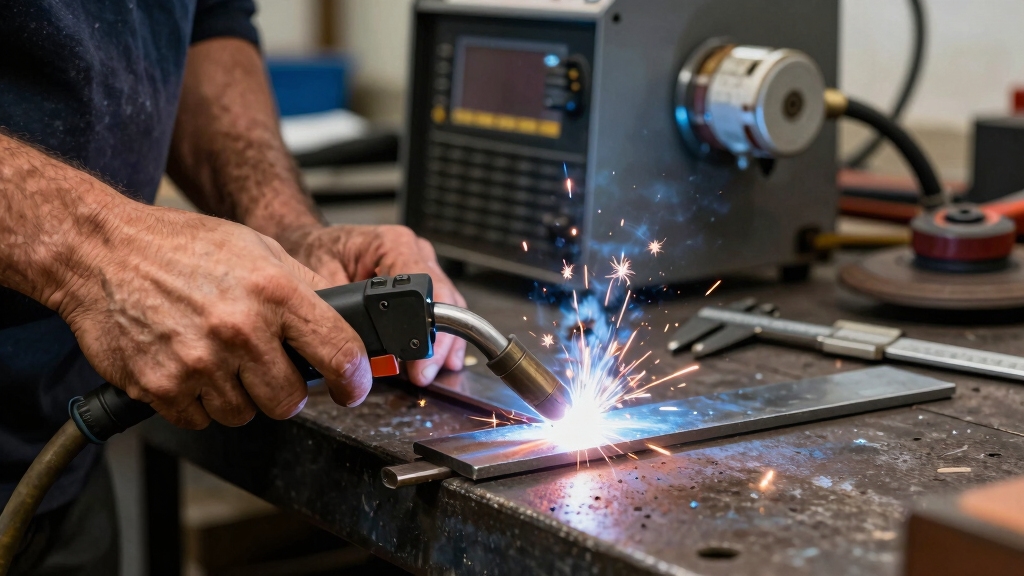
You’ll need a welder capable of delivering 250 to 400 amps to properly weld 1/2 inch steel. A machine with 300+ amps is preferred for multi-pass welding to guarantee full penetration and joint integrity.
A high-duty cycle at this amperage range is essential to avoid frequent stops and maintain consistent arc stability. Pairing this with .045 inch wire and correct technique helps control heat input and distortion. There’s plenty to keep in mind for peak results beyond just amperage.
When selecting a welder for 1/2 inch steel, you need a machine capable of delivering at least 250 amps to achieve proper penetration in a single pass. However, 300–400 amps is often necessary for multi-pass welding.
You should evaluate amperage capacity first, ensuring the machine meets the 1 amp per 0.001 inch thickness rule. This means up to 500 amps theoretically for 1/2 inch.
Consider machines with a duty cycle that supports extended welding at these currents, especially if multi-pass layers are required.
Voltage input matters; you’ll often need a 220–240V power supply for heavy-duty welders.
Also, match your wire size and feed system to the amperage to maintain stable arc performance. Precision in your welder choice directly influences penetration quality and weld integrity on 1/2 inch steel.
Welding is a critical step within fabrication workflow that ensures the components are securely joined to maintain structural integrity.
Selecting the best welding process for 1/2 inch steel hinges on balancing penetration capability, equipment amperage, and environmental conditions.
MIG welding, particularly with a flux-cored wire, delivers deep penetration and is efficient for this thickness when paired with a 350-amp or higher machine.
Stick welding also works well outdoors and on thicker sections, offering flexibility with larger electrodes at around 180 amps or more, though it often demands multi-pass techniques.
TIG welding generally isn’t recommended here due to its limited penetration and lower amperage range, best suited for steel up to 3/8 inch.
For consistent, quality welds on 1/2 inch steel, prioritize processes supporting adequate amperage and multi-pass capabilities.
Ensure proper joint preparation and bead profiles for structural integrity.
MIG welding’s high travel speeds can significantly improve productivity when welding 1/2 inch steel.
When you’re welding 1/2 inch steel, having the right amperage is super important. You really need enough current to get proper penetration, which helps create a strong, defect-free joint. If you skimp on the amperage, you’ll end up with shallow welds, and that can really compromise the structural integrity of your work.
Plus, there’s another thing to consider: duty cycle.
Using a higher amperage machine lets you maintain a steady pace without worrying about overheating or downtime. So, when you’re ready to tackle that 1/2 inch steel, make sure you’re set up with the right amperage to keep everything running smoothly!
Keep in mind that excessive heat input can enlarge grain size and reduce impact toughness, so controlling your heat is crucial for quality welds and material properties during the process heat effects on materials.
Since welding 1/2 inch steel demands deep penetration for a strong joint, amperage plays a critical role in achieving proper fusion.
You need sufficient amperage, typically between 300 and 400 amps, to guarantee the arc penetrates fully through the thickness, preventing weak welds or lack of fusion.
Using a 250-amp machine might handle single-pass welds but often requires multi-pass techniques to reach adequate penetration.
The amperage setting directly influences bead profile, width, and toe tie-in, which are key indicators of penetration quality.
Insufficient amperage leads to shallow welds prone to failure, while excessive amperage risks burn-through and warping.
Consequently, controlling amperage precisely assures a balanced heat input, optimizing penetration and structural integrity when welding 1/2 inch steel.
Additionally, managing heat input carefully is essential to minimize distortion and residual stress, which can compromise weld quality and joint performance.
Frequently, welders underestimate how critical duty cycle is when working with 1/2 inch steel, especially at high amperages.
The duty cycle defines how long your welder can operate at a given amperage before needing to cool down, expressed as a percentage over 10 minutes.
For 1/2 inch steel, you’ll need 300–400 amps, but many machines struggle to sustain a duty cycle above 25% at these levels.
If your welder’s duty cycle is too low, you risk overheating, reducing productivity and potentially damaging the equipment.
Selecting a machine with a higher duty cycle guarantees consistent penetration and efficient multi-pass welding without frequent pauses.
Consequently, amperage isn’t just about penetration; it directly influences your welder’s operational reliability and overall workflow on thick steel.
Additionally, using water-cooled torches can help manage heat dissipation during prolonged high-amperage welding, improving duty cycle performance.
When it comes to welding 1/2 inch steel, picking the right wire diameter is super important for getting that proper penetration and weld strength. So, you’ll usually want to go for a .045 inch solid wire if you’re using MIG.
If you’re leaning towards flux-cored wire, you might consider a range from .035 to .045 inch, but it really depends on what your machine can handle and how your gas setup is configured.
Choosing the right wire type and size is key! It helps ensure you have peak arc stability and that the material fuses efficiently, especially when you’re working with thick steel. So, don’t overlook this step; it can make all the difference in the quality of your welds!
Additionally, using V-groove drive rolls matched to your wire diameter can prevent feeding issues and improve weld consistency.
Choosing the right wire diameter critically impacts weld penetration and overall quality on 1/2 inch steel. For this thickness, a .045 inch diameter wire is ideal, delivering the necessary amperage range (around 250–300 amps) to achieve proper fusion and depth.
Smaller diameters like .035 inch can be used but typically require multi-pass welding and higher operator skill to avoid lack of penetration. The .045 inch wire supports higher wire feed speeds and consistent arc stability, pivotal for maintaining bead profile and minimizing defects.
Additionally, it matches well with flux-cored or solid MIG wire setups designed for heavy-gauge steel. Using the correct diameter reduces spatter and improves bead tie-in, ensuring a structurally sound weld capable of handling stress concentrations typical in 1/2 inch applications. Selecting the appropriate technique, such as push or pull methods, further optimizes weld quality and penetration for this thickness.
To zero in on the best wire type for welding 1/2 inch steel, you need to weigh factors like penetration, machine compatibility, and weld environment.
For this thickness, flux-cored and solid MIG wires are your main choices, each with specific advantages. Consider this:
Selecting the right wire guarantees weld integrity and efficiency on 1/2 inch steel. Also, choosing the correct shielding gas mixture can significantly improve arc stability and weld penetration for carbon steel.
Although single-pass welding offers speed and simplicity, it rarely suits 1/2 inch steel due to penetration and heat input constraints.
Achieving full penetration in one pass demands a 250-amp or higher machine with tuned wire size, typically .045 inch, and proper settings.
Full penetration in one pass requires a 250-amp machine, .045 inch wire, and precise settings.
However, many welders fall short of delivering consistent welds at this thickness in a single pass.
Multi-pass welding becomes necessary to control heat input, reduce distortion, and guarantee joint integrity.
It allows you to layer weld beads progressively, improving penetration and fusion, especially when bevel joints are involved.
While more time-consuming, multi-pass welding with 300–400 amps machines guarantees stronger, defect-free welds on 1/2 inch steel.
You must weigh equipment capacity and joint requirements to choose the most suitable welding approach.
Using a low-hydrogen electrode like the E7018 welding rod helps ensure strong, clean welds with minimal cracking risk in multi-pass applications.
Multi-pass welding on 1/2 inch steel demands machines that can sustain high amperage for extended periods, but duty cycle limitations often restrict this ability. When selecting a welder, you must consider how long it can operate at required currents without overheating or shutting down.
Key points include:
Understanding these constraints helps you choose a welder that meets the demands of 1/2 inch steel multi-pass welding. Additionally, maintaining precise heat input control during welding is essential to produce strong welds with adequate fusion and reduce distortion on thick materials, which can be challenging without proper equipment. This highlights the importance of heat input management in welding thicker steel.
Since welding 1/2 inch steel demands high amperage, often between 250 and 400 amps, you’ll need a power supply capable of delivering stable, continuous current at 220–240 volts.
This voltage range guarantees sufficient energy to maintain arc stability and penetration through the thick material. Your power source must also support the welder’s duty cycle to prevent overheating during multi-pass welds common with 1/2 inch steel.
Industrial-grade transformers or inverter-based supply units typically meet these requirements, providing consistent amperage output and rapid response to load changes.
Additionally, make certain your facility’s electrical infrastructure can handle the current draw safely, including appropriate circuit breakers and wiring.
Undersized power supplies risk voltage drop, arc instability, and insufficient penetration, compromising weld quality and equipment longevity.
Ensuring quality welds on 1/2 inch steel starts with properly preparing the joints to promote full penetration and strong fusion. You need to:
These steps optimize weld integrity on 1/2 inch steel, setting the stage for effective amperage use and weld bead control in subsequent passes.
Achieving proper penetration on 1/2 inch steel requires selecting the right amperage and welding technique to guarantee full fusion without burning through.
Use a 300–400 amp MIG or stick welder with multi-pass welding and proper joint preparation. Control travel speed and maintain consistent arc length to optimize heat input.
Adjust wire size and feed rate for steady bead profile and penetration depth. Verify penetration by inspecting bead width and toe tie-in.
| Parameter | Recommendation |
|---|---|
| Amperage Range | 300–400 amps |
| Welding Process | Multi-pass MIG or Stick |
| Wire Size | .045 inch (MIG) |
| Joint Prep | Bevel edges for full fusion |
| Travel Speed | Moderate, steady pace |
These tips guarantee structural integrity and consistent weld quality on thick steel.
Yes, you can weld 1/2 inch steel outdoors without shielding gas by using a stick welder.
Stick welding at 180 amps or higher with larger electrodes works well in windy conditions where shielding gas would dissipate.
Flux-cored arc welding (FCAW) with self-shielded wire is another option since it doesn’t require external gas.
Both methods provide adequate penetration and are practical for thick steel outdoors without relying on shielding gas.
You need a welding helmet with a shade 10 or higher to protect your eyes from intense UV rays when welding 1/2 inch steel.
Heavy-duty gloves and flame-resistant clothing are essential to prevent burns from sparks and molten metal.
Use ear protection to guard against noise and respirators to avoid inhaling harmful fumes, especially outdoors.
You’ll notice that slower welding speed increases heat input, causing greater distortion in 1/2 inch steel due to prolonged thermal exposure.
Conversely, faster speeds reduce heat concentration, minimizing warping but risking insufficient penetration.
To control distortion, balance your travel speed to guarantee adequate fusion without overheating.
Use multi-pass welding with proper interpass temperature control to limit residual stress and maintain dimensional stability in thick steel sections.
You’ll want to keep in mind brands like Miller, Lincoln Electric, and ESAB for heavy-duty 1/2 inch welding.
They offer machines in the 300–400 amp range, ensuring strong penetration and reliable duty cycles.
Miller’s Dynasty or Lincoln’s Power MIG series are known for durability and versatility.
ESAB’s Rebel line also excels for flux-cored and MIG processes on thick steel.
These brands provide robust support, making them ideal for demanding, industrial-grade 1/2 inch welding tasks.
You clean the wire feed mechanism regularly, inspect and replace worn contact tips, and tighten all connections.
You check the cooling system for blockages, clear dust from vents, and calibrate amperage settings for accuracy.
You monitor the duty cycle to prevent overheating, lubricate moving parts, and store the welder in a dry, dust-free environment.
Consistent maintenance secures peak performance, extends machine life, and guarantees safe, effective welding on 1/2 inch steel.
Choosing the right welder for 1/2 inch steel boils down to matching amperage, wire size, and welding process to your project’s demands.
Have you considered how your duty cycle and power supply affect consistent penetration and weld quality?
Proper joint preparation and understanding single versus multi-pass techniques guarantee strong, reliable welds.
By focusing on these factors, you’ll optimize performance and durability, avoiding common pitfalls when working with thicker steel materials.