Phone:
(701)814-6992
Physical address:
6296 Donnelly Plaza
Ratkeville, Bahamas.

Phone:
(701)814-6992
Physical address:
6296 Donnelly Plaza
Ratkeville, Bahamas.

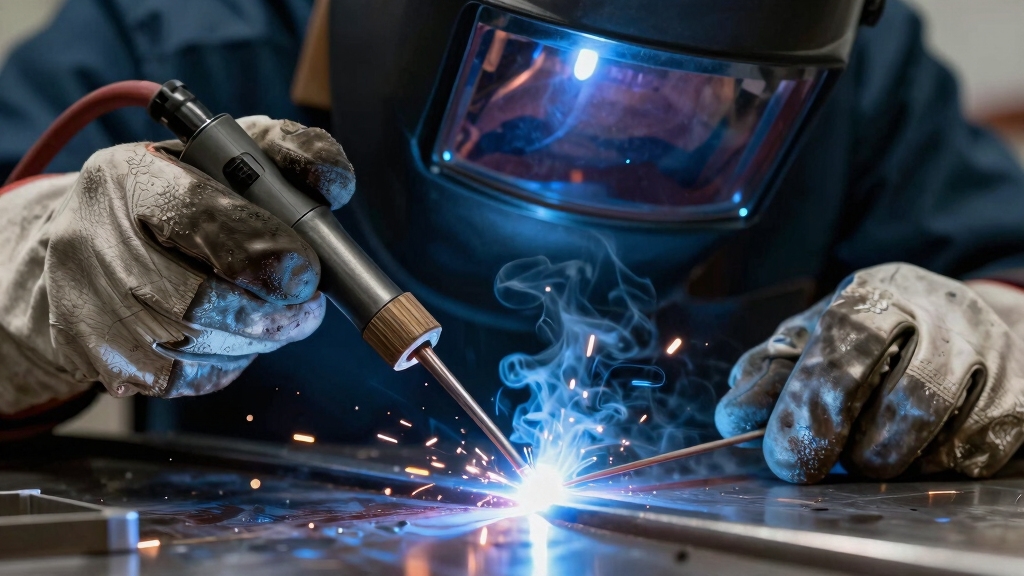
A heliarc welder uses a non-consumable tungsten electrode to generate an arc shielded by inert gases like helium or argon. This allows you to weld non-ferrous and stainless metals with precision and cleanliness.
You’ll control arc stability and heat input while manually feeding filler material under the gas shield to avoid contamination. Originally developed for aerospace applications, this process guarantees strong, corrosion-resistant joints.
Understanding its equipment and technique details will help you maximize performance and weld quality.
Although the term “Heliarc welder” originated from the use of helium as a shielding gas, it now generally refers to the TIG (Tungsten Inert Gas) welding process.
You use a non-consumable tungsten electrode to generate an electric arc between the electrode and the workpiece, creating heat that melts the metal.
The inert gas, helium initially but now often argon, shields the weld area from atmospheric contamination, preventing oxidation.
You position the electrode about 1.5 to 3 mm from the workpiece and initiate the arc via a high-frequency generator without physical contact.
You manually feed filler material into the weld pool under the gas shield.
This precise control allows you to produce clean, high-quality welds on non-ferrous metals like aluminum and stainless steel.
Argon’s inert atmosphere protects the molten metal from oxygen and nitrogen, ensuring defect-free, durable welds.
When you explore the origins of heliarc welding technology, you discover it was patented in 1941 by Russell Meredith of Northrop Aircraft. He developed it specifically to weld magnesium used in aircraft manufacturing.
Heliarc welding was patented in 1941 by Russell Meredith to weld magnesium in aircraft production.
This innovation marked the first practical gas-shielded welding process for non-ferrous metals. It employed a non-consumable tungsten electrode and helium shielding gas to protect the weld pool from atmospheric contamination.
The heliarc process enabled consistent, high-quality welds critical for aerospace applications. It facilitated scale production of airplanes and ships during World War II.
Over time, the technique evolved into what’s now known as TIG (Tungsten Inert Gas) welding. Importantly, heliarc welding contributed to the construction of the Saturn V rocket’s components for the Apollo 11 mission, underscoring its importance in advanced metal fabrication.
Mastery of GTAW (TIG) techniques, like those originating from heliarc welding, remains essential for aerospace welders working with thin, high-strength alloys today.
Building on the historical advancements that shaped heliarc welding, understanding the equipment and components involved is key to mastering the process.
You’ll need a power source capable of delivering a steady DC current with adjustable amperage to control arc intensity.
The non-consumable tungsten electrode, typically alloyed for durability, creates the arc without melting.
The welding torch holds the electrode securely and directs the inert shielding gas, which protects the weld pool from atmospheric contamination.
You’ll also use a filler rod, manually fed into the molten pool to add material.
A high-frequency generator often aids arc initiation without contact.
Additionally, gas delivery components, including regulators and flow meters, secure consistent shielding gas flow.
Each component must function precisely to produce clean, high-quality welds.
Using DCEN polarity is common in heliarc welding as it directs most heat to the workpiece, enabling deeper penetration and longer tungsten electrode life.
Why did early heliarc welders choose helium as the shielding gas? You’ll find helium provided a hotter arc due to its higher ionization potential compared to other gases.
This enabled deeper penetration and better welds on thicker, non-ferrous metals like magnesium and aluminum.
Helium’s inert nature prevented oxidation and contamination effectively during welding, essential for aircraft manufacturing.
| Property | Helium | Argon |
|---|---|---|
| Ionization Energy | 24.6 eV (higher) | 15.8 eV (lower) |
| Arc Temperature | Higher (hotter arc) | Lower (cooler arc) |
| Shielding Quality | Excellent | Excellent |
However, unlike argon, helium’s higher ionization potential requires adjustments in welding parameters to maintain a stable arc, a key consideration for achieving optimal weld quality with inert gases.
Although heliarc welding laid the foundation for gas tungsten arc welding (GTAW), modern TIG welding incorporates several advancements that enhance control, versatility, and efficiency.
Heliarc welding pioneered GTAW, but modern TIG welding significantly improves control, versatility, and efficiency.
While the original heliarc process relied primarily on helium shielding gas, today’s TIG welders commonly use argon or argon-helium blends. This shift provides improved arc stability and cost efficiency.
Modern equipment integrates advanced features like pulsed-current control and high-frequency arc initiation. This allows you to precisely manage heat input and weld bead characteristics.
Additionally, today’s TIG torches often include ergonomic designs and water-cooling options. These enhancements enable longer operation and better comfort.
Though the fundamental principle of a non-consumable tungsten electrode remains, you’ll notice that modern TIG systems offer greater automation and adaptability. They surpass the original heliarc limitations in performance and application scope.
For aluminum welding, the choice of zirconiated tungsten electrodes significantly improves arc stability and reduces contamination compared to early heliarc setups.
Understanding the metals best suited for heliarc welding helps you maximize the process’s strengths.
This welding method excels with metals that require clean, precise joints and are sensitive to contamination.
You’ll find the following metals particularly compatible with heliarc welding:
Helium’s ability to increase arc energy and heat transfer makes it especially effective for welding thicker sections of these metals.
To achieve precise heliarc welds, it’s really important to keep a close eye on the electrode angle. This helps ensure that the arc characteristics remain stable, which is key for a good weld.
Now, let’s talk about the filler rod. You’ve got to feed it consistently – if you don’t, you might run into defects and lose the integrity of the weld pool. It’s all about keeping that flow steady!
And don’t forget about the arc length. Ideally, you want it to be between 1.5 and 3 millimeters. This range is crucial for maintaining proper shielding gas coverage and ensuring the arc stays stable. So, keep these tips in mind, and you’ll be on your way to achieving those precise heliarc welds!
Additionally, selecting the correct shielding gas mixture is essential to prevent oxidation and ensure strong, clean welds.
When you control the electrode angle accurately during heliarc welding, you directly influence arc stability, weld bead shape, and penetration depth.
Maintaining the correct angle guarantees the arc concentrates heat efficiently, producing consistent fusion without defects.
Typically, you hold the electrode at a 10–15° work angle, tilting forward in the direction of travel to optimize gas coverage and molten pool visibility.
Improper angles cause arc wandering, contamination, or uneven bead profiles.
Key electrode angle control points include:
Mastering these techniques enhances weld quality and repeatability. Proper torch angle also ensures efficient gas shielding to protect the weld pool from contamination.
Controlling the electrode angle sets the foundation for a stable arc. Feeding the filler rod consistently directly impacts the weld’s strength and appearance.
You need to feed the rod steadily into the weld pool, maintaining a uniform speed to avoid defects like porosity or weak fusion. Proper rod positioning within the shielding gas envelope prevents contamination.
Adjust your hand motion to synchronize with the torch movement, ensuring even metal deposition.
Maintaining proper shielding gas coverage during and after welding is essential to protect the chromium oxide layer and prevent oxidation.
| Parameter | Recommended Action |
|---|---|
| Rod Feed Speed | 1–3 cm/s steady feed |
| Rod Angle | 15–20° to workpiece surface |
| Position | Just ahead of molten pool |
| Rod Diameter | Match to base metal thickness |
| Feed Rhythm | Consistent, synchronized pace |
Master this technique to optimize weld quality and appearance.
Although maintaining the correct arc length may seem straightforward, it demands careful attention to guarantee weld integrity and consistency. You must precisely control the distance between the tungsten electrode and the workpiece, typically 1.5 to 3 mm, to sustain a stable arc and avoid defects such as porosity or tungsten inclusion.
To maintain optimal arc length, focus on:
Keeping steady hand movement to prevent arc fluctuations.
Watching arc voltage indicators for immediate feedback.
Adjusting torch angle and position in response to workpiece geometry.
Practicing consistent electrode-to-work distance even during complex weld paths.
Mastering these techniques often requires extensive practice, as precise torch positioning is critical for stable arcs and consistent bead placement.
Since heliarc welding delivers clean, precise welds on non-ferrous metals, industries such as aerospace, shipbuilding, and food processing rely heavily on this process.
You’ll find heliarc welding essential when working with stainless steel, aluminum, and magnesium components that demand high-quality, contamination-free joints.
In aerospace, it guarantees structural integrity in critical assemblies.
Shipbuilding uses it for corrosion-resistant hulls and superstructures.
The food processing sector depends on it to maintain sanitary conditions by producing smooth, clean welds on stainless steel equipment.
Additionally, military and automotive industries utilize heliarc welding for fabricating lightweight, durable parts.
By controlling heat input and shielding weld areas with inert gas, you can achieve fusion without defects like undercut or overlap.
This assures consistency and strength in manufactured products across these demanding applications.
Hey there! It’s super important to regularly inspect and clean your torch. Doing this helps ensure that you’re getting the best performance from your electrode and that your gas flow is just right.
Now, let’s talk about some common welding issues you might run into. If you notice any arc instability or contamination, it’s a good idea to verify your connections and check the integrity of your components. Trust me, this can make a big difference.
Oh, and if you’re experiencing any irregularities with your shielding gas, don’t panic! Just take a moment to check for leaks, look out for any pressure inconsistencies, and make sure your regulator is functioning properly. Keeping an eye on these factors is key to maintaining the quality of your welds.
When you maintain your heliarc welding torch properly, you guarantee consistent arc stability and prolong the torch’s service life.
Regular inspection and cleaning prevent gas flow disruptions and electrode contamination, which could impair weld quality.
Focus on these key maintenance tasks:
Although heliarc welding offers precise and clean welds, several common issues can arise that affect performance and weld quality.
You might encounter tungsten contamination, where the electrode picks up impurities from the workpiece or filler metal, causing arc instability.
Incorrect electrode positioning or distance can lead to poor arc control or insufficient heat input, resulting in weak welds or lack of fusion.
Cracked or damaged tungsten electrodes reduce arc consistency and should be replaced promptly.
Additionally, inconsistent current settings can cause spatter or inadequate penetration.
You must perform regular inspections of cables, torch connections, and cooling systems to prevent interruptions.
Maintaining proper torch angle and steady filler rod feeding is essential to avoid defects such as undercut or overlap.
Addressing these issues promptly guarantees peak weld integrity and equipment longevity.
Proper gas flow is key to maintaining weld quality and preventing contamination in heliarc welding. If you notice oxidation or porosity, check your gas delivery system immediately.
Start by inspecting the regulator for leaks or damage. Safeguard the flow meter is calibrated and set to the correct rate, typically 15–20 cubic feet per hour.
Next, verify all hose connections are secure and free from cracks or blockages. Finally, examine the torch nozzle and diffuser for spatter buildup that can disrupt gas coverage.
To troubleshoot gas flow effectively:
Maintaining proper gas flow safeguards a stable arc and contaminant-free welds.
You need to prioritize shielding yourself from intense ultraviolet light and infrared radiation unique to heliarc welding’s high-temperature arc.
Wear specialized gloves, protective clothing, and a properly rated welding helmet with a darkened lens.
Make sure adequate ventilation to avoid helium or argon gas buildup, which can displace oxygen.
Maintain distance from the high-frequency start system to prevent electrical shock.
These measures help you avoid burns, eye damage, respiratory hazards, and electrical risks.
Heliarc welding maintains or improves material strength long-term by producing clean, precise welds with minimal contamination.
You’ll benefit from strong fusion and reduced oxidation thanks to the inert gas shielding.
Since the heat input is controlled, you avoid excessive distortion or weakening.
However, skillful filler addition is vital to prevent defects that could compromise durability.
Yes, you can automate heliarc welding for mass production, especially with advancements in robotic systems and CNC controls.
Automation improves consistency, speed, and precision, vital for aerospace and shipbuilding industries.
You’ll need specialized equipment to handle torch positioning, filler feeding, and gas shielding.
However, skilled programming and monitoring remain essential to maintain weld quality, as the process demands precise control over arc stability and filler addition to prevent defects.
You’ll find that heliarc welding gases like helium and argon have minimal direct environmental impact since they’re inert and non-toxic.
However, producing these gases consumes energy, contributing indirectly to carbon emissions.
Plus, gas leaks waste resources and may increase greenhouse gas footprints.
Managing consumption efficiently and preventing leaks helps reduce environmental effects.
You should also consider sourcing gases from suppliers committed to sustainable practices to further minimize your environmental impact.
Imagine your weld as a crystal-clear lake; electrode contamination throws debris into the water, disrupting clarity.
When your electrode is contaminated, it introduces impurities that cause unstable arcs and porosity in the weld pool.
This weakens fusion, leads to cracks, and creates uneven bead appearance.
You’ll lose precision, compromise strength, and risk oxidation.
Keeping the electrode clean guarantees consistent arc stability and high-quality, defect-free welds every time.
Now that you understand what a heliarc welder is and how it functions, you can appreciate its role in precision welding, much like a skilled conductor guiding an orchestra.
Though modern TIG welding has evolved, heliarc welding remains essential for certain metals and applications.
By mastering operator techniques and maintaining your equipment properly, you’ll make certain consistent, high-quality welds.
Keep these technical insights in mind to optimize your welding performance and troubleshoot effectively.