Phone:
(701)814-6992
Physical address:
6296 Donnelly Plaza
Ratkeville, Bahamas.

Phone:
(701)814-6992
Physical address:
6296 Donnelly Plaza
Ratkeville, Bahamas.

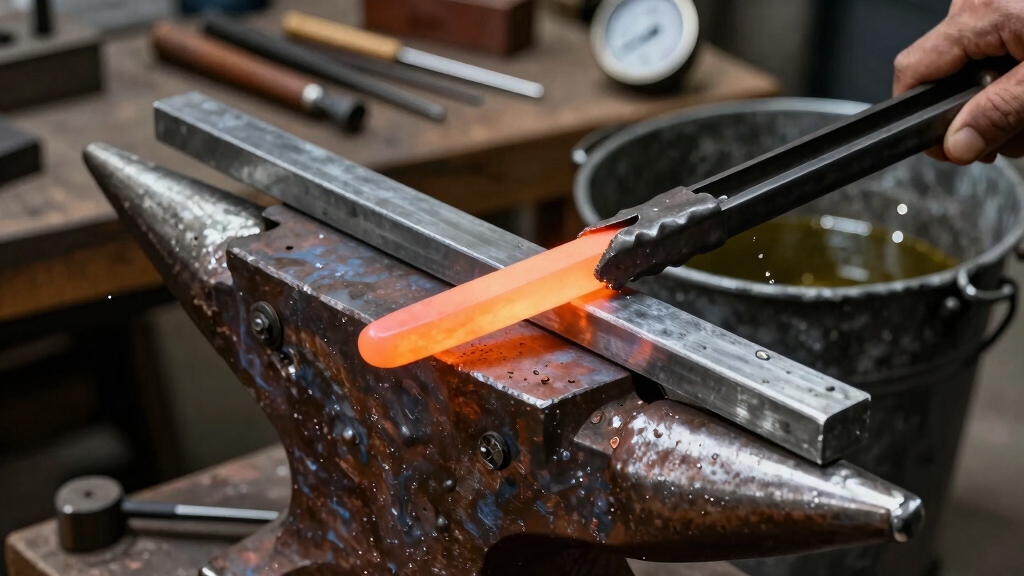
You can’t markedly harden mild steel solely by quenching because its low carbon content limits martensite formation, resulting in minimal hardness gain.
Instead, you should use surface-hardening methods like carburizing or carbonitriding. These techniques diffuse carbon and nitrogen into the outer layer to produce a hard, wear-resistant case while maintaining a tough core.
Cold working and alloying can improve strength but won’t replace hardening processes. Deeper exploration reveals best treatment choices and process controls.
One key reason mild steel resists effective hardening through conventional quenching is its low carbon content, typically below 0.25%.
You rely on carbon to form martensite during rapid cooling, which imparts hardness.
At such low levels, the steel lacks sufficient carbon to transform fully into martensite; instead, it retains softer phases like ferrite and pearlite.
This limited martensitic fraction reduces achievable hardness and wear resistance.
When you quench mild steel, the phase transformation is incomplete, so hardness gains remain minimal.
Quenching mild steel results in incomplete phase transformation, yielding only minimal hardness improvements.
Additionally, the microstructure can’t sustain the stresses required for a hardened state without cracking.
Consequently, you must consider alternative methods such as surface treatments or alloying to increase hardness, since the low carbon content inherently restricts the effectiveness of standard through hardening via quenching.
Heat treatment processes, including pre- and post-weld heat treatments, can improve strength and toughness in steels with limited hardening capability.
Hey there! So, when it comes to mild steel, you really can’t count on through hardening. Why? Well, it’s all about that low carbon content. This low content makes it tough for martensite to form when you go through the quenching process.
Even if you heat it up to the austenitizing range and then quench it quickly, the increase in hardness is just not that impressive. It’s actually pretty shallow and uneven. Because of this, using quenching alone just won’t cut it if you’re aiming for that nice, uniform, deep hardness in mild steel. The carbon content differences between mild steel and cast iron significantly affect their heat treatment responses.
Several factors linked to carbon content limit the effectiveness of through hardening in mild steel. Because mild steel contains less than 0.3% carbon, it cannot form a fully martensitic structure upon quenching. This low carbon restricts hardness depth and uniformity, preventing the steel from achieving ideal through hardening results.
You’ll notice diminishing returns in hardness as carbon decreases below the critical threshold for martensite formation.
| Carbon Content (%) | Hardenability |
|---|---|
| 0.05 | Very Low |
| 0.15 | Low |
| 0.25 | Moderate |
| 0.30 | Marginal |
| >0.40 | Effective |
Thus, for mild steel, carbon content constraints necessitate alternative hardening methods, such as case hardening, to improve surface hardness while maintaining core toughness. This is similar to how heat treatment and alloying can significantly shift hardness bands in other metals like aluminum and brass.
Although quenching can increase hardness in steels with sufficient carbon, mild steel’s low carbon content presents notable challenges for this method.
When you rapidly cool mild steel from the austenitizing temperature, the transformation to martensite is minimal due to insufficient carbon to stabilize this phase.
As a result, you get limited hardness increase and shallow hardening depth.
Additionally, water quenching, though fast, risks cracking and distortion in higher-carbon steels but offers marginal benefit for mild steel.
Oil quenching slows cooling but doesn’t markedly enhance hardness either.
To overcome these limitations, you must consider surface treatments like carburizing to enrich carbon at the surface before quenching.
Therefore, through hardening alone is ineffective for mild steel, making quenching a constrained technique without supplementary carbon enrichment.
Moreover, the carbon content directly influences the steel’s ability to form martensite during quenching, which is critical for achieving desired hardness levels.
Did you know that you can really boost the surface hardness of mild steel with case hardening? It’s pretty fascinating! By introducing carbon or nitrogen atoms into the outer layer, you can make a significant difference.
For example, carburizing is one method that works by diffusing carbon at high temperatures. This process helps form a hard martensitic case, which is great for increasing durability. On the other hand, nitriding is another technique that uses ammonia to create wear-resistant nitrides. What’s cool about nitriding is that it doesn’t require quenching, making it a more straightforward option.
Then there’s carbonitriding, which combines both carbon and nitrogen. This method actually creates a deeper and tougher surface, really enhancing the overall durability and performance of the steel. So, whether you choose carburizing, nitriding, or carbonitriding, you have some effective options for improving mild steel’s surface hardness! Additionally, applying a corrosion-resistant coating such as weld-through primer can help protect treated surfaces during welding and improve joint longevity.
Carburizing ramps up the surface hardness of mild steel by infusing carbon atoms into its outer layer at elevated temperatures.
You heat the steel to around 900°C in a carbon-rich environment, enabling carbon to diffuse into the austenitic surface.
This diffusion forms a high-carbon case that, after quenching, transforms into hard martensite.
The process depth depends on time and temperature, typically ranging from a few microns to several millimeters.
You achieve a wear-resistant, hardened surface while maintaining a tough, ductile core, ideal for components requiring surface durability without brittleness.
Controlling atmosphere composition and cooling rate is critical to prevent decarburization or distortion.
Carburizing consequently offers a precise method to enhance mild steel’s surface hardness beyond what simple quenching can provide.
To ensure structural integrity, it is essential to control heat input and apply proper post-weld heat treatments to minimize residual stresses and prevent cracking.
Enhancing mild steel’s surface hardness through nitriding involves exposing the metal to an ammonia-rich atmosphere at moderate temperatures between 500-550°C for extended periods, typically 12 to 36 hours.
This process diffuses nitrogen atoms into the steel’s surface, forming hard nitrides that markedly increase wear resistance without requiring quenching.
You’ll find that alloying elements like aluminum or chromium enhance nitride formation and dispersion, further improving surface durability.
Since nitriding occurs below the austenitizing temperature, it avoids distortion and dimensional changes common in higher-temperature treatments.
By carefully controlling time and temperature, you achieve a uniform, hard case that resists fatigue and abrasion.
This method suits mild steel when you need a hard, wear-resistant surface while maintaining the core’s toughness and ductility.
Nitriding can be integrated effectively into the fabrication workflow to enhance component longevity while preserving dimensional accuracy.
Carbonitriding builds on traditional case hardening by simultaneously introducing both carbon and nitrogen into the mild steel surface at austenitizing temperatures.
This dual-element diffusion forms a harder, more wear-resistant case than carburizing alone. You benefit from a deeper hardened layer with improved fatigue strength and corrosion resistance, thanks to the formation of carbonitrides.
The nitrogen addition refines the microstructure, reducing grain growth and enhancing surface hardness without excessive distortion. Carbonitriding typically occurs at lower temperatures than carburizing, minimizing thermal stresses and deformation.
You’ll find the process efficient for components requiring moderate case depth and toughness, such as gears and shafts. Overall, carbonitriding offers a precise balance of hardness, wear resistance, and dimensional stability, making it a superior surface treatment for enhancing mild steel’s performance in demanding applications.
To ensure consistent quality in treated components, it is essential to maintain detailed continuity records throughout the manufacturing process.
You can increase the hardness of mild steel through cold working by deforming it below its recrystallization temperature. This process raises dislocation density within the metal’s crystal lattice.
This process, also known as strain hardening, enhances yield and tensile strength by creating entangled dislocations that inhibit slip. However, it reduces ductility and requires careful control to avoid cracking or excessive brittleness.
| Property | Effect of Cold Working |
|---|---|
| Hardness | Increases due to dislocation entanglement |
| Ductility | Decreases as lattice defects accumulate |
| Workability | Limited; annealing needed after extensive deformation |
Cold working suits mild steel when moderate surface hardening is sufficient without heat treatment. It’s a practical, low-cost method but can’t replace through hardening techniques. Proper heat input management is essential if welding is later performed to maintain the steel’s structural integrity.
While cold working increases mild steel’s hardness by mechanically introducing lattice defects, solid solution alloying strengthens the metal by altering its atomic structure during solidification.
When you add alloying elements to mild steel, these atoms dissolve into the iron lattice, creating a solid solution. The size mismatch between solute and solvent atoms causes localized lattice strain fields, which are compressive if the solute is larger and tensile if smaller.
These strain fields impede dislocation motion, increasing the steel’s yield strength and hardness. Unlike cold working, solid solution alloying modifies the internal atomic arrangement permanently.
However, for mild steel, this method requires careful alloy modifications since its low carbon content limits the effectiveness of standard alloying elements. Still, incorporating elements like manganese or nickel can improve strength by this mechanism before other hardening steps.
Controlling the heat input during welding is critical to maintaining these strengths, as excessive heat can alter the microstructure and reduce hardness through thermal expansion and hardness effects.
Selecting the best quenching and tempering techniques for mild steel requires understanding its low carbon content and how it influences hardenability.
Since mild steel contains under 0.3% carbon, through hardening via quenching alone yields limited hardness and shallow martensitic transformation.
Mild steel’s low carbon means quenching alone only achieves limited hardness and shallow martensite formation.
You should heat the steel to 800-850°C to form austenite, then rapidly quench in water for maximum hardening speed, though this risks cracking.
Oil quenching provides slower cooling, reducing stress but also hardness gain.
Tempering follows quenching to relieve brittleness while retaining strength.
For practical surface hardness, consider case hardening methods before quenching.
Ultimately, you must balance the quenching medium’s cooling rate with tempering parameters to optimize hardness without inducing cracks or excessive brittleness in mild steel.
Safety first, as the saying goes. When hardening mild steel, you should wear heat-resistant gloves, safety goggles, and protective clothing to prevent burns and eye injuries.
Make sure proper ventilation to avoid inhaling fumes during carburizing or nitriding.
Always quench steel in a controlled area to manage splashing hot liquids safely.
Use tongs or tools to handle hot metal, and keep a fire extinguisher nearby to address any accidental fires promptly.
You’ll find that increased hardness in mild steel reduces weldability by raising the risk of cracking and brittleness in the heat-affected zone.
Harder steel has higher residual stresses and lower ductility, which complicates fusion during welding.
To maintain weld quality, you must control preheat and post-weld heat treatment to reduce hardness locally.
Balancing hardness with toughness guarantees structural integrity without sacrificing weldability.
You know what they say: “Measure twice, cut once.”
While professional hardness testers like Rockwell machines are best, you can estimate mild steel hardness at home using a file test.
Try scratching the surface with a steel file; if it skates off smoothly, the steel is hard.
You can also use a portable durometer or conduct simple scratch and rebound tests, but these methods lack precision and are more qualitative than quantitative.
You’ll find Rockwell and Brinell hardness testers most effective for mild steel, providing precise, standardized readings.
Portable Leeb hardness testers offer convenience and quick, non-destructive results, especially on-site.
For home use, a file test or a Mohs hardness kit can give rough estimates but lack accuracy.
Make sure you calibrate your device properly and test multiple points to account for material inconsistencies and surface finish variations.
Moisture magnifies metal’s malfunctions during heat treatment.
When you heat mild steel, any moisture present can cause steam pockets, leading to surface oxidation or scaling that degrades the steel’s finish and integrity.
Additionally, moisture trapped inside can prompt micro-cracking during rapid quenching, weakening the material.
To maintain metallurgical mastery, you should make sure steel is thoroughly dry before heating.
This prevents moisture-induced microstructural mishaps and preserves mechanical properties effectively.
Though mild steel won’t harden like high-carbon alloys, you can still sharpen its edge. Think of it as sculpting a marble statue rather than molding molten bronze.
By leveraging case hardening, cold working, and solid solution alloying, you enhance surface hardness and strength without losing ductility.
Choosing the right quenching and tempering methods lets you fine-tune its properties. This approach turns mild steel’s limitations into tailored performance for your engineering challenges.