Phone:
(701)814-6992
Physical address:
6296 Donnelly Plaza
Ratkeville, Bahamas.

Phone:
(701)814-6992
Physical address:
6296 Donnelly Plaza
Ratkeville, Bahamas.

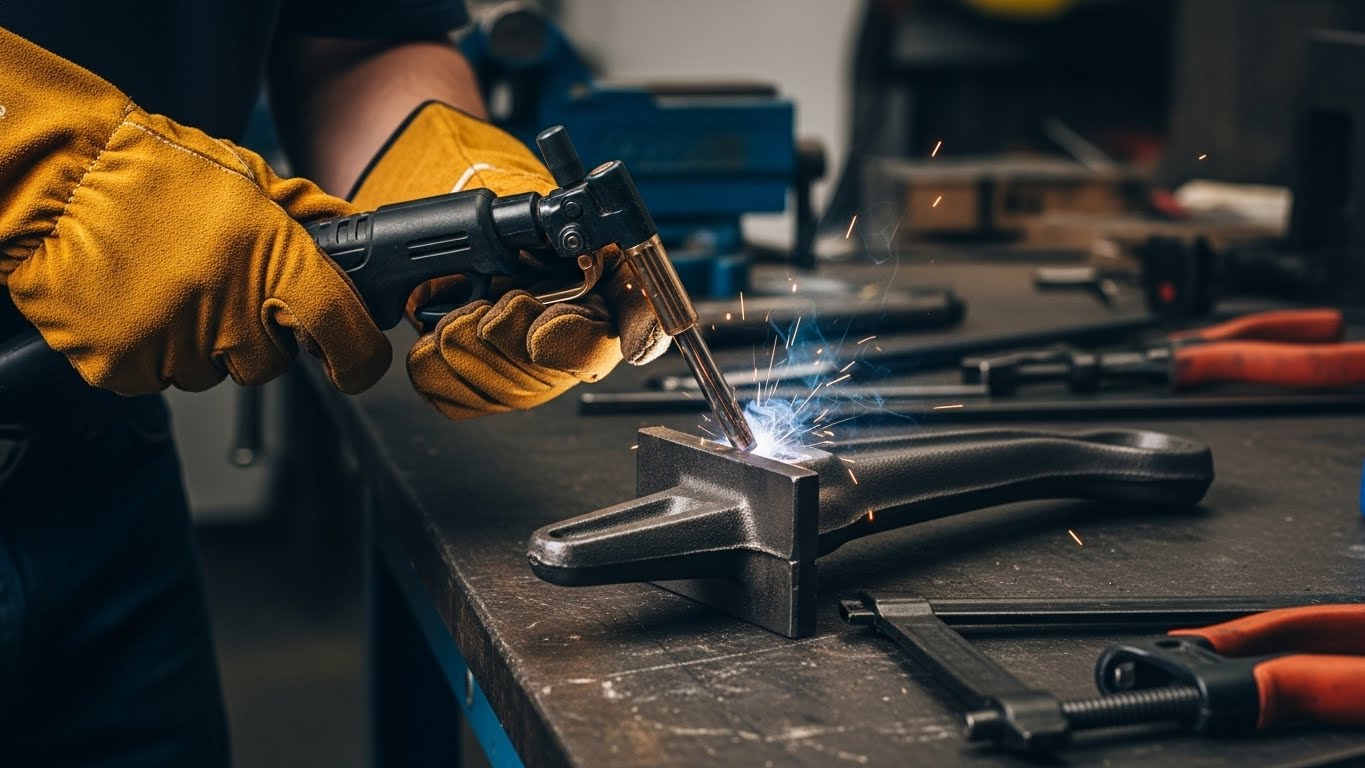
You can MIG weld cast iron effectively by controlling heat input and using nickel-based filler wires like ERNi55 or ENi-Cl. These reduce cracking risk and accommodate thermal expansion differences.
Preheating between 500°F and 900°F and employing short, controlled weld passes with interpass cooling are essential to minimize thermal stress and prevent brittle fractures.
Using dip transfer mode further limits heat. Proper surface preparation and temperature management guarantee weld quality. Explore more to master techniques for durable cast iron MIG welding.
Although MIG welding cast iron presents significant challenges due to the material’s brittleness and thermal sensitivity, you can achieve successful results by carefully managing heat and choosing the appropriate filler wire. Preheating cast iron to about 500–600°F is recommended to reduce thermal stresses and minimize cracking during welding.
MIG welding cast iron is challenging but achievable with careful heat control and proper filler wire selection.
Cast iron’s high carbon content makes it prone to cracking during rapid thermal cycles, so controlling heat input through preheating and slow cooling is vital. Its unique crystalline structure increases the risk of cracks during heating and cooling cycles, demanding precise technique adjustments. Using standard steel wire (ER70S-6) will likely cause hard, inflexible welds that crack upon cooling.
Instead, opt for specialized nickel-based filler wires that remain ductile and reduce crack risk. Employ short, controlled weld passes with interpass cooling and avoid continuous bead welding to minimize thermal stress.
Your welding skill matters, but thermal management—about 80% of the process—is paramount for durable cast iron repairs.
Cast iron comes in several distinct types, each with unique microstructures that affect their weldability using MIG processes.
You can successfully MIG weld gray, ductile, and malleable cast irons, but each requires specific preparation. Proper preparation also includes removing any surface contaminants such as oils or coatings to reduce welding defects and fumes during the process, which can improve overall weld quality and safety through surface cleaning.
Gray cast iron, featuring graphite flakes, is the least challenging due to its relatively forgiving structure. However, it demands thorough cleaning and preheating. Proper heat management, including preheating and slow cooling, is essential to prevent cracking in gray cast iron.
Ductile cast iron, with spherical graphite nodules, offers improved weldability but needs precise heat control before, during, and after welding.
Malleable cast iron, derived from heat-treated white cast iron, lies between gray and white in weldability. Avoid exceeding critical temperatures around 1700°F to prevent structural changes.
Conversely, white cast iron, composed primarily of cementite, is too brittle and prone to cracking, rendering it unsuitable for MIG welding.
Employ nickel or high-nickel wires for best results on weldable types. Using nickel-based filler materials helps accommodate thermal expansion differences and reduces cracking risks.
When it comes to MIG welding cast iron, there are some pretty significant challenges to keep in mind.
One of the main concerns is cracking. This happens because of carbon migration and those rapid thermal cycles that can lead to brittle martensite formation. It’s fascinating but also a bit tricky! Careful heat input control is crucial to avoid these issues and maintain weld integrity.
You really have to manage heat input carefully.
Why? Well, it’s all about controlling the expansion and contraction forces. Cast iron has low ductility, which means it doesn’t handle those forces well. If you’re not on top of thermal management, you could end up with cracks in the weld zone or the heat-affected zone. And let’s be honest, that’s the last thing you want if you’re aiming for structural integrity!
Also, using a nickel-iron wire as filler metal is essential to improve weld ductility and reduce cracking risk when MIG welding cast iron.
Since MIG welding subjects the metal to rapid heating and cooling cycles, you’ll face significant challenges due to cast iron’s inherent brittleness and complex thermal behavior. Proper welding parameters control is essential to minimize heat input and reduce the risk of defects.
This brittleness, caused by high carbon content, means the metal can crack easily as it lacks ductility to absorb stresses from expansion and contraction. Notably, white cast iron is especially problematic because it is too hard and brittle, making welds prone to cracking.
Rapid thermal swings create conflicting forces that foster crack formation, especially in the heat-affected zone (HAZ), which transforms into a brittle, martensitic structure. Applying preheat and controlled cooling can help manage these thermal stresses and reduce crack susceptibility.
Key cracking risks and causes include:
Managing heat input effectively is a primary challenge you’ll encounter while MIG welding cast iron due to its susceptibility to cracking from thermal stresses.
To control heat, use short, controlled passes. Limit weld lengths to half-inch tacks and employ a short-circuit transfer mode for low heat input.
Maintain low amperage settings by adjusting wire feed speed to prevent burn-through while ensuring adequate penetration. Consistent travel speed and torch positioning are essential to maintain a stable arc and bead quality.
Allow interpass cooling, keeping temperatures between 300–500°F, using natural pauses or compressed air to avoid thermal shock.
Preheating the weld area to 250–500°F reduces rapid expansion and contraction, minimizing stress. This is especially important because cast iron’s high carbon content causes inherent brittleness compared with mild steel.
Also, maintain a stable arc and optimize travel speed to balance penetration and heat input, avoiding excessive bead width or poor tie-in.
These strategies collectively help manage thermal stresses and reduce cracking risks.
To control heat and prevent cracking when MIG welding cast iron, it’s super important to manage your preheat and postheat temperatures. Aim for a range between 250°F and 500°F. Keeping the heat stable while you’re welding is key. Maintaining detailed continuity records of welding activity helps ensure consistent quality and compliance with industry standards.
This helps to minimize those thermal stresses that can lead to cracking.
Now, think about it: if you consistently control the temperature before, during, and after welding, you’re ensuring that the material expands and contracts evenly. This is crucial for avoiding any unexpected issues down the line.
A recommended workflow is to tack weld the parts cold first and then preheat the entire assembly to reduce handling of hot pieces and ease fit-up, which helps control thermal stress during welding tack then preheat workflow.
Controlling heat through proper preheating and postheating is vital to prevent cracking when MIG welding cast iron. You need to heat the weld area uniformly to reduce thermal gradients and stress, using methods like propane torches or heat blankets. Preheating also helps to avoid the formation of hard, brittle microstructures in the heat-affected zone. Additionally, managing heat input carefully during welding preserves the material’s mechanical properties and reduces the risk of defects.
For gray cast iron, preheat between 500°F and 1200°F; ductile cast iron requires 500°F to 900°F. After welding, slow cooling is vital. Wrap the part in insulating blankets or bury it in dry sand to avoid rapid temperature changes that cause brittleness.
Preheat reduces stress and thermal shock, preventing cracks before they start. Controlled postheat cooling maintains ductile microstructure and structural integrity. Monitoring temperature guarantees consistent heat, minimizing weld defects and warping.
Proper heat input plays a significant role in preventing cracking when MIG welding cast iron, complementing the preheat and postheat measures you’ve already applied.
You must balance wire feed speed and amperage carefully; too low causes weak penetration, while too high overheats and damages the weld. Use short, controlled passes with interpass cooling to reduce thermal stress. Since cast iron is brittle and prone to cracking, maintaining a slow heating rate is crucial to avoid thermal shock. Selecting the appropriate shielding gas like pure argon helps ensure arc stability and weld quality.
Adjust travel speed for arc stability and consistent heat. Shielding gas choice, like pure argon, also stabilizes the arc.
| Parameter | Effect of Too Low | Effect of Too High |
|---|---|---|
| Wire Feed Speed | Incomplete fusion | Burn-through, spatter |
| Amperage | Poor penetration | Excessive heat, cracking |
| Pass Length | Increased heat cycles | Uneven cooling, distortion |
| Travel Speed | Wide bead, overheating | Insufficient fusion |
| Cooling Rate | Thermal shock risk | Slow stress relief |
Selecting the right wire is essential when MIG welding cast iron, as the material’s brittleness demands specialized filler metals. Nickel-iron wires like ERNi55, containing 55% nickel, offer excellent compatibility and tensile strength, especially for repairing ductile or gray cast iron. Flux-cored arc welding (FCAW) shares fundamentals and machines with MIG welding but is a distinct process; flux-cored wire is not a type of solid MIG wire shielding method.
Nickel-based wires such as ENi-Cl provide machinable welds and perform well with preheating. Stainless steel wires like ER308 or ER309 can be used experimentally but require strict cooling control.
Consider these top choices:
Choose wires carefully to guarantee weld strength and minimize cracking risk.
Before you start MIG welding cast iron, you need to thoroughly prepare the surface to guarantee strong adhesion and reduce the risk of cracking.
First, remove all rust, paint, and dirt using a wire brush or sandpaper. Then wipe down the area with a cleaner to eliminate grease or oil. Using local exhaust ventilation during welding can help minimize harmful fumes generated when heating metals.
Next, grind any cracks or breaks into a 60-90 degree V-groove, ensuring proper depth for weld penetration.
Preheat the entire piece uniformly to 500°F–1200°F (260°C–650°C), depending on thickness and cast iron type, using a propane torch, heat gun, or oven. This minimizes thermal gradients and stress. Preheating is a crucial preventive measure to reduce cracking risks when welding cast iron.
Always clamp pieces securely, avoid white cast iron, and clear flammable materials from the area.
Proper preparation secures effective fusion and reduces weld imperfections and cracking risks.
After preparing cast iron thoroughly for MIG welding, choosing the right metal transfer mode markedly impacts weld quality and integrity.
Dip transfer mode, also known as short-circuiting transfer, excels by minimizing heat input, thereby reducing thermal stress and cracking risks. This mode is characterized by a buzzing short-circuiting sound that signals a stable transfer suitable for all positions. Additionally, wearing heat-resistant gloves during welding protects your hands from the high temperatures generated in this process.
It delivers controlled, steady molten droplets that promote deep fusion without excessive spatter, essential for clean, strong cast iron joints.
You’ll appreciate dip transfer mode because it:
This balance of control, penetration, and cleanliness makes dip transfer mode the best choice for MIG welding cast iron.
When MIG welding isn’t ideal for cast iron repairs, you have several alternative processes to evaluate, each with distinct advantages and limitations.
Consider alternative welding methods for cast iron when MIG welding falls short, each offering unique benefits and challenges.
Shielded Metal Arc Welding (SMAW) with nickel-based electrodes remains the most versatile electric arc method, providing simultaneous filler and shielding. This method is favored because regular welders can weld cast iron if they use the correct electrode and settings.
Flux-Cored Arc Welding (FCAW) offers faster deposition and internal flux shielding, reducing oxidation without requiring external gas.
Tungsten Inert Gas (TIG) welding applies localized heat but risks cracking due to steep temperature gradients, demanding precise control.
Oxyacetylene welding uses flame heat to expand the heat-affected zone, minimizing thermal stresses and cracking potential.
For non-structural or delicate repairs, brazing creates mechanical joints without melting the base metal, though resulting in weaker bonds unsuitable for high-stress areas.
Choose based on repair type, accessibility, and thermal management needs.
MIG welding cast iron generally costs more than stick welding but less than TIG welding.
You’ll pay extra for specialty wires like nickel or silicon bronze and for preheat and cooling materials.
Stick welding remains the most affordable option, especially for heavy-duty cast iron.
TIG welding demands higher equipment investment and skill, raising expenses.
MIG is a middle ground, more costly upfront than stick but often faster and cleaner, balancing cost and quality for many users.
When MIG welding cast iron, you must control thermal stress by preheating between 250°F and 500°F to prevent cracking.
Use short, controlled passes with interpass cooling to avoid thermal shock.
Remove all contaminants and make certain proper shielding gas like pure argon to maintain weld integrity.
Always wear flame-resistant gear, maintain ventilation to reduce fume exposure, and monitor equipment temperature closely for stable arcs and safe operation throughout the welding process.
Yes, MIG welding cast iron can affect its magnetic properties. The welding process generates electromagnetic fields that alter magnetic domain alignment, changing magnetic field strength and polarity in the metal.
Additionally, sulfur in the welding wire disrupts magnetic domain structures, weakening magnetic flux leakage. Localized heating and residual stresses from welding create magnetic inhomogeneity and modify local permeability.
You’ll typically spend 5 to 10 minutes warming up your MIG welder before starting.
The actual welding involves short 5-10 mm stitch welds with 20 mm gaps, requiring multiple cycles of welding, slag removal, and cooling.
Expect the entire process, including interpass cooling and gradual passes, to take several hours.
After welding, allow at least 12 hours for slow cooling to prevent cracking and guarantee structural integrity.
You’ll want a MIG welder with at least 200 amps output to handle cast iron’s high thermal conductivity effectively.
Machines like the Miller Millermatic or Lincoln Power MIG series offer precise amperage control and slow wire feed speeds, essential for minimizing cracking.
Look for models supporting nickel-based filler wires and adjustable shielding gas flow.
Preheating capability and consistent arc stability features also make a big difference in weld quality and integrity.
Welding cast iron with MIG isn’t as straightforward as turning on a welder. Think of it like finding your way through a maze where heat control and proper wire selection are your guiding lights.
If you follow the right prep steps and use dip transfer mode, you can avoid cracking and achieve a solid bond. But remember, sometimes classic methods like TIG or stick welding might be your best bet for a reliable repair. Choose wisely to keep your workpiece strong.