Phone:
(701)814-6992
Physical address:
6296 Donnelly Plaza
Ratkeville, Bahamas.

Phone:
(701)814-6992
Physical address:
6296 Donnelly Plaza
Ratkeville, Bahamas.

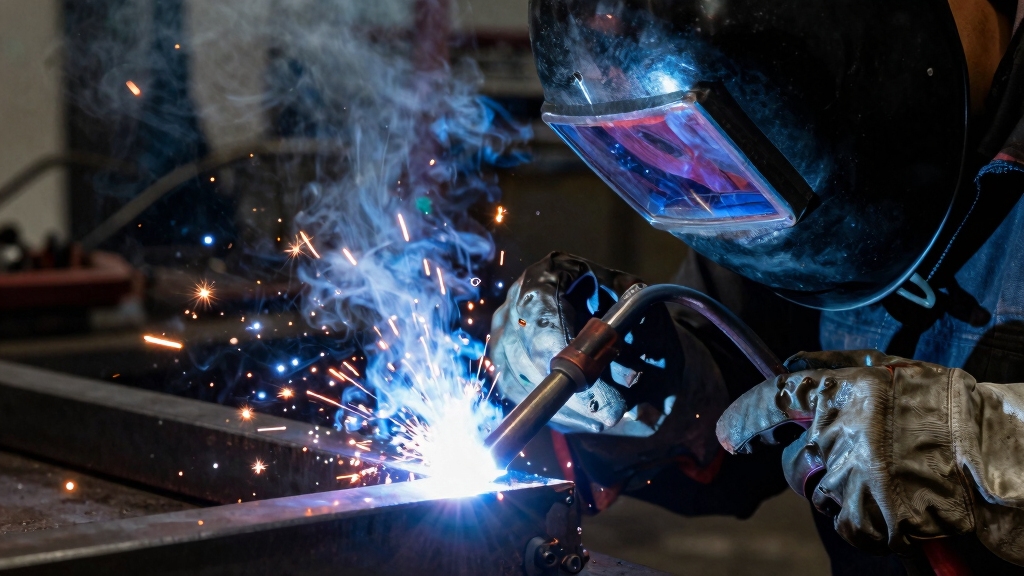
You can MIG weld with 100% argon, but it’s best suited for aluminum or thin materials due to poor penetration and unstable arc on steel.
Argon’s low thermal conductivity creates a narrow, high bead prone to undercutting and cracking when welding carbon steel.
To maintain arc stability, you’ll need to increase voltage and wire feed speed, especially for spray transfer.
For better steel weld quality, gas blends with CO2 or small oxygen additions are recommended. Understanding these factors will help optimize your welding results.
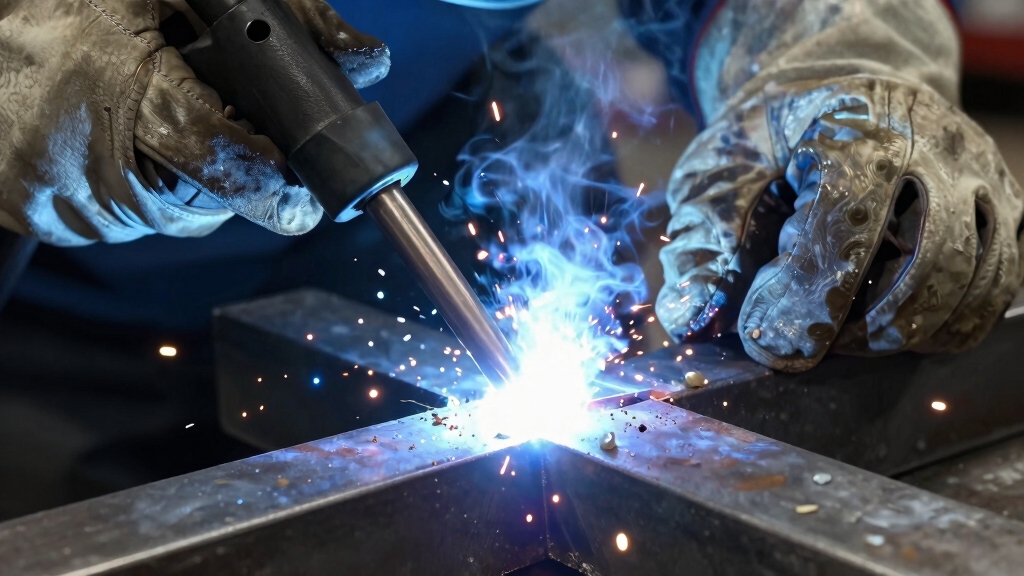
Although 100% argon offers excellent shielding in some welding applications, it presents significant challenges in steel MIG welding.
100% argon provides great shielding but complicates steel MIG welding with arc instability and poor penetration.
You’ll notice the arc becomes unstable due to argon’s lower ionization potential, requiring higher voltage adjustments to maintain stability.
The arc tends to flutter, creating a hazy appearance around the parent metal.
Penetration is narrow and pencil-like because argon’s lower thermal conductivity cools the arc edges, limiting fusion.
Molten puddle viscosity increases, making puddle control difficult and resulting in poor wetting at the toes.
The weld bead typically appears high and narrow, with filler metal sitting on top rather than integrating well.
Mechanically, these welds show reduced ductility and increased brittleness, making them prone to cracking and unsuitable for load-bearing applications without active gases like CO2 or oxygen.
This limitation is why argon-CO2 mixtures are commonly used to enhance arc stability and penetration in steel MIG welding.
When you’re using 100% argon for MIG welding steel, you can anticipate a narrower bead profile. This can really ramp up the risk of undercutting along the edges. Additionally, using pure argon can increase porosity risk in certain welding positions due to insufficient gas coverage.
Why does this happen? Well, argon is inert, which means it doesn’t have that cleaning action that helps in the welding process. This can lead to poor fusion and even potential cracking in your welds. Additionally, argon provides a stable arc but lacks the enhanced penetration properties of gases like CO2, which can affect weld quality on steel.
So, what can you do about it? You’ll need to carefully adjust your welding parameters to mitigate these defects. It’s all about finding that sweet spot to maintain the structural integrity of your welds.
It might take a bit of practice, but it’s definitely worth it for a strong, reliable finish.
Dealing with a narrow bead profile in MIG welding using 100% argon presents significant challenges due to the gas’s impact on arc stability and weld pool dynamics.
Pure argon reduces arc stiffness and causes erratic droplet detachment, leading to inconsistent heat input and shallow penetration. This is why gas mixtures like 75% argon / 25% CO₂ are often preferred to improve arc stability and penetration.
You’ll notice broader weld pools and convex bead shapes because argon’s low arc density fails to concentrate heat effectively.
This expands the weld pool width, making it tough to maintain a tight, narrow bead.
Adjusting travel speed seldom helps, as the weld pool fluidity becomes harder to control, causing irregular solidification and high crown beads.
Without reactive gases like CO₂, you also face poor arc stability, which further compromises precise bead geometry and repeatability in steel MIG welding.
Moreover, inadequate shielding with pure argon can lead to visual defects such as spatter and surface irregularities, affecting weld quality and appearance.
Because pure argon lowers arc voltage and heat input compared to CO2 or argon/CO2 blends, you’ll encounter challenges like undercutting and cracking during weld bead formation. The cooler arc reduces penetration and creates a high-viscosity puddle that resists smooth flow, leading to bead irregularities.
This occurs because pure argon in MIG results in a cold, non-penetrating weld, unlike argon mixtures that provide greater heat and penetration. Argon’s arc stability helps maintain a consistent weld pool despite these challenges.
Undercutting arises from insufficient melt-back and erratic arc behavior, while cracking risks increase due to shallow fusion and stress concentrators at the fusion line.
To manage these issues, consider:
These adjustments help mitigate weld defects inherent with 100% argon shielding.
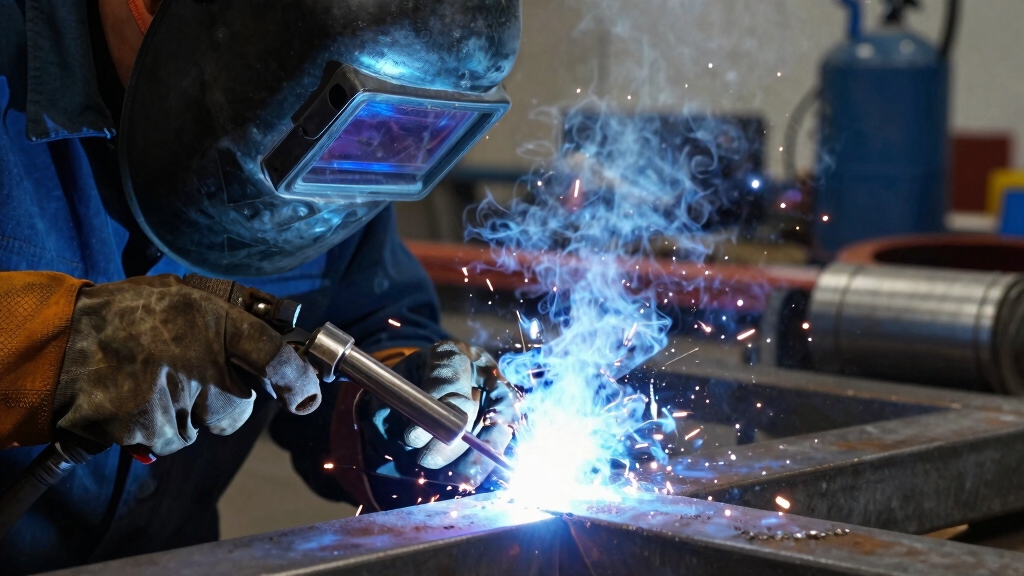
Although you might consider using 100% argon for MIG welding steel due to its availability and common use in aluminum welding, it falls short in delivering proper penetration and stable arc characteristics on carbon and mild steel.
Pure argon produces narrow, convex beads with poor fusion and increased undercutting risk. Instead, industry-standard blends like C-25 (75% Ar/25% CO2) enhance arc stability, penetration, and puddle wetting, reducing spatter and defects.
PrimeWeld offers a 75% argon / 25% CO2 blend specifically formulated for MIG welding to optimize these benefits. Using the correct gas mix helps achieve optimal weld penetration and strength.
Using 100% argon for steel MIG welding often results in poor penetration and unstable arcs.
Lower CO2 blends (90% Ar/10% CO2) offer smoother beads with moderate penetration, while argon-oxygen mixes (2–5% O2) improve arc stability and bead appearance when carefully controlled.
Helium-containing trimixes target specialized stainless steel applications by tailoring heat input and bead profile, though at higher cost. Selecting the right shielding gas blend is essential for best steel MIG weld quality.
When welding aluminum with MIG, you’ll find that 100% argon offers a stable arc thanks to its high ionization potential. This guarantees consistent energy without the instability caused by active gases like CO2.
Proper equipment setup and technique are essential to fully benefit from argon shielding gas in aluminum MIG welding, as mismatches can produce poor weld quality. Plasma cutting principles demonstrate how argon contributes to arc stability in conductive metals like aluminum.
This stability is vital for aluminum’s low melting point and prevents arc wandering. Argon also effectively shields the weld pool from oxidation, maintaining cleanliness and preventing defects.
Key advantages include:
Using 100% argon, you can achieve clean, precise aluminum welds that meet professional standards without complex gas mixtures.
When you’re welding with 100% argon, it’s important to tweak your settings a bit. To get that stable spray transfer, you’ll typically need to crank up the voltage and amperage.
Plus, make sure you have at least 80% argon in the mix. Spray transfer requires a high argon content to produce tiny droplets sprayed precisely across the arc, minimizing spatter. This gas mixture helps maintain a clean, precise arc which is crucial for high-quality welds.
Now, if you’re going for a short-circuit transfer, you can actually use lower settings. But here’s the catch: you’ll need to keep a close eye on things to prevent issues like cold lap, which can be a real headache.
Oh, and let’s not forget about arc stability. Argon does a great job of stabilizing the arc in spray modes. But if there’s too much CO2 in the mix, it can really mess with the quality of the transfer. So, finding that right balance is key.
Since spray transfer demands a stable, fine droplet stream, you’ll need to use high-argon gas mixtures, typically around 80–95% argon, to maintain this mode instead of globular or short-circuit transfer. This is important because higher argon content reduces spatter and improves arc stability, which enhances weld quality.
Pure argon can produce spray-like transfer at high heat input but often results in poor fusion and penetration on carbon steel.
To optimize spray transfer, adjust your parameters carefully:
Increase wire feed speed and arc voltage to meet spray thresholds; higher argon content requires more current and voltage.
Use wire diameters like .035–.045″ ER70S-6 and maintain shorter stickout for higher current density.
Add small amounts (1–5% O2 or 5–10% CO2) to improve puddle wetting and bead profile.
Set lower inductance on inverter machines to stabilize the spray arc with argon-rich gases.
For carbon steel of all thicknesses, a 92% Argon / 8% CO2 mixture is recommended as it provides a fluid and controllable weld puddle with good coalescence and bead contour.
These steps guarantee stable, high-quality spray transfer in MIG welding.
Spray transfer relies on high argon content to maintain a stable, fine droplet stream.
Short-circuit transfer behaves differently under 100% argon shielding.
You’ll find short-circuit transfer more stable at lower wire feed speeds due to reduced arc energy.
However, the short-circuit frequency decreases, so you must lower wire-feed-to-amperage ratios to sustain adequate shorting.
Expect a narrower parameter window.
Voltage and travel speed adjustments are essential to prevent incomplete wetting or excessive bead convexity.
To reduce spatter and stick-outs, increase inductance or soften short-circuit dynamics if your machine allows it.
Use a smaller stick-out to stabilize the shorting cycle.
Since 100% argon shifts transfer modes toward spray at lower currents, keep wire feed and voltage settings low to maintain short-circuit.
If instability persists, consider pulsed output or adding a small CO2 fraction.
It is important to note that welding parameter selection must consider droplet size, transit time and arc position on wire tip to minimize fume formation.
Additionally, understanding the arc temperature range in MIG welding helps optimize transfer mode and weld quality.
Although achieving arc stability with 100% argon shielding requires careful parameter control, you can optimize transfer modes by adjusting wire feed speed and voltage to suit material thickness and weld position. Proper electrode selection and tip geometry also play a crucial role in maintaining arc stability during welding.
Spray transfer dominates with increased amperage and voltage, producing fine droplets for precise, high-deposition welds on thicker materials. Pulsed spray transfer further refines control, enabling all-position welding with reduced heat input via pulse modulation. This process typically requires a water-cooled gun to manage the higher currents involved in spray transfer.
To maintain arc stability, consider these key adjustments:
Increase wire feed speed to 8–10 m/min and voltage to 28–32 V for stable spray transfer.
Employ pulsed mode with specialized power sources to regulate peak and background currents.
Maintain short arc lengths to minimize fume emissions and stabilize droplet size near wire diameter.
Add helium if needed to improve wetting and prevent convex bead formation during spray transfer.
These controls guarantee consistent, defect-free welds under 100% argon shielding. Selecting appropriate tungsten electrode types can further enhance arc stability and weld quality in TIG processes.
When you add CO2 or oxygen to argon-based shielding gases, you markedly influence arc behavior, metal transfer, and weld pool characteristics.
Adding CO2 or oxygen to argon shielding gases significantly changes arc dynamics and weld pool behavior.
CO2 increases penetration and produces a narrower, more forceful bead but raises spatter due to globular or short-circuit transfer modes.
It dissociates in the arc, releasing oxygen that alters surface chemistry and promotes oxide formation, impacting toughness and potentially causing carbon pickup in sensitive alloys.
Conversely, small oxygen additions (1–5%) enhance arc stability and wetting, improving bead smoothness and penetration with less spatter than CO2.
Oxygen doesn’t dissociate like CO2, minimizing metallurgical drawbacks.
Mixed-gas selection also reduces the need for extensive inventories of filler metals or gases by tailoring specific gas mixtures to alloys and thicknesses, improving operational efficiency. mixed-gas selection benefits
You must balance productivity, spatter, and mechanical properties by selecting appropriate CO2 or oxygen levels for your base metal and wire chemistry, as excessive CO2 or oxygen can degrade weld quality.
Because gas requirements directly affect weld quality and process stability, understanding the differences between TIG and MIG shielding gases is essential.
TIG welding relies primarily on high-purity argon (≥99.995%) to guarantee clean, oxidation-free arcs and welds. It also requires careful flow rate control to ensure optimal shielding.
MIG welding, however, uses argon-based mixtures with active gases like CO2 or O2 to maximize arc stability, penetration, and bead profile based on metal type and transfer mode.
TIG demands very high-purity argon, often with back-purge for root shielding.
MIG employs argon-CO2 blends (e.g., C25) for short-circuit transfer and argon-He mixes for spray transfer.
Pure argon suits TIG and aluminum MIG for oxidation prevention.
Active gases in MIG modify weld chemistry, increasing penetration and transfer stability.
You must match gas composition to welding method and material to achieve peak results.
Selecting the right shielding gas for MIG welding depends on several factors including the base metal, wire type, and desired weld characteristics.
For aluminum, 100% argon guarantees arc stability and excellent cleaning action, ideal for short-circuit transfer. This pure inert gas prevents oxidation and contamination, ensuring a clean weld.
When welding carbon steel, avoid pure argon; instead, use CO₂ or argon/CO₂ blends like 75/25 Ar/CO₂ to achieve deeper penetration and stable spray transfer.
Stainless steel benefits from tri-mix gases with small oxygen or hydrogen additions to improve wetting and bead contour.
Consider arc stability, bead profile, and spatter levels when choosing gas.
Also, factor in cost and availability—CO₂ is economical but rougher, while argon blends improve quality at higher expense.
Finally, always follow wire manufacturer recommendations to prevent porosity or transfer issues.
Make certain your equipment matches gas requirements for peak performance.
You can’t rely on 100% argon safely for outdoor MIG welding because wind disperses the shielding gas, causing porosity and weld defects.
Even if you increase flow rates, gas coverage remains unstable in open air.
To guarantee weld integrity outdoors, you need wind protection or alternative processes like flux-cored welding.
Use 100% argon primarily indoors or for aluminum, where it’s effective.
Outdoors, shielding gas stability becomes your biggest challenge.
You might picture a clean, steady arc, but using 100% argon for MIG welding steel often hikes your costs.
It lowers deposition rates and slows travel speed, raising labor expenses.
Plus, expect more spatter and wire waste, which increases consumable costs.
Equipment upgrades for argon compatibility add capital expenses.
In contrast, Ar/CO2 blends optimize productivity and reduce rework, making them more cost-effective for steel MIG welding.
Choose wisely to control your budget.
You don’t need special equipment to MIG weld with pure argon; standard MIG setups handle it well.
However, you’ll have to adjust your welding parameters markedly since pure argon alters arc characteristics and penetration.
Using unchanged settings leads to poor weld quality, especially on steel.
Gas flow rates for short-circuit MIG typically range from 25-35 cubic feet per hour.
You’ve got to overhaul your maintenance routine!
With 100% argon, you must constantly verify gas purity—no room for impurities beyond 99.997%.
Monitor and adjust flow rates meticulously to keep laminar flow, avoiding turbulence that invites contamination.
Regularly inspect consumables for compatibility since argon’s flow velocity differs.
Also, clean and check your torch and liners more often to prevent buildup caused by erratic arcs.
Precision in maintenance is your shield here.
Yes, 100% argon can affect your welding consumables’ lifespan.
Its constricted, hotter arc increases thermal loading on contact tips and liners, accelerating softening and spatter buildup.
You’ll likely see faster wear, especially under high-amp or long-duty-cycle conditions.
To counter this, you should adjust parameters like drive speed and voltage, use larger-diameter consumables, and schedule cooling intervals to reduce heat stress and extend consumable durability.
You can MIG weld with 100% argon, but it’s not always ideal for steel due to poor bead formation and less stable transfer modes.
Remember, “the right tool for the right job” applies here. Argon excels with aluminum MIG welding but requires mixing with CO2 or oxygen for steel to achieve peak penetration and arc stability.
Adjust your parameters carefully and choose your shielding gas based on the metal and weld characteristics you need.