Phone:
(701)814-6992
Physical address:
6296 Donnelly Plaza
Ratkeville, Bahamas.

Phone:
(701)814-6992
Physical address:
6296 Donnelly Plaza
Ratkeville, Bahamas.

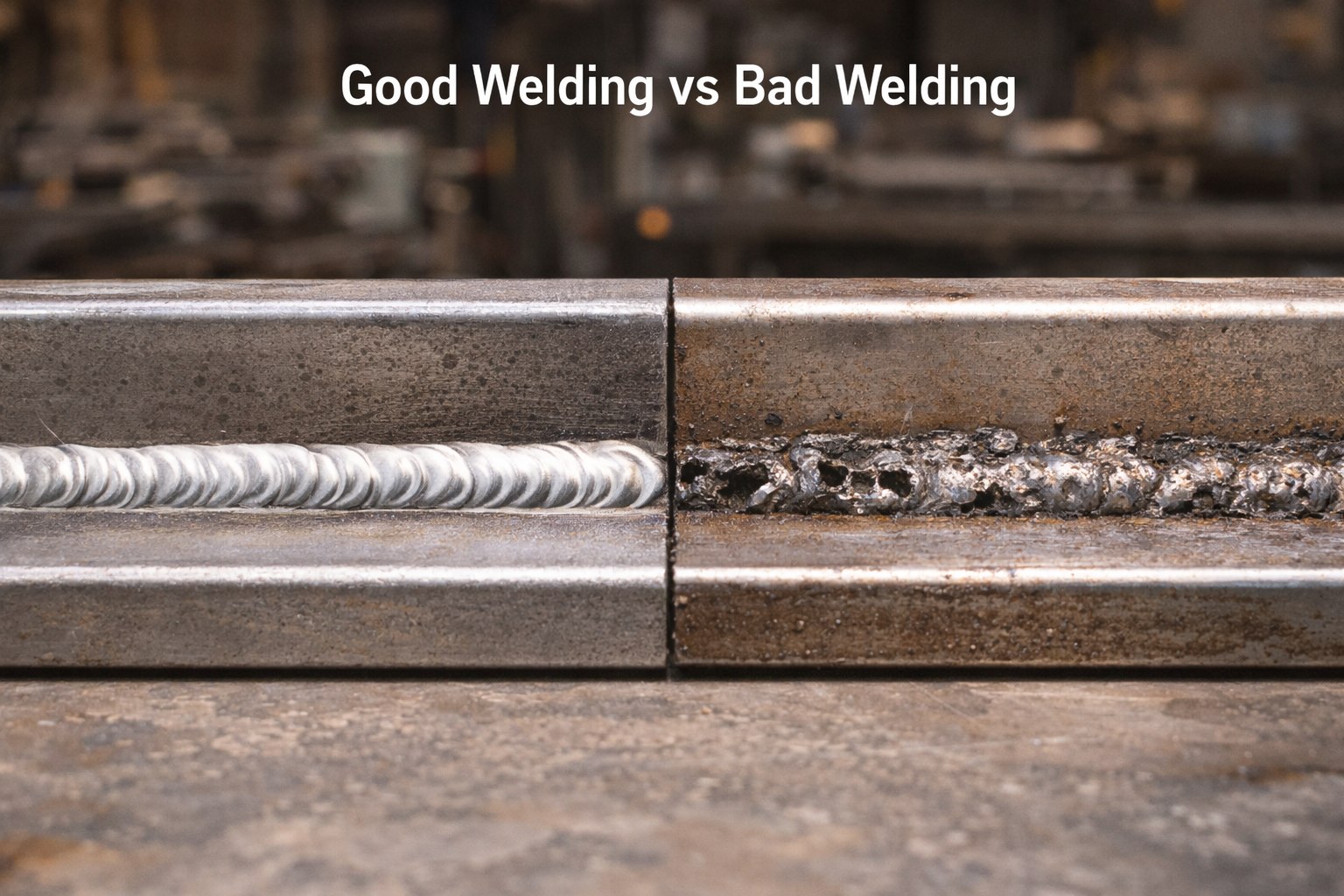
You can tell good welding from bad by a smooth, uniform bead free from cracks, porosity, or undercut. This ensures strong fusion and proper penetration.
Good welding uses controlled heat, clean surfaces, and correct parameters to prevent defects that weaken joints and reduce durability.
Bad welding often shows inconsistent bead shape, visible defects, and poor metallurgical bonding, risking structural failure.
Understanding inspection methods, process controls, and quality management helps you identify and achieve superior welds.
| Aspect | Good Welding | Bad Welding |
|---|---|---|
| Bead Appearance | Smooth, uniform, defect-free with consistent width and height | Irregular, uneven, spattered, often with undercut or overlap |
| Fusion & Penetration | Complete fusion, deep penetration, strong metallurgical bonding | Shallow penetration, lack of fusion, weak joint strength |
| Surface Defects | No cracks, porosity, or inclusions | Visible cracks, porosity, slag inclusions |
| Heat-Affected Zone (HAZ) | Controlled microstructure, minimal stress, preserved toughness | Excessive grain growth, brittleness, residual stresses |
| Structural Integrity | Strong, durable, stress-resistant | Prone to failure under load, weak and brittle |
| Process Control | Optimized parameters, clean surfaces, correct consumables | Inconsistent technique, improper heat input or materials |
| Inspection Compliance | Meets WPS standards, passes NDT and destructive tests | Fails inspection, potential hidden defects |
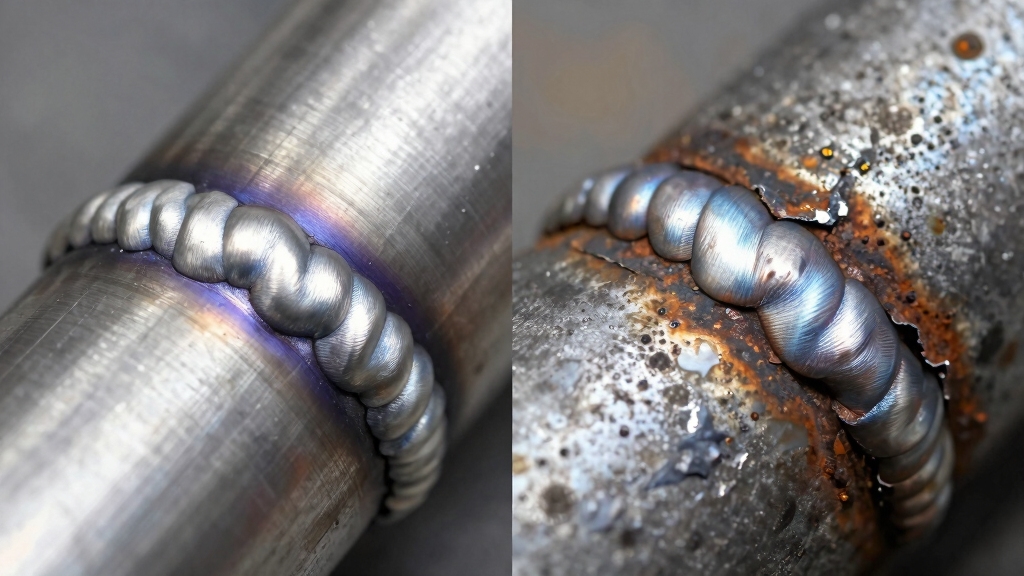
When inspecting welds, you’ll often find that bead appearance and uniformity serve as the first indicators of quality. You should look for consistent bead width and height along the weld length, signaling steady travel speed and heat input. This visual inspection is a crucial step in detecting surface defects early and helps ensure the structural integrity of the weld.
A smooth, slightly convex profile with even ripples, such as the “stacked-dimes” pattern in TIG welding, indicates controlled puddle and repeatable technique. Avoid excessive convexity or concavity, which can concentrate stress.
Make certain no visible spatter or excess weld material on the base metal, as spatter suggests incorrect parameters or contamination. Uniform color and texture across the bead, with acceptable minor hues, reflect proper shielding and heat control.
Surface defects like cracks, porosity, undercut, slag inclusions, or lack of fusion must be absent to confirm weld quality.
To achieve a solid weld, it’s important to ensure full fusion and penetration. This means the base and filler metals need to bond uniformly without any weak spots. You see, controlling heat input and cooling rates plays a crucial role here.
If not managed properly, it can lead to cracks and compromise the metallurgical structure within the heat-affected zone. Proper heat input management produces strong welds with adequate fusion and reduces distortion. The final joint strength depends significantly on the welding method, tools, and materials used.
Although achieving sound fusion and penetration demands careful control, these factors critically determine a weld’s structural integrity and metallurgical quality.
You must guarantee the weld metal fully bonds with the base metal at the molecular level, eliminating unfused zones that cause weak points. The deep penetration capability of certain welding rods ensures aggressive fusion essential for root passes.
Deep penetration is essential to fuse the base metals completely, enhancing load capacity and durability.
Pay attention to heat input, electrode diameter, and amperage for consistent root fusion.
Poor fusion and shallow penetration result in defects equivalent in severity to cracks, risking fractures and leaks.
Both lack of fusion and lack of penetration create weak points that may remain undetected until failure, making nondestructive testing crucial for weld quality assurance.
Key points to ponder:
Achieving proper fusion and penetration lays the groundwork for preventing cracks that compromise weld integrity. Controlling the welding heat input is essential to avoid metallurgical changes that weaken the weld zone.
You must follow a well-defined Welding Procedure Specification (WPS) that details base and filler metals, preheat and interpass temperatures, heat input, and shielding gas to control metallurgical soundness. Monitoring and maintaining the specified thermal parameters helps preserve optimal microstructure and mechanical properties.
Use low-hydrogen consumables and maintain strict moisture control to minimize diffusible hydrogen, a primary cause of delayed cracking.
Implement balanced welding sequences and apply mechanical stress-relief methods like peening to manage residual stresses effectively, since high residual stresses are a key factor promoting cold cracking.
Optimize joint design with smooth transitions and proper fit-up to reduce stress concentrations. Proper fit-up also helps maintain consistent heat distribution during welding, reducing localized overheating.
Finally, make certain cleanliness before welding to prevent inclusions. Together, these strategies reinforce structural integrity and reduce crack initiation and propagation risks, assuring durable, reliable welds.
Understanding the effects within the Heat-Affected Zone (HAZ) is essential for ensuring structural integrity and metallurgical soundness in welded joints.
The HAZ experiences microstructural transformations that can compromise performance if uncontrolled. You must consider these critical factors:
The rate of heat input during welding directly influences the size of the HAZ, affecting the extent of microstructural and property changes. Controlling heat input with appropriate welding methods like TIG or pulsed MIG helps minimize distortion and carbide precipitation within the HAZ.
Proper control of heat input, cooling rates, and post-weld heat treatments helps you maintain optimal HAZ properties. This ensures durable, high-quality welds.
When you inspect welds closely, you’ll find defects that compromise structural integrity and performance.
Cracks, whether hot, cold, or reheat, originate from factors like high restraint, rapid cooling, hydrogen contamination, or poor material selection. This weakens tensile strength and fatigue life. Cold cracks develop after solidification and may appear days later, requiring careful monitoring and preheating to prevent.
Lack of fusion results from inadequate heat, improper angle, or contamination. This produces weak interfaces that are prone to failure. Proper surface preparation is essential to avoid contamination and ensure quality bonding.
Porosity arises from moisture, rust, or incorrect shielding gas, creating gas pockets that reduce ductility and cause leak paths.
Undercut, overlap, and reinforcement issues stem from excessive heat, poor technique, or incorrect current. These act as stress concentrators and complicate inspection.
To avoid these defects, control heat input, maintain clean surfaces, select proper consumables, and apply correct welding parameters. This ensures sound metallurgical bonding and peak weld quality.
When it comes to assessing weld quality, the first step you’ll take is visual weld inspection. This is where you’ll look closely at the welds to spot any surface defects and check if everything measures up correctly. Surface indication is especially useful during visual inspection for early detection of defects such as porosity or cracks. Proper surface preparation and corrosion-resistant primers are essential factors that influence the overall weld inspection results.
After that, you can move on to non-destructive testing methods, such as ultrasonic or radiographic testing. These techniques are pretty cool because they let you find any internal flaws without causing any damage to the weld itself.
Now, if you’re dealing with critical applications, you might want to consider destructive mechanical testing. This method really gives you the final word on weld quality since it involves physically stressing the weld samples until they fail. It might seem extreme, but it’s a reliable way to ensure that the weld can handle its intended load.
Although visual weld inspection may seem straightforward, it demands strict adherence to standardized procedures and precise measurement techniques to accurately assess weld quality.
You’ll need proper lighting (minimum 1,000 lux) and essential tools such as fillet weld gauges, calipers, magnifiers, flashlights, and straightedges. Preparing the weld surface according to preparation steps enhances the accuracy of defect detection. Additionally, selecting the appropriate shade number for inspection lighting can help reduce eye strain and improve defect visibility.
Clean the weld surface thoroughly before inspection to avoid masking defects.
Focus on these critical areas:
Document findings meticulously and enforce hold points when defects exceed acceptance criteria.
Employing non-destructive testing (NDT) methods allows you to assess weld quality without damaging the component, ensuring structural integrity while maintaining usability. These methods rely heavily on the competence and training of the inspector to ensure reliable results. Maintaining certification continuity through regular welding activity is essential for inspectors to stay qualified and proficient in these techniques.
Liquid Penetrant Testing detects surface-breaking defects by applying dye that penetrates cracks, then using a developer to reveal flaws visually.
Magnetic Particle Testing identifies surface and near-surface discontinuities in ferromagnetic materials via iron particle accumulation in magnetic fields.
Ultrasonic Testing employs high-frequency sound waves to locate internal flaws, with techniques like Phased Array and Time of Flight Diffraction enhancing accuracy.
Radiographic Testing uses X-rays or gamma rays to produce internal weld images, highlighting voids or cracks.
Eddy Current Testing detects surface and subsurface defects in conductive materials by monitoring changes in electromagnetic induction.
Selecting appropriate NDT methods depends on material type, defect location, and inspection depth, and inspectors must maintain certification records to ensure ongoing compliance with industry standards.
Non-destructive testing methods provide valuable insights into weld integrity without impairing the component. However, certain assessments require physically altering the weld to obtain detailed mechanical performance data.
Destructive mechanical testing reveals internal weld properties and confirms compliance with design specifications. Here are four key techniques you should know:
These tests provide quantitative metrics critical for procedure qualification, welder performance, and failure analysis. They ensure welds meet safety and quality standards.
When you adjust welding parameters like current amperage, voltage, travel speed, wire feed speed, and shielding gas flow, you directly influence weld quality and performance.
Current amperage controls weld size and penetration; too high risks spatter and burn-through, too low causes weak fusion.
Voltage sets arc length and bead profile; excessive voltage leads to turbulent weld pools, insufficient voltage causes poor arc starts and spatter.
Travel speed balances heat input; too fast results in incomplete penetration, too slow causes warping. Consistent monitoring and adjustment are necessary to maintain weld quality and integrity.
Wire feed speed in MIG welding regulates amperage; incorrect speed alters bead shape and fusion.
Shielding gas flow protects the weld pool; low rates invite porosity, high rates create turbulence and contamination.
Precise control of these parameters guarantees consistent, defect-free welds matching material thickness and application requirements.
By paying close attention to proper welding practices, you greatly enhance the durability of welded joints. Effective material preparation, defect prevention, tensile strength optimization, and rigorous inspection form the backbone of durable welds.
Consider these critical factors:
Implementing these practices guarantees welds withstand operational stresses, prolonging structural longevity while mitigating failure risks in critical applications.
Maintaining consistency in welding quality hinges on thorough training programs and meticulous documentation practices. You must implement standardized training syllabi, competency assessments, and multimodal instruction to guarantee uniform skills. Comprehensive training also ensures that all team members understand the critical importance of documentation essential alongside their technical skills. Additionally, emphasizing the use of protective gloves during training reinforces safety protocols that prevent common hand injuries.
Concurrently, maintain updated Welding Procedure Specifications (WPS) and Procedure Qualification Records (PQR) with strict version control and welder qualifications. Centralize document management with audit trails and controlled access, enabling easy retrieval and compliance verification.
Supervision and inspection protocols, supported by documented feedback loops, detect deviations early and prevent recurrence.
| Aspect | Key Elements |
|---|---|
| Training | Standardized syllabus, competency tests |
| Procedure Docs | WPS/PQR version control, welder qualification |
| Document Control | Centralized management, audit trails |
| Supervision & Feedback | Inspection plans, nonconformance reporting |
This framework minimizes variability and sustains welding quality across operations.
You should know welding environment temperature directly impacts weld quality by influencing cooling rates and fusion.
Cold ambient or base metal temperatures increase heat extraction, raising risks of incomplete fusion, residual stresses, and cold cracking.
Conversely, high ambient temperatures reduce heat sink effect, potentially causing excessive penetration or burn-through.
Managing temperature differentials prevents condensation and hydrogen pickup, which cause defects.
Did you know over 50% of welding-related injuries involve eye damage? You must wear a welding helmet with an appropriate filter shade to protect your eyes and face from harmful rays and sparks.
Use safety glasses underneath for extra protection when lifting the helmet. Don’t forget flame-resistant clothing, leather gloves, and steel-toe boots for heat and impact resistance.
Respirators and hearing protection are essential when fumes or noise exceed safe limits, ensuring your safety on every job.
You’ll find MIG welding offers the best cost efficiency with lower equipment costs and high deposition rates, reducing overall expenses by 20-50%.
TIG is pricier but ideal for precision, minimizing rework on high-value parts despite slower speeds.
Stick welding is cheapest upfront but labor-intensive and less efficient for production.
Flux-cored welding balances high deposition and outdoor usability, cutting rework markedly while boosting productivity in heavy fabrication.
Sure, you can just weld exotic metals like you do with scrap steel if you enjoy ruined parts and epic failures.
In reality, you adapt welding techniques by matching the process to metal type, controlling heat input with pulsed modes, and using solid-state joining when fusion harms microstructures.
You also maintain inert atmospheres to prevent contamination, select compatible fillers, and rigorously control parameters to preserve mechanical properties and avoid costly defects.
Post-weld heat treatment (PWHT) markedly enhances durability by relieving residual stresses and preventing distortion or cracking.
It refines the heat-affected zone’s microstructure, improving toughness and ductility while reducing hardness gradients that cause embrittlement.
PWHT also allows hydrogen to diffuse out, minimizing cracking risks.
You might assume that perfect visual appearance guarantees weld quality, but that’s not always true.
While good welding often shows consistent beads and minimal defects, structural integrity depends on metallurgical soundness and proper parameters.
By rigorously inspecting welds and adhering to precise techniques, you make certain durability and performance.
Remember, maintaining consistency through training and documentation is vital. Without it, even seemingly flawless welds can fail under stress.