Phone:
(701)814-6992
Physical address:
6296 Donnelly Plaza
Ratkeville, Bahamas.

Phone:
(701)814-6992
Physical address:
6296 Donnelly Plaza
Ratkeville, Bahamas.

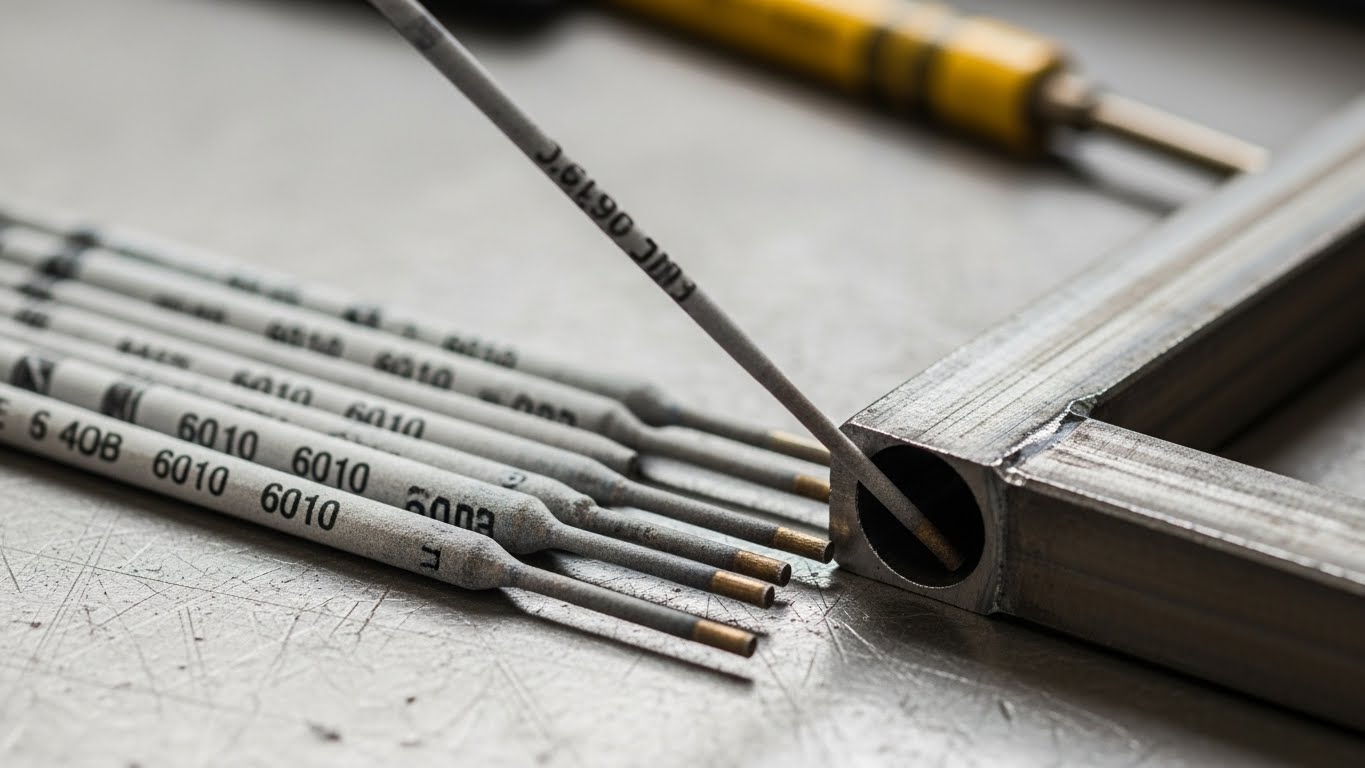
6010 welding rods are your go-to for deep-penetration root passes on carbon-steel pipelines and structural fabrications.
They produce an aggressive, forceful arc with fast-freezing, thin slag that’s easy to chip away, allowing reliable welds even on rusty or mill-scaled surfaces.
Ideal for all positions, they excel in pipeline construction, shipbuilding, and outdoor maintenance where strong arc force and quick slag removal matter.
If you want to understand their techniques and advantages more thoroughly, there’s further detail ahead.
Although 6010 welding rods are versatile, they excel in applications requiring deep penetration and strong root fusion, such as pipe welding and pipeline root passes. Proper adjustment of welding parameters and maintaining a short arc length are essential to maximize their performance and reduce defects.
6010 welding rods deliver deep penetration and strong root fusion, ideal for pipe and pipeline root pass welding.
You’ll find these rods preferred for root-pass welding in butt and girth joints on carbon-steel pipes, owing to their forceful arc action and cleaning ability that removes mill scale and contaminants.
They’re commonly used in pipeline construction and repair, running on DCEP polarity to maximize penetration and travel speed. The fast-freezing slag system of 6010 rods helps provide good bead shape control and quick welds.
In structural steel fabrication, 6010 rods provide reliable fusion for root and initial passes, tolerating mill scale and light rust. Their all-position capability also suits field and confined welding conditions, where heat input management is critical to avoid distortion.
You can also use them in shipbuilding, marine repair, and heavy equipment maintenance, especially where deep penetration and cleaning action are crucial on contaminated or rough surfaces.
Their all-position capability suits field and confined welding conditions.
You’ll notice that 6010 rods really shine when it comes to deep penetration. This makes them perfect for those root passes and for welding on thicker materials. Have you ever tried them for that? They work wonders! Their ability to provide consistent arc stability is comparable to the gas mixtures used in MIG welding for deep penetration.
What’s fascinating is their cellulose-based flux. It produces a forceful, spray-type arc that not only cleans the weld pool chemically but also keeps the arc stable. Pretty neat, right? Their fast-freeze characteristics allow the weld puddle to solidify quickly, giving welders better control.
Another great thing about these rods is their versatility. They’re designed for all-position welding, so whether you’re working on vertical, overhead, or flat joints, 6010 rods have got you covered. It’s just one more reason to love using them!
When you need deep penetration in your welds, 6010 welding rods deliver exceptional performance by producing an aggressive digging arc that fuses base metals thoroughly. This ability guarantees robust weld integrity and full root penetration, essential for structural steel and pipe joints. Proper nozzle positioning and welding technique help maintain consistent bead quality during the process. You’ll appreciate how the rod’s forceful base metal melt achieves tensile strength up to 60,000 psi, surpassing many standard electrodes. 6010 rods are also suitable for mild and low-alloy steels, making them ideal for pipe welding and structural work.
Key aspects of 6010’s deep penetration include:
Mastering these characteristics lets you create strong, durable welds in various industrial applications in demanding environments.
Because 6010 welding rods utilize a cellulose-based flux, they exhibit distinctive characteristics that enhance arc stability, penetration, and slag behavior.
The high cellulose content decomposes into hydrogen-rich gases, creating a protective, turbulent shield that stabilizes the arc and improves penetration. Sodium compounds boost arc force, while iron powder increases deposited metal and heat output, allowing faster travel speeds. These factors contribute to the intense arc brightness that requires a darker welding shade for optimal eye protection.
The flux’s mineral additives produce a fast-freezing, thin, friable slag that’s easy to chip away, reducing post-weld cleaning time. This slag also minimizes adhesion and contamination risks.
Additionally, the thick flux coating tolerates surface contaminants like rust or mill scale, making 6010 rods ideal for outdoor or maintenance work where cleanliness can’t be guaranteed.
Proper polarity (DCEP) maintains these benefits, ensuring consistent arc performance and weld quality. The fast-freezing, light slag formed by titanium dioxide in the flux allows welding in vertical and overhead positions with easy slag removal.
Frequently chosen for its versatility, the 6010 welding rod excels in all-position welding thanks to its deep penetration and aggressive arc characteristics. You can rely on it for flat, horizontal, vertical, and overhead positions, classified as “1” by AWS standards. Proper ventilation and respiratory protection should be considered when welding to minimize exposure to hazardous fumes.
Its fast-freeze puddle solidification minimizes sagging, essential for vertical and overhead work. When welding out-of-position, reduce amperage about 15% from flat settings to control the puddle effectively.
Key features include:
The rod’s cellulose-based flux generates CO2 gas that contributes to its deep penetration and weld protection.
This makes the 6010 ideal for pipe roots and structural welding where positional flexibility is critical.
Although 6010 rods demand careful control, you’ll achieve ideal results by setting your welder to DC electrode positive (DCEP) with amperage tailored to the rod diameter. Typically, this is 90 to 130 amps for 1/8″. Make sure to experiment with arc force settings, aiming for around 30% dig sensitivity to improve puddle behavior during welding. Maintain a short arc length about the rod’s diameter. Hold the rod at a 10–20° drag angle to direct heat efficiently.
For 6010 rods, use DC electrode positive with 90 to 130 amps for optimal welding control.
Employ a whip-and-pause technique to expand the puddle and allow slag to form, which is vital for root passes and open joints.
Maintain a controlled, slow travel speed to guarantee full penetration without excessive reinforcement. For vertical-up welding, use short, fast whips with pauses to stack layers without collapse.
Always chip and wire brush slag between passes to avoid defects. Adjust arc force modestly to maintain penetration while preventing excessive digging and spatter.
When you choose 6010 welding rods, you gain deep penetration and reliable root-pass performance that surpass many other electrodes. These rods excel in welding applications where joint integrity and full penetration are critical. Understanding the welding environment and electrode characteristics is key to achieving optimal results with 6010 rods, especially when managing arc stability and penetration.
Here are four key advantages of 6010 rods compared to others:
You’ll find 6010 welding rods are super popular in the pipeline and construction industries. Why? Because their deep penetration and ability to weld in any position ensure strong and reliable welds on all sorts of pipe materials. Proper heat control and electrode angle are important to reduce defects and porosity when using these rods.
Now, let’s talk about shipbuilding and maintenance. These rods really shine here too, handling demanding tasks like hull and bulkhead welding with impressive precision and durability. They typically have a recommended polarity of DCEP (Reverse Polarity) which helps achieve optimal welding performance.
All in all, their versatility is a game changer! They’re absolutely essential for any job that calls for robust welds, especially in challenging conditions.
Because 6010 welding rods deliver deep penetration and fast-freeze characteristics, they’re widely used in pipeline and construction industries where reliable root passes and rapid welding cycles are critical. You’ll find them preferred for root passes in transmission pipelines, ensuring full joint penetration even on contaminated surfaces. Their all-position capability speeds up tie-ins and repair work on buried lines. In fact, downhand 6010 welding is a production-favored technique on mainline pipelines due to its speed advantage over vertical methods. The effectiveness of these rods is enhanced when used with proper surface preparation to ensure weld integrity. In structural applications, 6010 rods provide strong welds under dynamic loads for pump stations and pipe supports. They’re also used in fabrication yards for hydrocarbon piping, where speed and reproducibility are essential.
Beyond pipeline and construction, 6010 welding rods find extensive application in shipbuilding and maintenance due to their deep penetration, fast-freeze slag, and all-position welding capabilities.
You’ll rely on them for hull fabrication, performing root and tack welds on carbon-steel plates with excellent cleaning action and minimal distortion. Their versatility lets you weld complex hull curvatures in flat, vertical, overhead, and horizontal positions.
During repairs, 6010 rods tackle rusted or scaled surfaces effectively, enabling reliable single-pass root welds on pressure vessels and hull penetrations. They’re indispensable for joining decks, bulkheads, and internal stiffeners where structural integrity and radiographic-quality roots are essential. The rods are specifically designed for use with DCEP power/current, which enhances their welding performance and penetration characteristics recommended use.
In offshore fabrication and ship repair yards, their tolerance for contamination and portability support efficient maintenance, even under adverse conditions. This reduces downtime and ensures durable, defect-free welds in marine environments.
When selecting 6010 welding rods, you must carefully consider factors such as base material compatibility, joint design, and welding parameters to guarantee peak performance. These rods excel in deep penetration and cleaning action, but their effectiveness depends on matching them to your specific application. Known for producing x-ray quality welds in all positions, 6010 rods are especially valued in critical welds requiring high integrity.
Choosing the right 6010 welding rod ensures deep penetration and optimal cleaning tailored to your project’s needs.
Keep these key considerations in mind:
No, you can’t effectively use 6010 rods with AC welding machines. They require DC+ polarity for a stable arc and deep penetration.
Using AC causes erratic arc behavior, poor weld quality, and inconsistent penetration because the cellulose-based flux doesn’t burn properly on AC.
If you need AC compatibility, consider E6011 rods, which mimic 6010 characteristics but work well on both AC and DC power sources.
You store 6010 welding rods in airtight, moisture-proof containers like hermetically sealed cans or vacuum-packed packaging to prevent moisture absorption.
Keep them in dry, temperature-controlled environments away from humidity, direct sunlight, and extreme temperatures.
Use rod ovens only if the temperature matches cellulosic tolerance, typically around 200°F or less.
Always handle rods with clean, dry gloves and inspect them for damage before use to maintain peak performance.
Think of welding as entering a dragon’s den; you need armor.
You’ll wear a welding helmet with shade 10–13, safety goggles beneath to shield eyes from sparks and slag, and flame-resistant clothing covering all skin.
Leather gloves, apron, and boots protect you from heat and molten metal.
Use respiratory protection, a NIOSH-approved respirator or local exhaust, to avoid toxic fumes.
Always inspect gear for damage to maintain full, reliable protection during 6010 welding.
You should wait about 10 to 30 seconds after completing a 6010 weld pass before removing the slag.
This short wait allows the thin slag layer to cool just enough to avoid burn hazards but remain warm enough to chip off easily without cracking or sticking.
Removing slag promptly after each pass guarantees a clean weld bead, preventing contamination and preparing the surface properly for subsequent passes or filler layers.
No, you shouldn’t use 6010 rods for aluminum or non-ferrous metals. They’re designed for mild steel and produce iron-rich welds incompatible with aluminum’s chemistry.
Using them on aluminum causes brittle intermetallics, poor fusion, and cracking due to different melting points and unsuitable flux.
Instead, use aluminum-specific fillers like ER4043 with GTAW or GMAW processes to make certain strong, defect-free welds that meet safety and quality standards.
When you choose 6010 welding rods, you’re wielding a precision tool designed to cut through rust and dirt like a surgeon’s scalpel.
Their deep penetration and fast-freezing arc make them ideal for challenging conditions, ensuring strong, reliable welds every time.
Whether you’re working in construction or pipeline repair, these rods deliver consistent performance.
Keep their key traits in mind, and you’ll master tough welding tasks with confidence and accuracy.