Phone:
(701)814-6992
Physical address:
6296 Donnelly Plaza
Ratkeville, Bahamas.

Phone:
(701)814-6992
Physical address:
6296 Donnelly Plaza
Ratkeville, Bahamas.

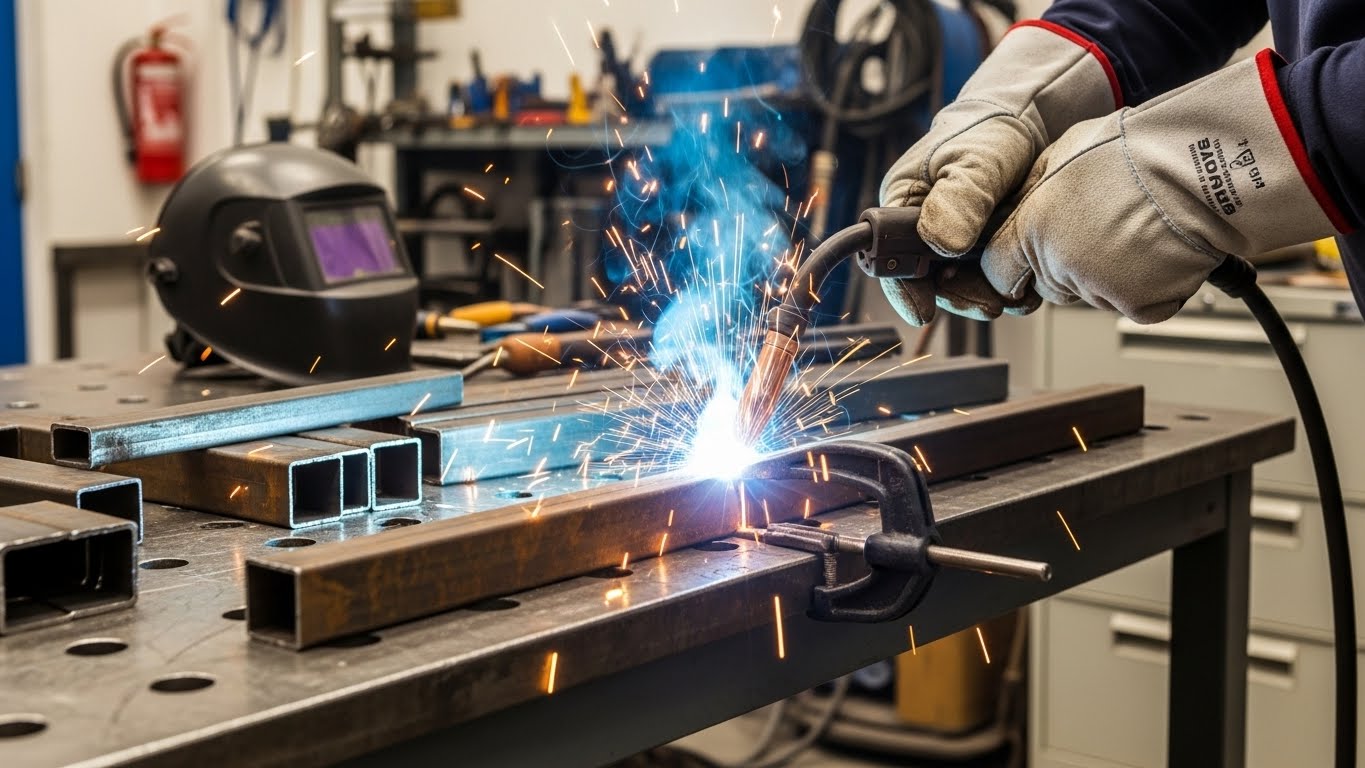
You’ll benefit from MIG welding’s high speed, steady wire feed, and broad material compatibility, especially with mild steel and aluminum. It’s user-friendly, offering quick proficiency and smooth operation.
Yet, be aware of precision constraints, heat-induced distortions, and challenges when welding out-of-position or heat-sensitive metals. Costs include equipment, consumables, and maintenance, affecting your budget.
Understanding these trade-offs empowers you to optimize efficiency and quality while avoiding common pitfalls, with more insights available to refine your approach.
Frequently, choosing MIG welding translates directly into faster travel speeds and enhanced productivity compared to other welding methods. You can achieve travel speeds up to 90 cm/min on 10-mm plates with Spray Arc Transfer (SAT), nearly doubling robotic speeds and tripling manual rates. The optimal gas mixtures and proper heat management are crucial to maintain weld quality at these increased speeds.
In practical terms, SAT boosts throughput by 8-10% and sharply cuts defects in applications like truck compressor tanks and crane box beams. Pulsed MIG further increases speeds while minimizing spatter. The continuous wire feed and stable arc allow you to maintain steady deposition rates, reducing cycle times by up to 50% in automotive exhaust pipe welding. Additionally, replacing larger diameter wires with smaller diameter non-copper-coated wire enables much higher wire feed speeds, resulting in significant productivity gains.
These factors combine to lower labor hours and material waste, while improving weld consistency and minimizing rework. This makes MIG welding a highly efficient choice for industrial productivity.
Although mastering welding techniques can be challenging, MIG welding offers a relatively straightforward entry point for beginners due to its simple setup and intuitive operation.
You only need to learn three main factors: gun distance, angle, and movement. The continuous feed wire and shielding gas system simplify equipment choices and machine adjustments like wire feed speed and voltage. Using a 75% argon / 25% CO2 blend or straight CO2 as the shielding gas ensures proper protection and weld quality. Proper welding parameters adjustment is critical to avoid defects and ensure strong welds.
You can quickly gain initial proficiency, especially by practicing gun positioning during “dry runs” before striking an arc.
Still, achieving consistent quality welds demands mastering travel speed and subtle gun manipulation.
Focusing on one variable at a time accelerates learning, while visual feedback from the open arc helps you identify defects early.
MIG welding is pretty versatile! It’s compatible with a wide range of metals, like mild steel, aluminum, and even copper alloys. This makes it a go-to choice for all sorts of industrial applications. Its versatility is enhanced by the use of argon/CO2 blends, which improve arc stability and reduce spatter.
Now, one thing to keep in mind is that its adaptability also extends to different environmental conditions. But don’t forget—choosing the right shielding gas is super important if you want to maintain good weld quality. The process involves feeding a solid wire electrode through a welding gun into the weld pool while a shielding gas protects the weld from contamination.
When selecting MIG welding for various projects, understanding metals compatibility is essential to achieve ideal results across different alloys.
MIG welding excels with carbon and mild steels using ER70S-3 wire and argon/CO2 shielding, guaranteeing strong, tough welds. Solid MIG wire is uniform and requires shielding gas to protect the weld puddle from contamination. Stainless steel variants require specific wires like ER308L or ER309LT1 and controlled shielding to prevent carbide precipitation and corrosion.
Aluminum demands particular wire types (ER4043, ER5356) and equipment adjustments due to its thermal properties and oxide layer. Aluminum MIG welding requires specialized aluminum wires per AWS A5.10 for bare aluminum and alloy electrodes/rods.
Copper and its alloys need high heat input, clean surfaces, and specialized fillers to avoid porosity and distortion.
While MIG can weld nickel alloys effectively, magnesium and titanium pose challenges. Magnesium requires expert control, and titanium welding is typically limited to TIG. Mastery of metal-specific parameters guarantees MIG welding’s versatility across diverse materials.
Since MIG welding combines speed, adaptability, and strong weld quality, it serves a critical role across multiple industrial sectors.
You’ll find it indispensable for applications demanding precision and durability, especially where throughput and consistency are vital.
Here’s how MIG welding’s versatility benefits you industrially:
This breadth of application underscores why MIG welding remains a foundational process in modern industry.
Although MIG welding offers impressive versatility across many applications, its environmental constraints markedly impact where and how you can use it effectively. Proper eye protection is essential to prevent UV and IR radiation exposure during welding.
Wind sensitivity limits outdoor use since shielding gas displacement causes porosity and weld defects. Additionally, fume generation poses health risks, requiring ventilation or respirators to meet safety standards. The manufacturing and use of MIG welding wire also contribute to carbon emissions, highlighting the need for sustainable production practices.
Energy consumption and resource demands are higher than some alternatives, increasing operational costs and environmental footprint. You must weigh these factors carefully when selecting MIG welding for specific environments.
| Constraint | Impact | Mitigation |
|---|---|---|
| Wind sensitivity | Gas displacement, porosity | Indoor or sheltered environment |
| Fume generation | Health hazards, regulatory limits | Ventilation, PPE |
| Energy/resource use | Higher carbon footprint | Efficient setups, process control |
| Thickness/materials | Limited on thick/exotic alloys | Specialized equipment, prep work |
Because MIG welding generates a relatively high heat input, you must carefully consider its impact on heat-sensitive materials and complex alloys. The high temperatures can cause distortion, large heat-affected zones (HAZ), and microstructural changes that degrade mechanical properties. Using inappropriate shielding gases, such as 75/25 argon-CO2 on stainless steel, can exacerbate oxidation and carbide precipitation issues.
MIG welding’s high heat input risks distortion and microstructural changes in heat-sensitive materials and complex alloys.
You’ll find that materials like stainless steel, thin metals, and certain nickel alloys are especially vulnerable. Additionally, MIG welding’s limited heat control makes it less ideal for very high melting point or brittle materials. The melting point of the base material determines the required heat and suitable welding method to ensure a strong and durable bond.
Excessive heat can cause warping and residual stresses, risking cracks near welds. Pulsed MIG offers improved heat management for thinner or sensitive materials.
Shielding gas choice affects weld heat and contamination risk; argon mixtures improve control. Some materials require preheating or alternative welding due to MIG’s continuous high heat profile.
When you tackle MIG welding, you’ll quickly notice that controlling the weld pool’s fluidity demands careful attention to settings and technique.
Incorrect voltage or wire feed speed disrupts the arc, causing erratic penetration and imprecise weld beads. Excessive heat accelerates consumable wear, further compromising consistency. Proper voltage and wire feed speed settings are essential to avoid issues such as wire pile-up and burnbacks.
Proper nozzle positioning, with about a 1/8 inch recess, is vital to maintain bead quality. Additionally, rapid cooling limits your ability to shape the weld bead precisely. Because MIG welding can vaporize zinc coatings on galvanized steel, controlling heat input is crucial to minimize zinc fume hazards.
Position-wise, MIG welding restricts you mostly to flat and horizontal orientations. Gravity pulls the molten pool downward in vertical or overhead positions, causing defects like porosity and uneven penetration.
Out-of-position welding also disrupts shielding gas coverage, increasing contamination risk. These constraints limit your application scope and demand stable, accessible setups to guarantee consistent, high-quality welds.
When you’re diving into MIG welding, you’ll notice that the initial equipment costs can really vary. On one end, you have entry-level machines that are quite budget-friendly, and on the other, there are high-end industrial welders packed with advanced features. It’s all about finding what fits your needs and budget. Additionally, choosing the right protective gear, such as MIG gloves designed for heat resistance and dexterity, is essential for safe and efficient welding.
But it doesn’t stop there. Once you have your welder, you’ll also need to think about ongoing expenses. Consumables like MIG wire and shielding gas can add up, and their costs will fluctuate depending on the materials you’re working with and how often you’re welding. Additionally, deciding whether to rent or buy welding equipment depends largely on your project duration and frequency, impacting your overall investment strategy.
Several factors determine the initial equipment expenses for MIG welding, with the welder machine itself being the primary cost driver. MIG welders range widely in price, from about $100 for basic hobbyist models to over $1,500 for professional-grade units. Your choice depends on required power output, features, and brand reliability. Additionally, investing in proper safety gloves is essential to protect hands from heat and sparks during welding.
Beyond the welder, you must also invest in essential support gear. Consider these critical cost components: safety equipment (helmets, gloves, respirators) costing several hundred dollars, accessories like gas cylinders, regulators, and hoses needed for MIG operation, and additional tools such as angle grinders and clamps, adding up to $1,000–$3,000.
Infrastructure requirements include ventilation and power supply upgrades. Each factor influences your total startup investment, affecting both capability and long-term value. For a mobile-only operation, total startup costs typically range from $10,000 to $50,000, including vehicle and portable equipment expenses startup cost range.
Managing ongoing consumable costs plays a crucial role in maintaining the economic efficiency of MIG welding operations. You’ll spend about $3.96 on wire and $1.30 per hour on shielding gas, totaling roughly $5.00 to $5.50 per part in industrial settings. Using weld-through primer can sometimes reduce rework costs by protecting weld joints from corrosion.
Consumables like contact tips, nozzles, and diffusers require regular replacement, adding to expenses beyond wire and gas. Although consumables represent only 12% to 18% of total welding costs, their quality directly impacts arc stability, spatter, and rework rates. It is essential to consider equipment, consumables evaluation to ensure the best performance and cost-effectiveness.
Price volatility, driven by raw material fluctuations and geopolitical risks, can cause up to 30% annual cost swings. Efficient usage and automation can cut gas costs by 20%, but optimizing labor and process controls yields greater savings.
You must balance consumable investment and maintenance to minimize downtime and waste effectively.
When maintaining MIG welding equipment, paying close attention to consumable parts is critical for consistent weld quality and equipment longevity.
Regular replacement of contact tips every 10-15 hours and nozzles every 25-30 hours prevents arc instability and spatter buildup. You must clean gun liners frequently and inspect diffusers for wear. It is also important to use filtered compressed air to remove debris from the MIG gun liner every three months to maintain optimal performance. Proper gas flow and leak checks guarantee stable shielding gas delivery.
Key maintenance actions include:
Adhering to these practices minimizes equipment failure and enhances weld consistency. Additionally, turning the welder on regularly is a best practice to keep components in good working order.
Yes, you can automate MIG welding for mass production effectively.
It offers continuous wire feed and stable arcs, which robotic systems control precisely to guarantee consistent weld quality.
You’ll benefit from increased throughput, reduced lead times, and minimized human error.
However, you must invest in robotic cells, program specific parameters, and maintain equipment regularly.
Proper fixture design and skilled operators are essential to optimize performance and handle diverse materials efficiently.
You’d think sparks from MIG welding could set the sky on fire!
To stay safe, you’ve got to wear helmets with ANSI-approved shade lenses and full leather gloves; sparks fly far and molten metal burns deeply.
Protect your skin completely, contain your hair, and use P95 or better respirators to guard against toxic fumes.
Keep flammable materials 35 feet away and maintain fire watches for at least 30 minutes post-weld to prevent hidden infernos.
You’ll find MIG welding produces more fumes and particulate matter than TIG, impacting air quality and ecosystems negatively.
However, it uses less energy and operates faster, lowering overall environmental footprint compared to TIG.
While solid-state methods emit minimal pollutants, they’re less practical for large projects.
To reduce MIG’s environmental impact, you should implement advanced fume extraction, eco-friendly consumables, and energy-efficient equipment, balancing productivity with sustainability.
If you want to weld like a pro, yes, specific certifications are required for MIG welders.
You’ll need to pass AWS Certified Welder tests, including positions like 3G and 4G, performed at an Accredited Testing Facility.
These certifications demand solid knowledge, practical experience, and precision, proving you meet industry standards.
Without them, you risk missing key career opportunities in fabrication, construction, and automotive sectors.
You can’t effectively use MIG welding underwater because water disrupts the shielding gas, causing contamination and arc instability.
The equipment isn’t designed for submerged conditions, increasing risks like electrical shock and machine damage.
In extreme environments, unless you have specialized dry hyperbaric chambers and adapted gear, MIG welding is impractical.
Instead, you should rely on SMAW or TIG methods, which handle wet and high-pressure conditions more safely and reliably.
Think of MIG welding like driving a well-tuned sports car: it gets you there fast and handles a variety of terrains, but requires careful attention to avoid overheating and costly repairs.
With its speed and versatility, you’ll boost productivity, yet precision and material limits demand skill.
Investing in quality equipment and maintenance pays off, ensuring consistent performance.
Weigh these factors carefully to maximize your welding efficiency without compromising quality or budget.